Pasing Grades
  • Start Selling
  • Blog
  • Contact
  • 0

    Your cart is empty!

English

  • English
  • Spanish
  • Arabic
Create Account Sign In
  • Library
    • New Prep Guides
    • Featured Prep Guides
    • Free Exam Prep Guides
    • Best sellers
  • General
  • Nursing
    • Research Paper
    • Case Study
    • Discussion Post
    • Assignment
    • Exam
    • Practice Questions and Answers
    • Test Bank
    • solutions manual
  • Accounting
    • Case Study
    • Thesis
    • Study Guide
    • Summary
    • Research Paper
    • test bank
  • English
    • Creative Writing
    • Research Paper
    • Summary
    • Rhetorics
    • Literature
    • Journal
    • Exam
    • Grammar
    • Discussion Post
    • Essay
  • Psychology
    • Hesi
    • Presentation
    • Essay
    • Summary
    • Study Guide
    • Essay
    • Solution Manual
    • Final Exam Review
    • Class Notes
    • test bank
  • Business
    • Lecture Notes
    • Solution Manual
    • Presentation
    • Business Plan
    • Class Notes
    • Experiment
    • Summary
    • Practice Questions
    • Study Guide
    • Case Study
    • test bank
    • Exam
  • More
    • Computer Science
    • Economics
    • Statistics
    • Engineering
    • Biology
    • Religious Studies
    • Physics
    • Chemistry
    • Mathematics
    • History
    • Sociology
    • Science
    • Philosophy
    • Law
  • Pages
    • About Us
    • Selling Tips
    • Delivery Policy
    • Faq
    • Privacy Policy
  • Flash Sale
  • Home
  • CMY1501 EXAM PACK 620 QUESTIONS LATEST

CMY1501 EXAM PACK 620 QUESTIONS LATEST

Preview page 1 Preview page 2 Preview page 3
Add To Favorites

Share this item Share this item

  • Item Details
  • Comments (0)
  • Reviews (0)
  • Contact Seller

CMY1501 EXAM PACK 620 QUESTIONS LATEST

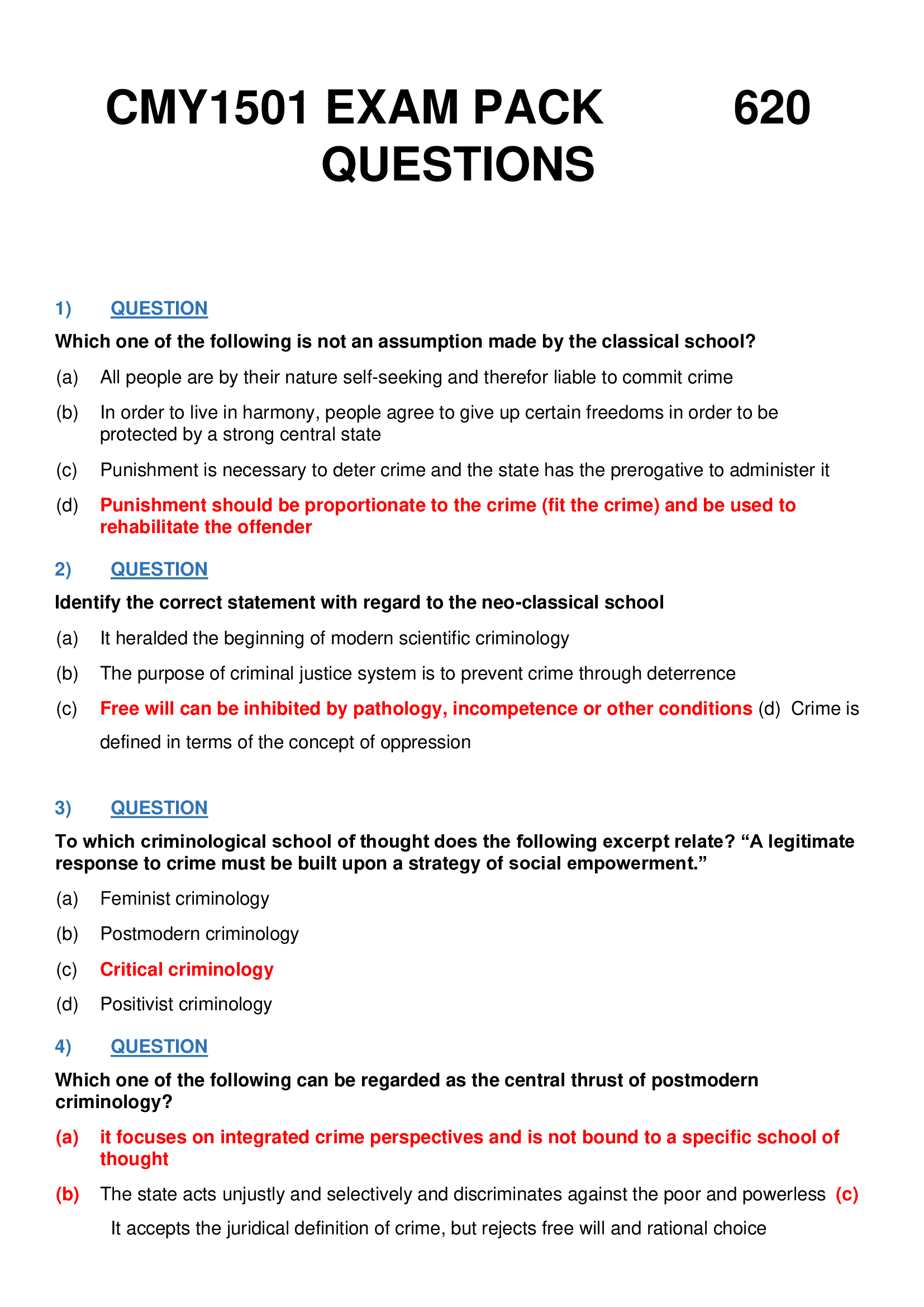
1 QUESTION

Which one of the following is not an assumption made by the classical school?   

(a)       All people are by their nature self-seeking and therefor liable to commit crime   

(b)       In order to live in harmony, people agree to give up certain freedoms in order to be protected by a strong central state   

(c)       Punishment is necessary to deter crime and the state has the prerogative to administer it   

(d)       Punishment should be proportionate to the crime (fit the crime) and be used to rehabilitate the offender   

2)         QUESTION   

Identify the correct statement with regard to the neo-classical school   

(a) It heralded the beginning of modern scientific criminology   

(b)       The purpose of criminal justice system is to prevent crime through deterrence   

(c)       Free will can be inhibited by pathology, incompetence or other conditions (d)  Crime is defined in terms of the concept of oppression   

3) QUESTION   

To which criminological school of thought does the following excerpt relate? “A legitimate response to crime must be built upon a strategy of social empowerment.”   

(a)       Feminist criminology   

(b)       Postmodern criminology   

(c)       Critical criminology   

(d)       Positivist criminology   

4)  QUESTION   

Which one of the following can be regarded as the central thrust of postmodern criminology?   (a)    it focuses on integrated crime perspectives and is not bound to a specific school of thought   

(b) The state acts unjustly and selectively and discriminates against the poor and powerless  (c)

 It accepts the juridical definition of crime, but rejects free will and rational choice   

(d) It focuses on the way individuals become criminals by studying socialisation and learning processes              

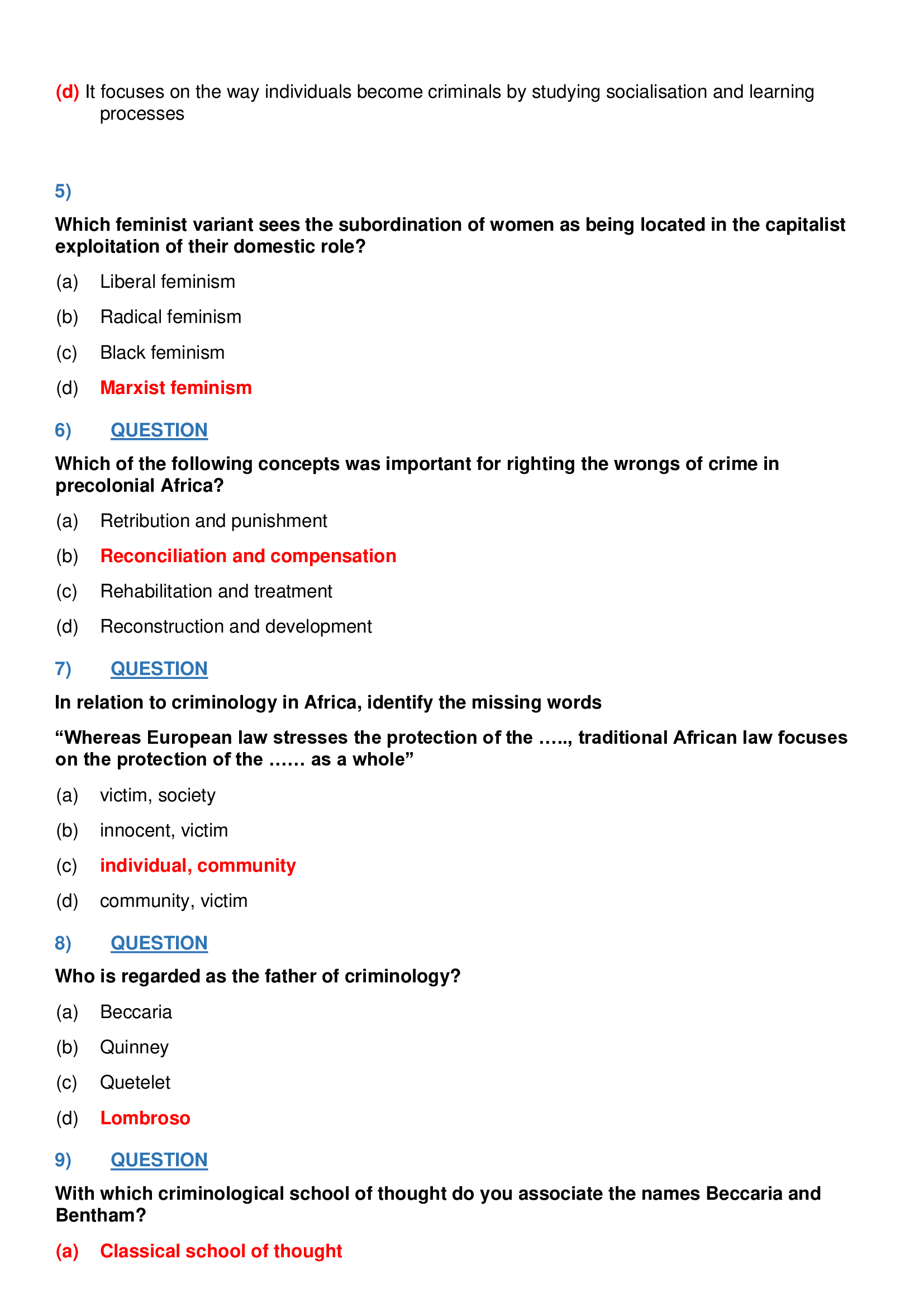
5)   Which feminist variant sees the subordination of women as being located in the capitalist exploitation of their domestic role?   

(a)       Liberal feminism   

(b)       Radical feminism   

(c)       Black feminism   

(d)       Marxist feminism   

6)         QUESTION   Which of the following concepts was important for righting the wrongs of crime in precolonial Africa?   

(a)       Retribution and punishment   

(b)       Reconciliation and compensation   

(c)       Rehabilitation and treatment   

(d)       Reconstruction and development   

7)         QUESTION   

In relation to criminology in Africa, identify the missing words   

“Whereas European law stresses the protection of the ….., traditional African law focuses on the protection of the …… as a whole”   

(a)       victim, society   

(b)       innocent, victim   

(c)      individual, community   

(d)       community, victim   

8) QUESTION   

Who is regarded as the father of criminology?   

(a)       Beccaria   

(b)       Quinney   

(c)       Quetelet   

(d)       Lombroso   


9)       QUESTION

With which criminological school of thought do you associate the names Beccaria and

Bentham?


(a)    Classical school of thought

(b)   Feminist school of thought


(c)    Critical school of thought


(d)   Postmodern school of thought


10) Who was the first person to use the term “white collar crime”?

(a)    Lombroso

(b)    Quetelet

(c)    Beccaria

(d)   Sutherland

11) QUESTION

According to liberal feminist theory, the lower crime rate for women in comparison to me

can be attributed to…..


(a)    lack of opportunity to commit crime


(b)    women’s lower economic and social position


(c)    women’s physical weakness


(d)    inborn qualities


(e)    lower level of aggression

12) QUESTION


Farrington’s Integrated Cognitive Antisocial Potential (ICAP) theory stresses…..


(a)    antisocial behaviour at all ages


(b)    neurological and temperamental difficulties


(c)    low self-control and irritability


(d)    antisocial potential and cognition


(e)    the power of informal social control


13) QUESTION


The term “motivation” refers to……


(a)    mental events such as beliefs, expectations and self-concept


(b)    subjective feelings that stem from physiological needs


(c)    the desire that a specific result will follow from a particular action


(d)     a causative factor that drives an action to bring about a definite result (e) physiological preparedness to meet situational demands

14) To understand why an offender committed a particular crime, it is essential to establish the perpetrator’s…….

(a)    intelligence

(b)    previous criminal record

(c)    personality characteristics

(d)    mental make-up

(e) motive


15) QUESTION


Which one of the following statements is incorrect?


(a)     Emotions are subjective feelings that make us feel a particular way, such as angry, joyful or sad


(b)   Emotions are short-lived subjective-physiological-functional-expressive phenomena that orchestrate how we react to events in our lives


(c)    Emotions indicate the desire that a specific result will follow from a particular action


(d)   Emotions prepare our bodies for action


(e)     Emotions have four components, namely feelings, bodily arousal, sense of purpose and social expressions


16) QUESTION


Arnold, Robertson and Cooper are of the opinion that there are three components of

motivation, namely….


(a)    Goal, effort and persistence


(b)    Direction, effort and persistence


(c)    Need, goal and action


(d)    Direction, need and effort


(e)    Goal, persistence and effort


17) QUESTION


Cognitive processes play an important role in appraising available aims when designing a particular strategy. Cognition involves…… (a)  thoughts, needs, emotions and understanding


(b)    goals, judgment, emotions and understanding


(c)    emotions, judgment, interpretation and understanding


(d)    thought, judgment, interpretation and understanding


(e)    needs, emotions, interpretation and understanding

18)


Read the following statement and identify the missing word(s):

The role that …. can play as a criminogenic risk factor is based on research which found that the criminal or antisocial behaviour of parents acts as one of the primary risk factors for criminal behaviour in children


(a)    socialisation


(b)    hereditary factors


(c)    family


(d)    predisposing factors


19) QUESTION


During his research, Sheldon (in Hunter & Dantzker 2002:50) identified three basic body types (somatotypes) namely endomorphs, mesomorphs and ectomorphs. According to Sheldon’s somatotypes delinquent boys are mainly……


(a)    endomorphs (b)    mesomorphs (c)    ectomorphs

(d)    all of the above


20) QUESTION


Personality can be defined as…..


(a)     a unique relatively stable and consistent behaviour pattern, including emotions and behaviour, that distinguishes one person from another


(b)     a unique relatively stable and consistent behaviour pattern, including behaviour and thoughts, that distinguishes one person from another


(c)     a unique relatively stable and consistent behaviour pattern, including emotions and actions, that distinguishes one person from another


(d)     a unique relatively stable and consistent behaviour pattern, including emotions and thoughts, that distinguishes one person from another


21) QUESTION

What type of impact do physiological disorders have on a person’s functioning?


(a)     biological (genetic) and psychological influences on human behaviour as well as labelling impact


(b)   social and psychological influences on human behaviour as well as labelling impact

(c)    biological and psychosocial influences on human behaviour as well as labelling impact

(d)   social and biological influences on human behaviour as well as labelling impact

22) Lyken (in Schoeman 2002:99) is of the opinion that socialisation comprises three principal components, namely:


(a)    conscientiousness, pro-sociality and acceptance of adult discipline

(b)    conscientiousness, values and acceptance of adult control

(c)    conscientiousness, pro-sociality and acceptance of adult responsibility

(d) conscientiousness, values and submission to adult control


23) QUESTION


In relation to family functioning, criminal risk factors can be associated with…..


(a)    interfamilial abuse, criminality and offending


(b)    interpersonal relationships, functioning and socialisation within the family


(c)    family structure, size and composition


(d)    family structure, functioning and relationships


24) QUESTION


Parental neglect is associated with and includes child abuse and is often associated with

the ……


(a)    deprivation of the child’s physical needs


(b)    deprivation of the child’s of the child’s social needs


(c)    deprivation of the child’s emotional needs


(d)    deprivation of the child’s psychosocial needs


25) QUESTION


Being psychologically present literally implies that a child will….


(a)    consciously, or unconsciously, evaluate behaviour against their parents’ opinion of

that particular act


(b)   consciously, or unconsciously, evaluate behaviour against their society’s opinion of that

particular act


(c)    consciously, or unconsciously, evaluate behaviour against their community’s opinion of that

particular act


(d)   consciously, or unconsciously, evaluate behaviour against their peers’ opinion of that

particular act

26) According to Bartol and Bartol (2005)…. Is one of the strongest predictors of adolescent

violence for both males and females


(a)    alcohol and drug abuse


(b)    poverty


(c)    family criminality


(d)    childhood aggression

27) QUESTION

Loeber (in Siegel & Welsh 2009:185) identified three paths of antisocial behaviour that, during the development process of a child, may lead to a delinquent career, namely:


(a)    conflict pathway, covert pathway and overt pathway


(b)   social pathway, covert pathway and overt pathway


(c)    conflict pathway, aggressive pathway and overt pathway


(d)   conflict pathway, covert pathway and hidden pathway


28) QUESTION

Epilepsy is a ….. disorder that may play a role in criminal behaviour

(a)    genetic

(b)    biochemical

(c)    congenital

(d)    social

(e) neurological


29) QUESTION

Research by Hollin and Wheeler has indicated that violent young offenders tend to display greater ….. than non-violent young offenders

(a)    internal control

(b)    cognitive ability

(c)    emotional stress

(d)    external control

(e)emotional immaturity

30) Intention consists of two elements, namely….

(a)    conative and emotional elements

(b)    conscious and intellectual elements

(c)    expressive and volitional elements (d)    affective and cognitive elements

(e)   cognitiveand volitional elements


Contact the Seller

Please Sign In to contact this seller.


  • 👎  Report Copyright Violation

Frequently Asked Questions

What Do I Get When I Buy This Study Material?

+

When you buy a study material on Passing Grades, an instant download link will be sent directly to your email, giving you access to the file anytime after payment is completed.

Is Passing Grades a Trusted Platform?

+

Yes, Passing Grades is a reputable students’ marketplace with a secure payment system and reliable customer support. You can trust us to ensure a safe and seamless transaction experience.

Will I Be Stuck with a Subscription?

+

No, all purchases on Passing Grades are one-time transactions. You only pay for the notes you choose to buy, with no subscriptions or hidden fees attached.

Who Am I Buying These Study Materials From?

+

Passing Grades is a marketplace, which means you are purchasing the document from an individual vendor, not directly from us. We facilitate the payment and delivery process between you and the vendor.

Does Passing Grades Offer Free Study Materials?

+

Yes, sellers on Passing Grades have uploaded numerous free test banks, exams, practice questions, and class notes that can be downloaded at no cost.

Pasinggrades - Quality Study Materials

USD 7

    • Quality checked by Pasing Grades
    • 100% satisfaction guarantee
    • Seller: Eddah-Nafula
Buy PDF $7

Seller Information

Eddah-Nafula

Member since June 2021

  • icon
  • icon
  • icon
View Profile
  • total sales

    0
  • Favourites

    0
  • Comments

    0
    ( 0 Ratings )

Item Information

  • Uploaded

    07 November 2021

  • Updated

    21 March 2025

  • Category

    General

  • Item Type

    questions & answers

  • Tags

    CMY1501 EXAM PACK questions and answers CMY1501 exam 2025

Related Exam Prep Guides by Eddah-Nafula

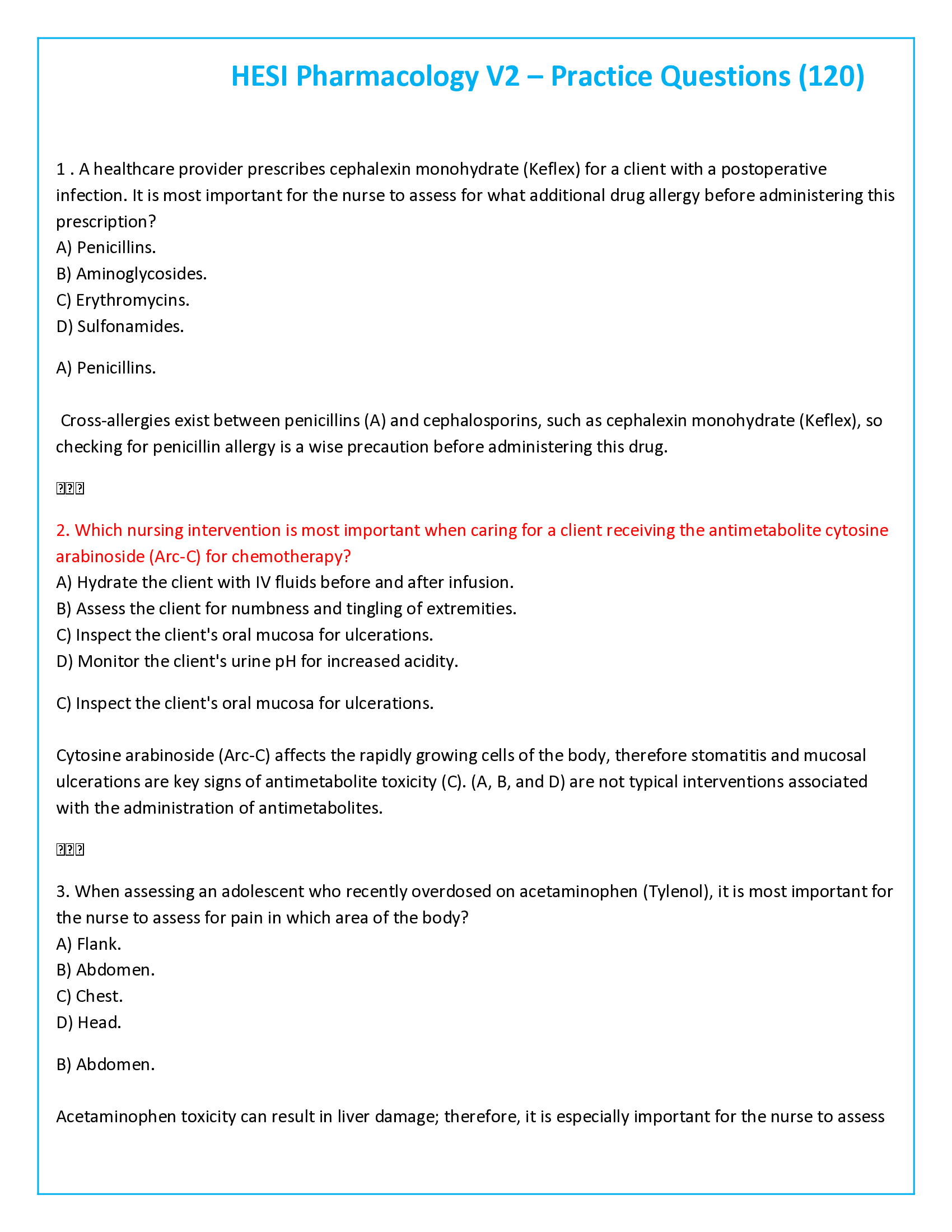
HESI Pharmacology V2 – Practice Questions (120) Latest 2026
View Document

HESI Pharmacology V2...

  • Eddah-Nafula

    Eddah-Nafula

  • questions & answers

HESI Pharmacology V2 – Practice Questions (120) Latest 2025...

7 USD

0

0

AIN2601 ASSIGNMENT 1 QUESTIONS AND ANSWERS 100 CORRECT (2021)
View Document

AIN2601 ASSIGNMENT 1...

  • Eddah-Nafula

    Eddah-Nafula

  • questions & answers

AIN2601 ASSIGNMENT 1 QUESTIONS AND ANSWERS 100 CORRECT (2021)...

7 USD

0

0

Ashley Davis patho objectives 5,6,7,20
View Document

Ashley Davis patho o...

  • Eddah-Nafula

    Eddah-Nafula

  • questions & answers

Ashley Davis patho objectives 5,6,7,20...

7 USD

0

0

Purchase

Download link will be sent to this email immediately after purchase.

IMPORTANT LINKS

  • How To Upload Class Notes
  • Selling Tips
  • Passing Grades's Study Materials
  • Scholarships for International Students 2026

POPULAR CATEGORIES

  • Law
  • Accounting
  • English
  • Psychology
  • Business
  • Nursing
  • Computer Science
  • General

View Document

  • Blog
  • Contact
  • Delivery Policy
  • Latest Scholarships Around the World
  • How to Pass Bar Exams: Passing Grades’ Strategies
  • How to Study and Pass the CPA Exam
  • All Test Banks
  • Faq
  • Copyright Claims
  • Privacy Policy
  • Terms of Use

KNOWLEDGE BASE

  • How to Write A+ Grade Good Research Paper
  • How to Manage Stress During Exam Period
  • Best Time to Study
  • How to Pass NCLEX-RN Exam
  • How To Effectively Utilize Test Banks
  • Popular Shadow Health Exam Assessments
  • Popular HESI Case Studies
  • How to Prepare for a Nursing Career
  • The Importance Of Summaries in Exam Revisvion

© 2026 Pasing Grades. All rights reserved.