Pasing Grades
  • Start Selling
  • Blog
  • Contact
  • 0

    Your cart is empty!

English

  • English
  • Spanish
  • Arabic
Create Account Sign In
  • Library
    • New Prep Guides
    • Featured Prep Guides
    • Free Exam Prep Guides
    • Best sellers
  • General
  • Nursing
    • Research Paper
    • Case Study
    • Discussion Post
    • Assignment
    • Exam
    • Practice Questions and Answers
    • Test Bank
    • solutions manual
  • Accounting
    • Case Study
    • Thesis
    • Study Guide
    • Summary
    • Research Paper
    • test bank
  • English
    • Creative Writing
    • Research Paper
    • Summary
    • Rhetorics
    • Literature
    • Journal
    • Exam
    • Grammar
    • Discussion Post
    • Essay
  • Psychology
    • Hesi
    • Presentation
    • Essay
    • Summary
    • Study Guide
    • Essay
    • Solution Manual
    • Final Exam Review
    • Class Notes
    • test bank
  • Business
    • Lecture Notes
    • Solution Manual
    • Presentation
    • Business Plan
    • Class Notes
    • Experiment
    • Summary
    • Practice Questions
    • Study Guide
    • Case Study
    • test bank
    • Exam
  • More
    • Computer Science
    • Economics
    • Statistics
    • Engineering
    • Biology
    • Religious Studies
    • Physics
    • Chemistry
    • Mathematics
    • History
    • Sociology
    • Science
    • Philosophy
    • Law
  • Pages
    • About Us
    • Selling Tips
    • Delivery Policy
    • Faq
    • Privacy Policy
  • Flash Sale
  • Home
  • Clinical Chemistry - by Bishop Exam Review Study Guide with Answers

Clinical Chemistry - by Bishop Exam Review Study Guide with Answers

Preview page 1 Preview page 2 Preview page 3
Add To Favorites

Share this item Share this item

  • Item Details
  • Comments (0)
  • Reviews (0)
  • Contact Seller
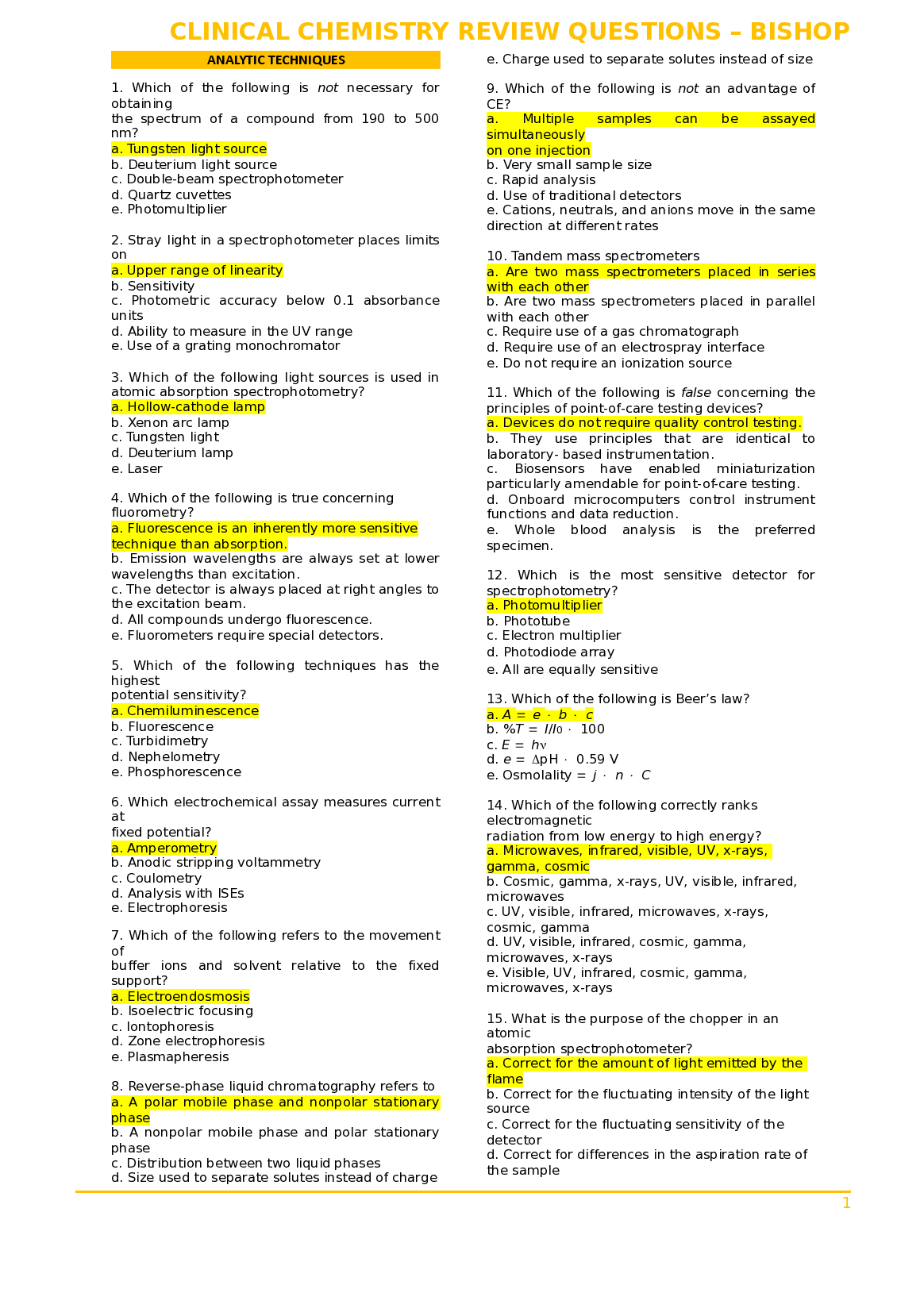
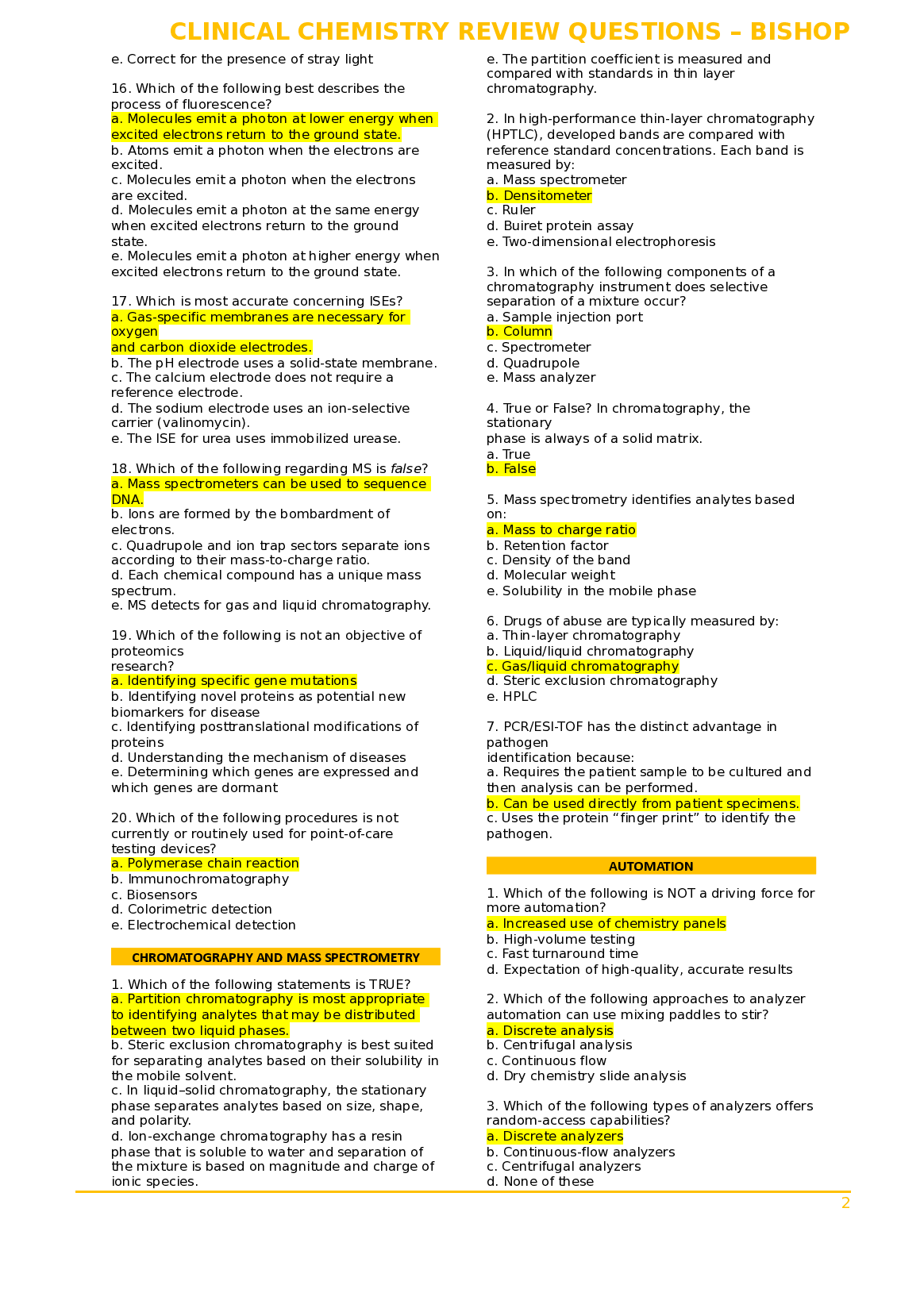
CLINICAL CHEMISTRY REVIEW QUESTIONS – BISHOP ANALYTIC TECHNIQUES 1. Which of the following is necessary fornot obtaining the spectrum of a compound from 190 to 500 nm? a. Tungsten light source b. Deuterium light source c. Double-beam spectrophotometer d. Quartz cuvettes e. Photomultiplier 2. Stray light in a spectrophotometer places limits on a. Upper range of linearity b. Sensitivity c. Photometric accuracy below 0.1 absorbance units d. Ability to measure in the UV range e. Use of a grating monochromator 3. Which of the following light sources is used in atomic absorption spectrophotometry? a. Hollow-cathode lamp b. Xenon arc lamp c. Tungsten light d. Deuterium lamp e. Laser 4. Which of the following is true concerning fluorometry? a. Fluorescence is an inherently more sensitive technique than absorption. b. Emission wavelengths are always set at lower wavelengths than excitation. c. The detector is always placed at right angles to the excitation beam. d. All compounds undergo fluorescence. e. Fluorometers require special detectors. 5. Which of the following techniques has the highest potential sensitivity? a. Chemiluminescence b. Fluorescence c. Turbidimetry d. Nephelometry e. Phosphorescence 6. Which electrochemical assay measures current at fixed potential? a. Amperometry b. Anodic stripping voltammetry c. Coulometry d. Analysis with ISEs e. Electrophoresis 7. Which of the following refers to the movement of buffer ions and solvent relative to the fixed support? a. Electroendosmosis b. Isoelectric focusing c. Iontophoresis d. Zone electrophoresis e. Plasmapheresis 8. Reverse-phase liquid chromatography refers to a. A polar mobile phase and nonpolar stationary phase b. A nonpolar mobile phase and polar stationary phase c. Distribution between two liquid phases d. Size used to separate solutes instead of charge e. Charge used to separate solutes instead of size 9. Which of the following is an advantage ofnot CE? a. Multiple samples can be assayed simultaneously on one injection b. Very small sample size c. Rapid analysis d. Use of traditional detectors e. Cations, neutrals, and anions move in the same direction at different rates 10. Tandem mass spectrometers a. Are two mass spectrometers placed in series with each other b. Are two mass spectrometers placed in parallel with each other c. Require use of a gas chromatograph d. Require use of an electrospray interface e. Do not require an ionization source 11. Which of the following is concerning thefalse principles of point-of-care testing devices? a. Devices do not require quality control testing. b. They use principles that are identical to laboratory- based instrumentation. c. Biosensors have enabled miniaturization particularly amendable for point-of-care testing. d. Onboard microcomputers control instrument functions and data reduction. e. Whole blood analysis is the preferred specimen. 12. Which is the most sensitive detector for spectrophotometry? a. Photomultiplier b. Phototube c. Electron multiplier d. Photodiode array e. All are equally sensitive 13. Which of the following is Beer’s law? a. A e b c= × × b. %T = I/I0 × 100 c. E = hν d. pH 0.59 Ve = Δ × e. Osmolality = × × j n C 14. Which of the following correctly ranks electromagnetic radiation from low energy to high energy? a. Microwaves, infrared, visible, UV, x-rays, gamma, cosmic b. Cosmic, gamma, x-rays, UV, visible, infrared, microwaves c. UV, visible, infrared, microwaves, x-rays, cosmic, gamma d. UV, visible, infrared, cosmic, gamma, microwaves, x-rays e. Visible, UV, infrared, cosmic, gamma, microwaves, x-rays 15. What is the purpose of the chopper in an atomic absorption spectrophotometer? a. Correct for the amount of light emitted by the flame b. Correct for the fluctuating intensity of the light source c. Correct for the fluctuating sensitivity of the detector d. Correct for differences in the aspiration rate of the sample 1 CLINICAL CHEMISTRY REVIEW QUESTIONS – BISHOP e. Correct for the presence of stray light 16. Which of the following best describes the process of fluorescence? a. Molecules emit a photon at lower energy when excited electrons return to the ground state. b. Atoms emit a photon when the electrons are excited. c. Molecules emit a photon when the electrons are excited. d. Molecules emit a photon at the same energy when excited electrons return to the ground state. e. Molecules emit a photon at higher energy when excited electrons return to the ground state. 17. Which is most accurate concerning ISEs? a. Gas-specific membranes are necessary for oxygen and carbon dioxide electrodes. b. The pH electrode uses a solid-state membrane. c. The calcium electrode does not require a reference electrode. d. The sodium electrode uses an ion-selective carrier (valinomycin). e. The ISE for urea uses immobilized urease. 18. Which of the following regarding MS is ?false a. Mass spectrometers can be used to sequence DNA. b. Ions are formed by the bombardment of electrons. c. Quadrupole and ion trap sectors separate ions according to their mass-to-charge ratio. d. Each chemical compound has a unique mass spectrum. e. MS detects for gas and liquid chromatography. 19. Which of the following is not an objective of proteomics research? a. Identifying specific gene mutations b. Identifying novel proteins as potential new biomarkers for disease c. Identifying posttranslational modifications of proteins d. Understanding the mechanism of diseases e. Determining which genes are expressed and which genes are dormant 20. Which of the following procedures is not currently or routinely used for point-of-care testing devices? a. Polymerase chain reaction b. Immunochromatography c. Biosensors d. Colorimetric detection e. Electrochemical detection CHROMATOGRAPHY AND MASS SPECTROMETRY 1. Which of the following statements is TRUE? a. Partition chromatography is most appropriate to identifying analytes that may be distributed between two liquid phases. b. Steric exclusion chromatography is best suited for separating analytes based on their solubility in the mobile solvent. c. In liquid–solid chromatography, the stationary phase separates analytes based on size, shape, and polarity. d. Ion-exchange chromatography has a resin phase that is soluble to water and separation of the mixture is based on magnitude and charge of ionic species. e. The partition coefficient is measured and compared with standards in thin layer chromatography. 2. In high-performance thin-layer chromatography (HPTLC), developed bands are compared with reference standard concentrations. Each band is measured by: a. Mass spectrometer b. Densitometer c. Ruler d. Buiret protein assay e. Two-dimensional electrophoresis 3. In which of the following components of a chromatography instrument does selective separation of a mixture occur? a. Sample injection port b. Column c. Spectrometer d. Quadrupole e. Mass analyzer 4. True or False? In chromatography, the stationary phase is always of a solid matrix. a. True b. False 5. Mass spectrometry identifies analytes based on: a. Mass to charge ratio b. Retention factor c. Density of the band d. Molecular weight e. Solubility in the mobile phase 6. Drugs of abuse are typically measured by: a. Thin-layer chromatography b. Liquid/liquid chromatography c. Gas/liquid chromatography d. Steric exclusion chromatography e. HPLC 7. PCR/ESI-TOF has the distinct advantage in pathogen identification because: a. Requires the patient sample to be cultured and then analysis can be performed. b. Can be used directly from patient specimens. c. Uses the protein “finger print” to identify the pathogen. AUTOMATION 1. Which of the following is NOT a driving force for more automation? a. Increased use of chemistry panels b. High-volume testing c. Fast turnaround time d. Expectation of high-quality, accurate results 2. Which of the following approaches to analyzer automation can use mixing paddles to stir? a. Discrete analysis b. Centrifugal analysis c. Continuous flow d. Dry chemistry slide analysis 3. Which of the following types of analyzers offers random-access capabilities? a. Discrete analyzers b. Continuous-flow analyzers c. Centrifugal analyzers d. None of these 2 CLINICAL CHEMISTRY REVIEW QUESTIONS – BISHOP 4. All of the following are primary considerations in the selection of an automated chemistry analyzer EXCEPT a. How reagents are added or mixed b. The cost of consumables c. Total instrument cost d. The labor component 5. An example of a modular integrated chemistry/ immunoassay analyzer would be the a. Aeroset b. Dimension Vista 3000T c. Paramax d. Vitros 6. refers to theDwell time a. Time between initiation of a test and the completion of the analysis b. Number of tests an instrument can handle in a specified time c. Ability of an instrument to perform a defined workload in a specified time d. None of these 7. The first commercial centrifugal analyzer was introduced in what year? a. 1970 b. 1957 c. 1967 d. 1976 8. All of the following are advantages to automation EXCEPT a. Correction for deficiencies inherent in methodologies b. Increased number of tests performed c. Minimized labor component d. Use of small amounts of samples and reagents in comparison to manual procedures 9. Which of the following steps in automation generally remains a manual process in most laboratories? a. Preparation of the sample b. Specimen measurement and delivery c. Reagent delivery d. Chemical reaction phase 10. Which of the following chemistry analyzers uses slides to contain the entire reagent system? a. Vitros analyzers b. ACA analyzers c. Synchron analyzers d. None of these 11. Reflectance spectrometry uses which of the following? a. Luminometer b. Tungsten–halogen lamp c. Photomultiplier tube d. UV lamp e. Thermometer to monitor temperature in reaction vessel 12. Modifications in microsampling and reagent dispensing improve which of the following phases in clinical testing? a. Physician ordering phase b. Preanalytical phase c. Analytical phase d. Postanalytical phase e. All of the above phases 13. Bidirectional communication between the chemistry analyzer and the laboratory information system has had the greatest impact on which of the following phases of clinical testing? a. Preanalytical b. Analytical c. Postanalytical d. All of the above e. None of the above IMMUNOCHEMICAL TECHNIQUES 1. The strength of binding between an antigen and antibody is related to the: a. Goodness of fit between the epitope and the F(ab) b. Concentration of antigen and antibody c. Source of antibody production, because monoclonal antibodies bind better d. Specificity of the antibody 2. In monoclonal antibody production, the specificity of the antibody is determined by the: a. Sensitized B lymphocytes b. Myeloma cell line c. Sensitized T lymphocytes d. Selective growth medium 3. Which unlabeled immune precipitation method in gel is used to quantitate a serum protein? a. Radial immunodiffusion b. Double diffusion c. Counterimmunoelectrophoresis d. Immunofixation electrophoresis 4. In immunofixation electrophoresis, discrete bands appear at the same electrophoretic location, one reacted with antihuman IgA (α chain specific) reagent and the other reacted with antihuman reagent. This is best described as:λ a. An IgA monoclonal proteinλ b. An IgA polyclonal proteinλ c. IgA biclonal proteins d. Cross-reactivity 5. In nephelometry, the antigen–antibody complex formation is enhanced in the presence of: a. Polyethylene glycol b. High-ionic-strength saline solution c. Normal saline d. Complement 6. Which homogeneous immunoassay relies on inhibiting the activity of the enzyme label when bound to antibody reagent to eliminate separating freelabeled from bound-labeled reagent? a. EMIT b. CEDIA c. MEIA d. ELISA 7. In flow cytometry, the side scatter is related to the: a. Granularity of the cell b. DNA content of the cell c. Size of the cell d. Number of cells in G and G0 1 3

Contact the Seller

Please Sign In to contact this seller.


  • 👎  Report Copyright Violation

Frequently Asked Questions

What Do I Get When I Buy This Study Material?

+

When you buy a study material on Passing Grades, an instant download link will be sent directly to your email, giving you access to the file anytime after payment is completed.

Is Passing Grades a Trusted Platform?

+

Yes, Passing Grades is a reputable students’ marketplace with a secure payment system and reliable customer support. You can trust us to ensure a safe and seamless transaction experience.

Will I Be Stuck with a Subscription?

+

No, all purchases on Passing Grades are one-time transactions. You only pay for the notes you choose to buy, with no subscriptions or hidden fees attached.

Who Am I Buying These Study Materials From?

+

Passing Grades is a marketplace, which means you are purchasing the document from an individual vendor, not directly from us. We facilitate the payment and delivery process between you and the vendor.

Does Passing Grades Offer Free Study Materials?

+

Yes, sellers on Passing Grades have uploaded numerous free test banks, exams, practice questions, and class notes that can be downloaded at no cost.

Pasinggrades - Quality Study Materials

USD 15

    • Quality checked by Pasing Grades
    • 100% satisfaction guarantee
    • Seller: K
Buy PDF $15

Seller Information

K

Member since December 2023

  • icon
View Profile
  • total sales

    0
  • Favourites

    0
  • Comments

    0
    ( 0 Ratings )

Item Information

  • Uploaded

    29 December 2023

  • Updated

    21 April 2025

  • Category

    General

  • Item Type

    test bank

  • Tags

    Clinical Chemistry

Related Exam Prep Guides by K

NR 509 Week 1-8 Quizzes 2026 Real Test
View Document

NR 509 Week 1-8 Quiz...

  • K

    K

  • test bank

NR 509 Week 1-8 Quizzes 2026: Access real test questions and answers on holistic health, assessment ...

15 USD

0

0

HESI RN Exit Exam 2024 All Versions with Complete Solutions
View Document

HESI RN Exit Exam 20...

  • K

    K

  • test bank

HESI RN Exit Exam 2024 All Versions with Complete Solutions...

15 USD

0

0

Test Bank for Clinical Chemistry Principles, Techniques, and Correlations 9th Edition by Bishop Fody
View Document

Test Bank for Clinic...

  • K

    K

  • test bank

Test Bank for Clinical Chemistry Principles, Techniques, and Correlations 9th Edition by Bishop Fody...

15 USD

0

0

Purchase

Download link will be sent to this email immediately after purchase.

IMPORTANT LINKS

  • How To Upload Class Notes
  • Selling Tips
  • Passing Grades's Study Materials
  • Scholarships for International Students 2025

POPULAR CATEGORIES

  • Law
  • Accounting
  • English
  • Psychology
  • Business
  • Nursing
  • Computer Science
  • General

View Document

  • Blog
  • Contact
  • Delivery Policy
  • Latest Scholarships Around the World
  • How to Pass Bar Exams: Passing Grades’ Strategies
  • How to Study and Pass the CPA Exam
  • All Test Banks
  • Faq
  • Copyright Claims
  • Privacy Policy
  • Terms of Use

KNOWLEDGE BASE

  • How to Write A+ Grade Good Research Paper
  • How to Manage Stress During Exam Period
  • Best Time to Study
  • How to Pass NCLEX-RN Exam
  • How To Effectively Utilize Test Banks
  • Popular Shadow Health Exam Assessments
  • Popular HESI Case Studies
  • How to Prepare for a Nursing Career
  • The Importance Of Summaries in Exam Revisvion

© 2026 Pasing Grades. All rights reserved.