Pasing Grades
  • Start Selling
  • Blog
  • Contact
  • 0

    Your cart is empty!

English

  • English
  • Spanish
  • Arabic
Create Account Sign In
  • Library
    • New Prep Guides
    • Featured Prep Guides
    • Free Exam Prep Guides
    • Best sellers
  • General
  • Nursing
    • Research Paper
    • Case Study
    • Discussion Post
    • Assignment
    • Exam
    • Practice Questions and Answers
    • Test Bank
    • solutions manual
  • Accounting
    • Case Study
    • Thesis
    • Study Guide
    • Summary
    • Research Paper
    • test bank
  • English
    • Creative Writing
    • Research Paper
    • Summary
    • Rhetorics
    • Literature
    • Journal
    • Exam
    • Grammar
    • Discussion Post
    • Essay
  • Psychology
    • Hesi
    • Presentation
    • Essay
    • Summary
    • Study Guide
    • Essay
    • Solution Manual
    • Final Exam Review
    • Class Notes
    • test bank
  • Business
    • Lecture Notes
    • Solution Manual
    • Presentation
    • Business Plan
    • Class Notes
    • Experiment
    • Summary
    • Practice Questions
    • Study Guide
    • Case Study
    • test bank
    • Exam
  • More
    • Computer Science
    • Economics
    • Statistics
    • Engineering
    • Biology
    • Religious Studies
    • Physics
    • Chemistry
    • Mathematics
    • History
    • Sociology
    • Science
    • Philosophy
    • Law
  • Pages
    • About Us
    • Selling Tips
    • Delivery Policy
    • Faq
    • Privacy Policy
  • Flash Sale
  • Home
  • BIOS 242 Week 8 Final Exam Study Guide

BIOS 242 Week 8 Final Exam Study Guide

Preview page 1 Preview page 2 Preview page 3
Add To Favorites

Share this item Share this item

  • Item Details
  • Comments (0)
  • Reviews (0)
  • Contact Seller

BIOS 242 Week 8 Final Exam Study Guide

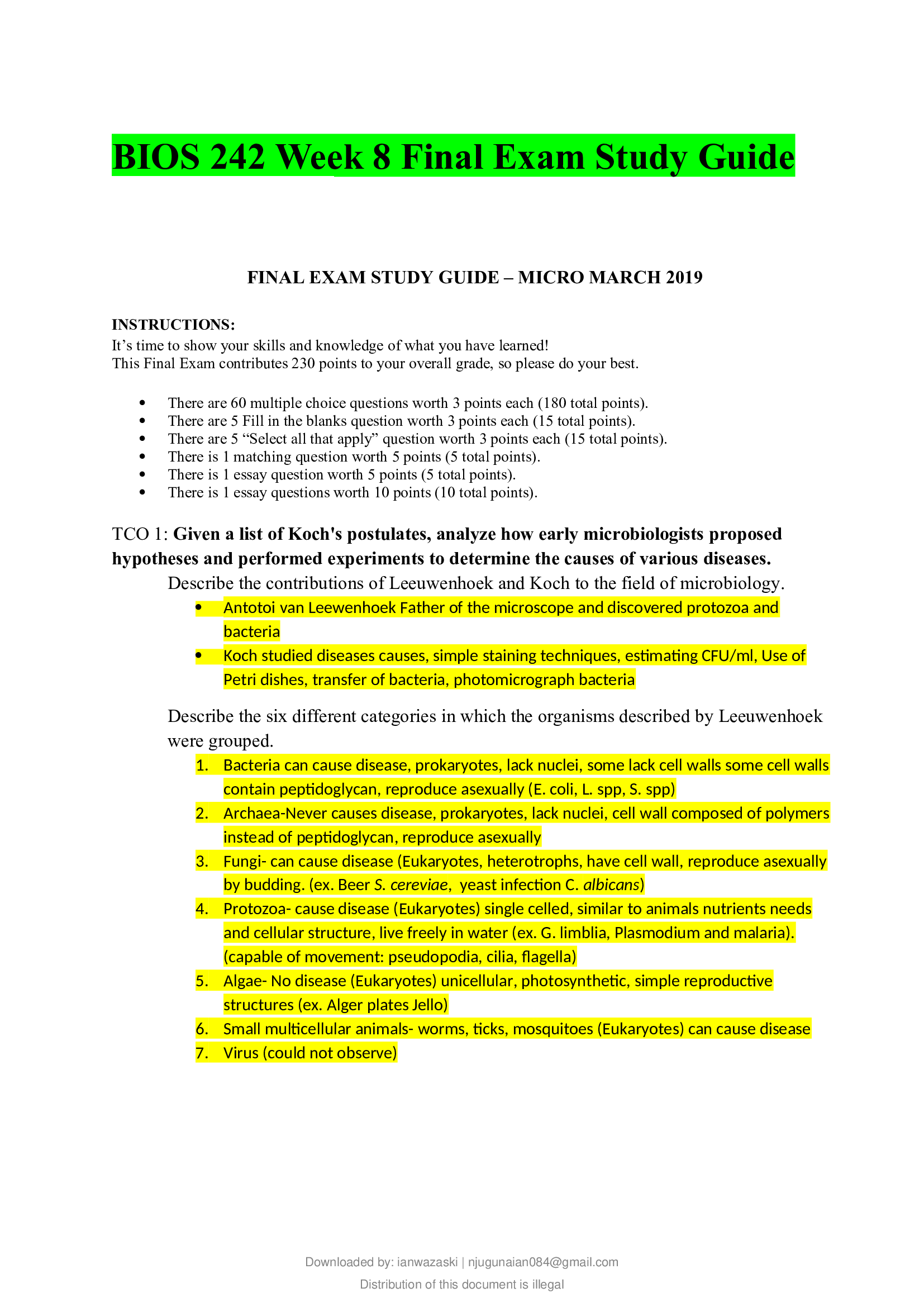
FINAL EXAM STUDY GUIDE

INSTRUCTIONS:

It’s time to show your skills and knowledge of what you have learned!

This Final Exam contributes 230 points to your overall grade, so please do your best.

•       There are 60 multiple choice questions worth 3 points each (180 total points).

•       There are 5 Fill in the blanks question worth 3 points each (15 total points).

•       There are 5 “Select all that apply” question worth 3 points each (15 total points).

•       There is 1 matching question worth 5 points (5 total points).

•       There is 1 essay question worth 5 points (5 total points).

•       There is 1 essay questions worth 10 points (10 total points).

TCO 1: Given a list of Koch's postulates, analyze how early microbiologists proposed hypotheses and performed experiments to determine the causes of various diseases. Describe the contributions of Leeuwenhoek and Koch to the field of microbiology.



Antotoi van Leewenhoek Father of the microscope and discovered protozoa and

bacteria



Koch studied diseases causes, simple staining techniques, estimating CFU/ml, Use of

Petri dishes, transfer of bacteria, photomicrograph bacteria

Describe the six different categories in which the organisms described by Leeuwenhoek were grouped.

1.

Bacteria can cause disease, prokaryotes, lack nuclei, some lack cell walls some cell walls

contain peptidoglycan, reproduce asexually (E. coli, L. spp, S. spp)

2.

Archaea-Never causes disease, prokaryotes, lack nuclei, cell wall composed of polymers

instead of peptidoglycan, reproduce asexually

3.

Fungi- can cause disease (Eukaryotes, heterotrophs, have cell wall, reproduce asexually

by budding. (ex. Beer S. cereviae,  yeast infection C. albicans)

4.

Protozoa- cause disease (Eukaryotes) single celled, similar to animals nutrients needs

and cellular structure, live freely in water (ex. G. limblia, Plasmodium and malaria).

(capable of movement: pseudopodia, cilia, flagella)

5.

Algae- No disease (Eukaryotes) unicellular, photosynthetic, simple reproductive

structures (ex. Alger plates Jello)

6.

Small multicellular animals- worms, ticks, mosquitoes (Eukaryotes) can cause disease

7.

Virus (could not observe)


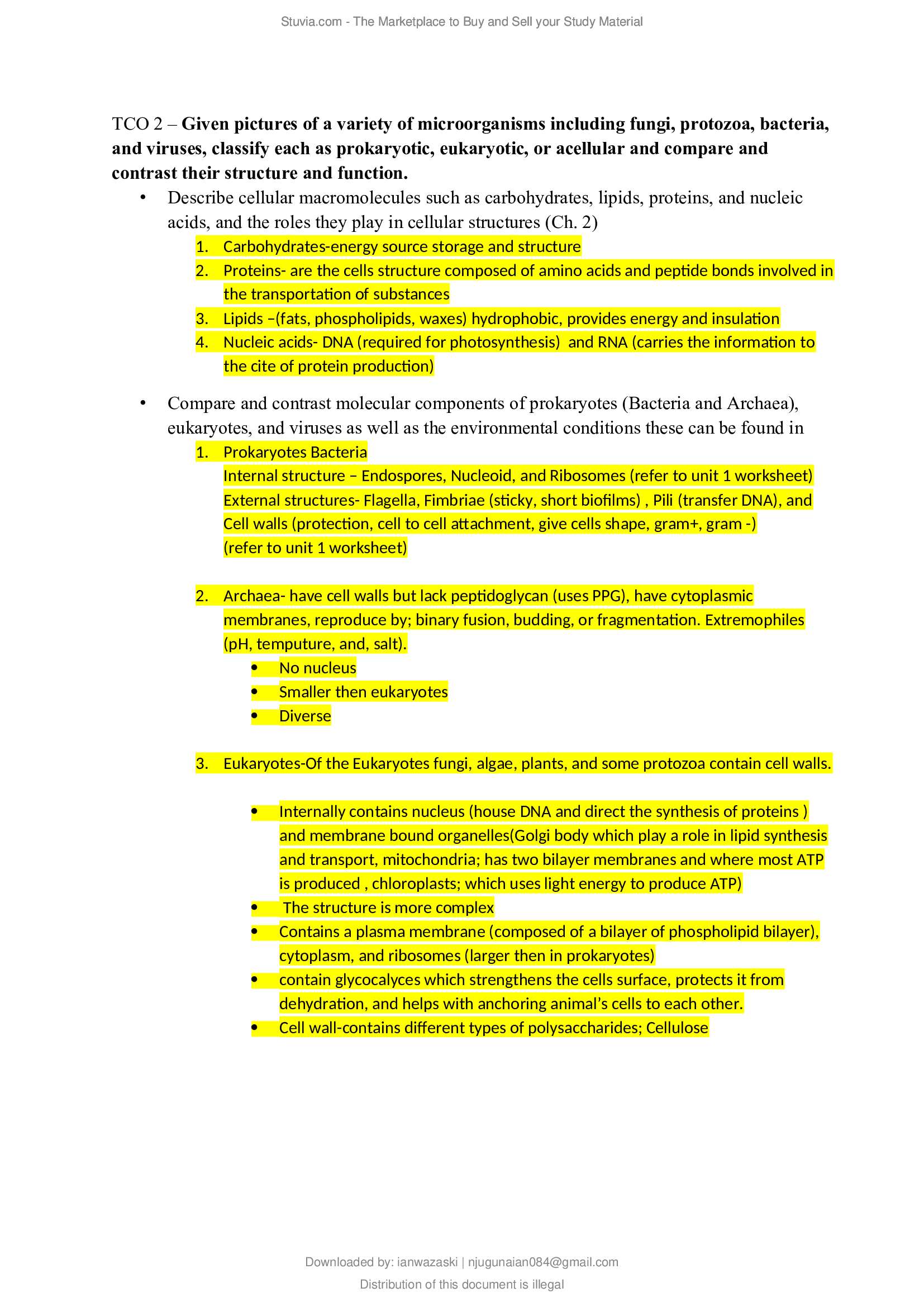
TCO 2 – Given pictures of a variety of microorganisms including fungi, protozoa, bacteria, and viruses, classify each as prokaryotic, eukaryotic, or acellular and compare and contrast their structure and function.

•      Describe cellular macromolecules such as carbohydrates, lipids, proteins, and nucleic acids, and the roles they play in cellular structures (Ch. 2)

1.

Carbohydrates-energy source storage and structure


2.

Proteins- are the cells structure composed of amino acids and peptide bonds involved in

the transportation of substances

3.

Lipids –(fats, phospholipids, waxes) hydrophobic, provides energy and insulation


4.

Nucleic acids- DNA (required for photosynthesis)  and RNA (carries the information to

the cite of protein production)

•      Compare and contrast molecular components of prokaryotes (Bacteria and Archaea), eukaryotes, and viruses as well as the environmental conditions these can be found in

1.

Prokaryotes Bacteria

Internal structure – Endospores, Nucleoid, and Ribosomes (refer to unit 1 worksheet)

External structures- Flagella, Fimbriae (sticky, short biofilms) , Pili (transfer DNA), and

Cell walls (protection, cell to cell attachment, give cells shape, gram+, gram -)

(refer to unit 1 worksheet)

2.

Archaea- have cell walls but lack peptidoglycan (uses PPG), have cytoplasmic

membranes, reproduce by; binary fusion, budding, or fragmentation. Extremophiles (pH, temputure, and, salt).


No nucleus







Smaller then eukaryotes


Diverse





3.

Eukaryotes-Of the Eukaryotes fungi, algae, plants, and some protozoa contain cell walls.


Internally contains nucleus (house DNA and direct the synthesis of proteins )





and membrane bound organelles(Golgi body which play a role in lipid synthesis and transport, mitochondria; has two bilayer membranes and where most ATP is produced , chloroplasts; which uses light energy to produce ATP)


 The structure is more complex







Contains a plasma membrane (composed of a bilayer of phospholipid bilayer),

cytoplasm, and ribosomes (larger then in prokaryotes)



contain glycocalyces which strengthens the cells surface, protects it from

dehydration, and helps with anchoring animal’s cells to each other.



Cell wall-contains different types of polysaccharides; Cellulose

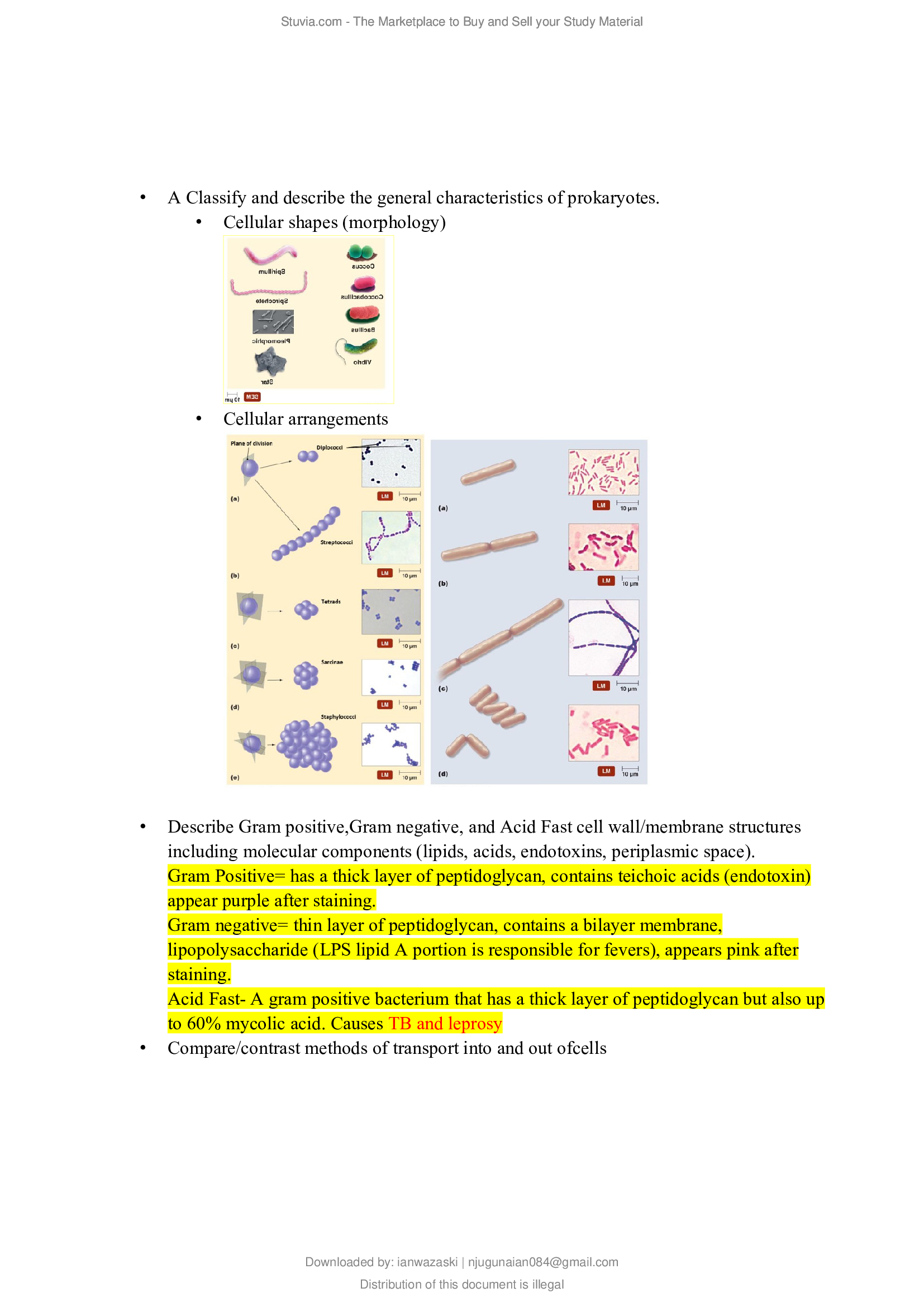
•      A Classify and describe the general characteristics of prokaryotes.

•      Cellular shapes (morphology)

Contact the Seller

Please Sign In to contact this seller.


  • 👎  Report Copyright Violation

Frequently Asked Questions

What Do I Get When I Buy This Study Material?

+

When you buy a study material on Passing Grades, an instant download link will be sent directly to your email, giving you access to the file anytime after payment is completed.

Is Passing Grades a Trusted Platform?

+

Yes, Passing Grades is a reputable students’ marketplace with a secure payment system and reliable customer support. You can trust us to ensure a safe and seamless transaction experience.

Will I Be Stuck with a Subscription?

+

No, all purchases on Passing Grades are one-time transactions. You only pay for the notes you choose to buy, with no subscriptions or hidden fees attached.

Who Am I Buying These Study Materials From?

+

Passing Grades is a marketplace, which means you are purchasing the document from an individual vendor, not directly from us. We facilitate the payment and delivery process between you and the vendor.

Does Passing Grades Offer Free Study Materials?

+

Yes, sellers on Passing Grades have uploaded numerous free test banks, exams, practice questions, and class notes that can be downloaded at no cost.

Pasinggrades - Quality Study Materials

USD 6

    • Quality checked by Pasing Grades
    • 100% satisfaction guarantee
    • Seller: GradeA
Buy PDF $6

Seller Information

GradeA

Member since April 2021

  • icon
  • icon
  • icon
View Profile
  • total sales

    0
  • Favourites

    0
  • Comments

    0
    ( 0 Ratings )

Item Information

  • Uploaded

    24 October 2021

  • Updated

    24 October 2025

  • Category

    General

  • Item Type

    exam

  • Tags

    BIOS 242 Week 8 Final Exam Study Guide

Related Exam Prep Guides by GradeA

Test Bank for Fundamentals of Corporate Finance 12th Edition By Stephen Ross and Randolph Westerfield and Bradford Jordan
View Document

Test Bank for Fundam...

  • GradeA

    GradeA

  • exam

Test Bank for Fundamentals of Corporate Finance 12th Edition By Stephen Ross and Randolph Westerfiel...

6 USD

0

0

[SOLUTION MANUAL) Fundamentals of Corporate Finance 12th Edition By Stephen Ross and Randolph Westerfield and Bradford Jordan
View Document

[SOLUTION MANUAL) Fu...

  • GradeA

    GradeA

  • exam

[SOLUTION MANUAL) Fundamentals of Corporate Finance 12th Edition By Stephen Ross and Randolph Wester...

6 USD

0

0

QMI1500 Assignment 02 2021 AS PER UPDATED TUTORIAL LETTER
View Document

QMI1500 Assignment 0...

  • GradeA

    GradeA

  • exam

QMI1500 Assignment 02 2021 AS PER UPDATED TUTORIAL LETTER...

6 USD

0

0

Purchase

Download link will be sent to this email immediately after purchase.

IMPORTANT LINKS

  • How To Upload Class Notes
  • Selling Tips
  • Passing Grades's Study Materials
  • Scholarships for International Students 2025

POPULAR CATEGORIES

  • Law
  • Accounting
  • English
  • Psychology
  • Business
  • Nursing
  • Computer Science
  • General

View Document

  • Blog
  • Contact
  • Delivery Policy
  • Latest Scholarships Around the World
  • How to Pass Bar Exams: Passing Grades’ Strategies
  • How to Study and Pass the CPA Exam
  • All Test Banks
  • Faq
  • Copyright Claims
  • Privacy Policy
  • Terms of Use

KNOWLEDGE BASE

  • How to Write A+ Grade Good Research Paper
  • How to Manage Stress During Exam Period
  • Best Time to Study
  • How to Pass NCLEX-RN Exam
  • How To Effectively Utilize Test Banks
  • Popular Shadow Health Exam Assessments
  • Popular HESI Case Studies
  • How to Prepare for a Nursing Career
  • The Importance Of Summaries in Exam Revisvion

© 2026 Pasing Grades. All rights reserved.