Pasing Grades
  • Start Selling
  • Blog
  • Contact
  • 0

    Your cart is empty!

English

  • English
  • Spanish
  • Arabic
Create Account Sign In
  • Library
    • New Prep Guides
    • Featured Prep Guides
    • Free Exam Prep Guides
    • Best sellers
  • General
  • Nursing
    • Research Paper
    • Case Study
    • Discussion Post
    • Assignment
    • Exam
    • Practice Questions and Answers
    • Test Bank
    • solutions manual
  • Accounting
    • Case Study
    • Thesis
    • Study Guide
    • Summary
    • Research Paper
    • test bank
  • English
    • Creative Writing
    • Research Paper
    • Summary
    • Rhetorics
    • Literature
    • Journal
    • Exam
    • Grammar
    • Discussion Post
    • Essay
  • Psychology
    • Hesi
    • Presentation
    • Essay
    • Summary
    • Study Guide
    • Essay
    • Solution Manual
    • Final Exam Review
    • Class Notes
    • test bank
  • Business
    • Lecture Notes
    • Solution Manual
    • Presentation
    • Business Plan
    • Class Notes
    • Experiment
    • Summary
    • Practice Questions
    • Study Guide
    • Case Study
    • test bank
    • Exam
  • More
    • Computer Science
    • Economics
    • Statistics
    • Engineering
    • Biology
    • Religious Studies
    • Physics
    • Chemistry
    • Mathematics
    • History
    • Sociology
    • Science
    • Philosophy
    • Law
  • Pages
    • About Us
    • Selling Tips
    • Delivery Policy
    • Faq
    • Privacy Policy
  • Flash Sale
  • Home
  • AP Psychology Exam Review

AP Psychology Exam Review

Preview page 1 Preview page 2 Preview page 3
Add To Favorites

Share this item Share this item

  • Item Details
  • Comments (0)
  • Reviews (0)
  • Contact Seller

AP Psychology Exam Review 2024

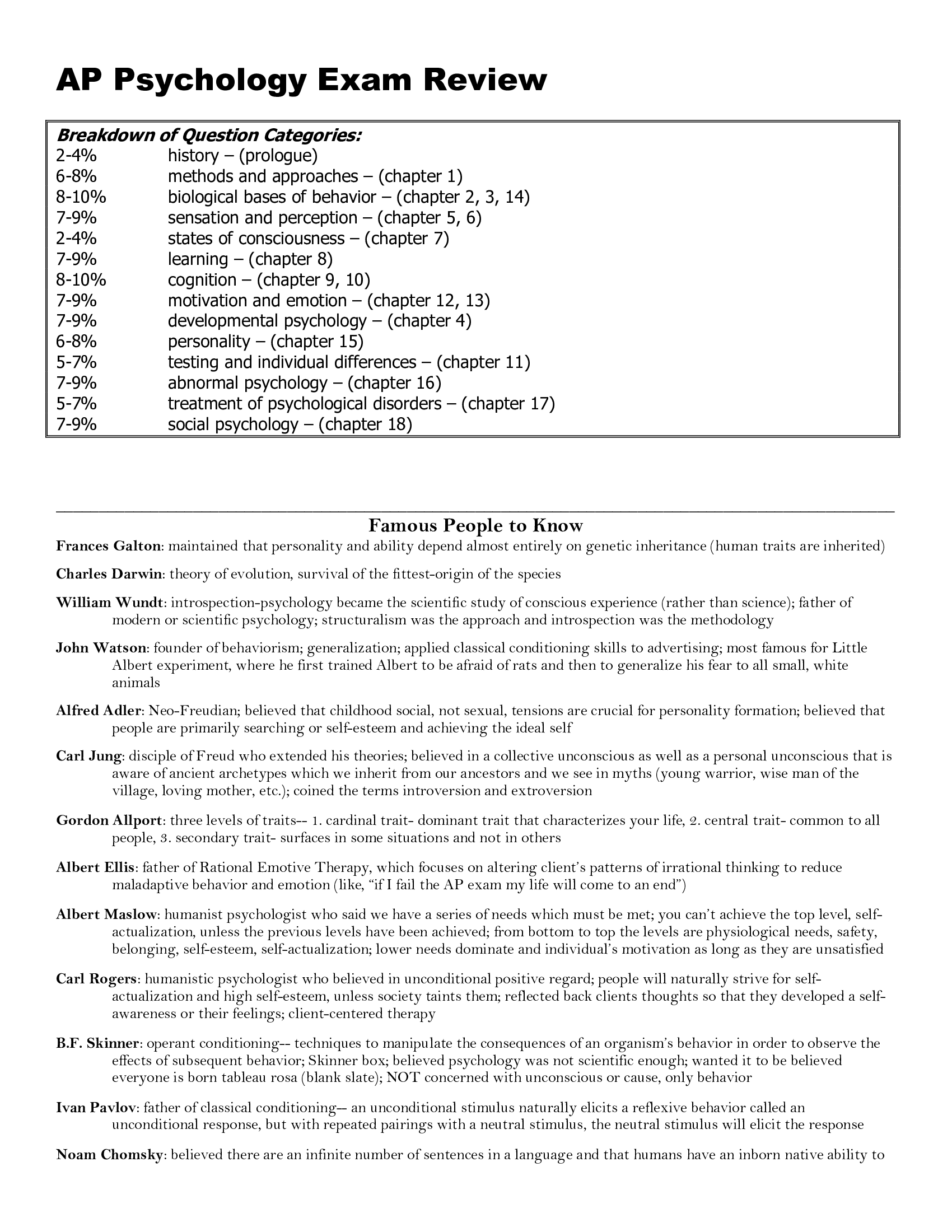
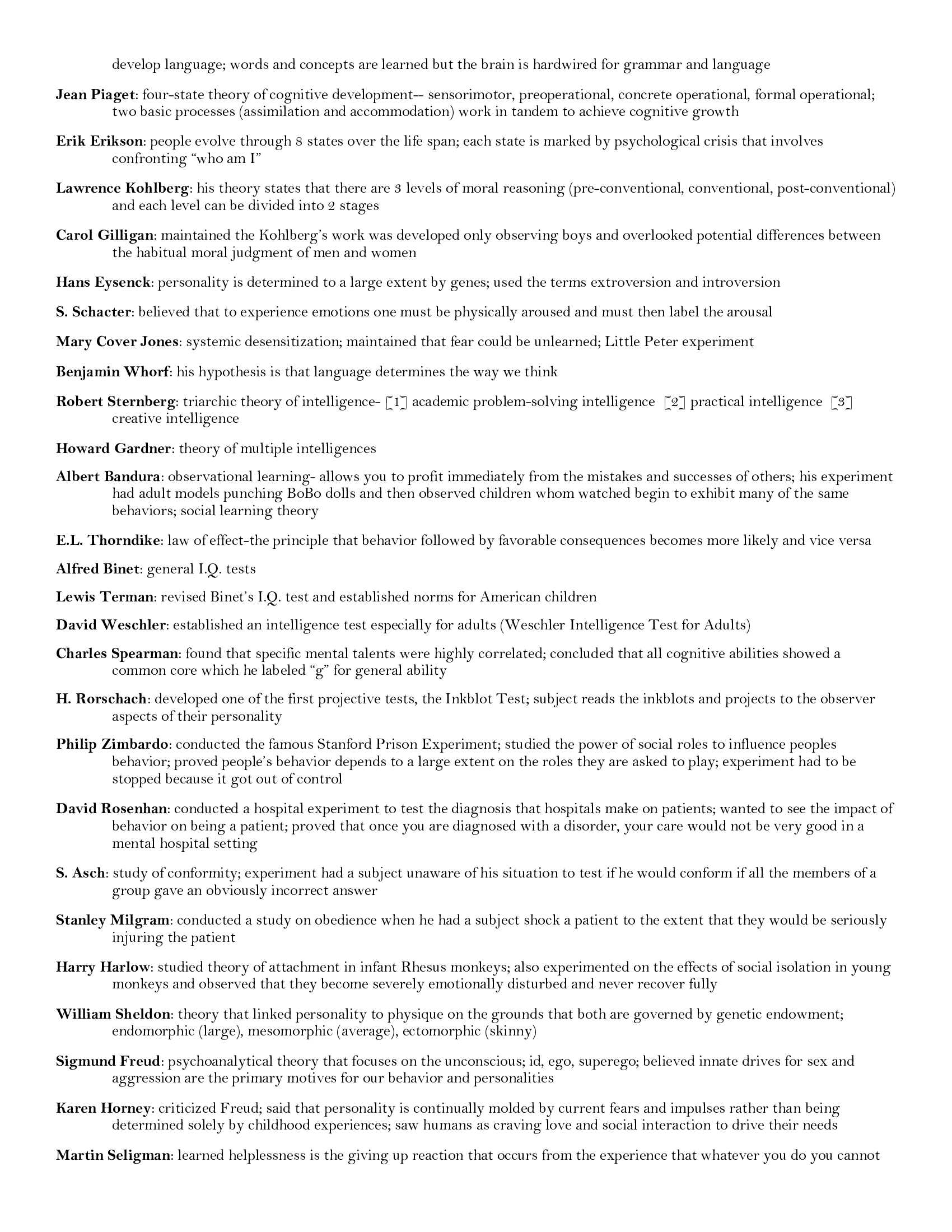
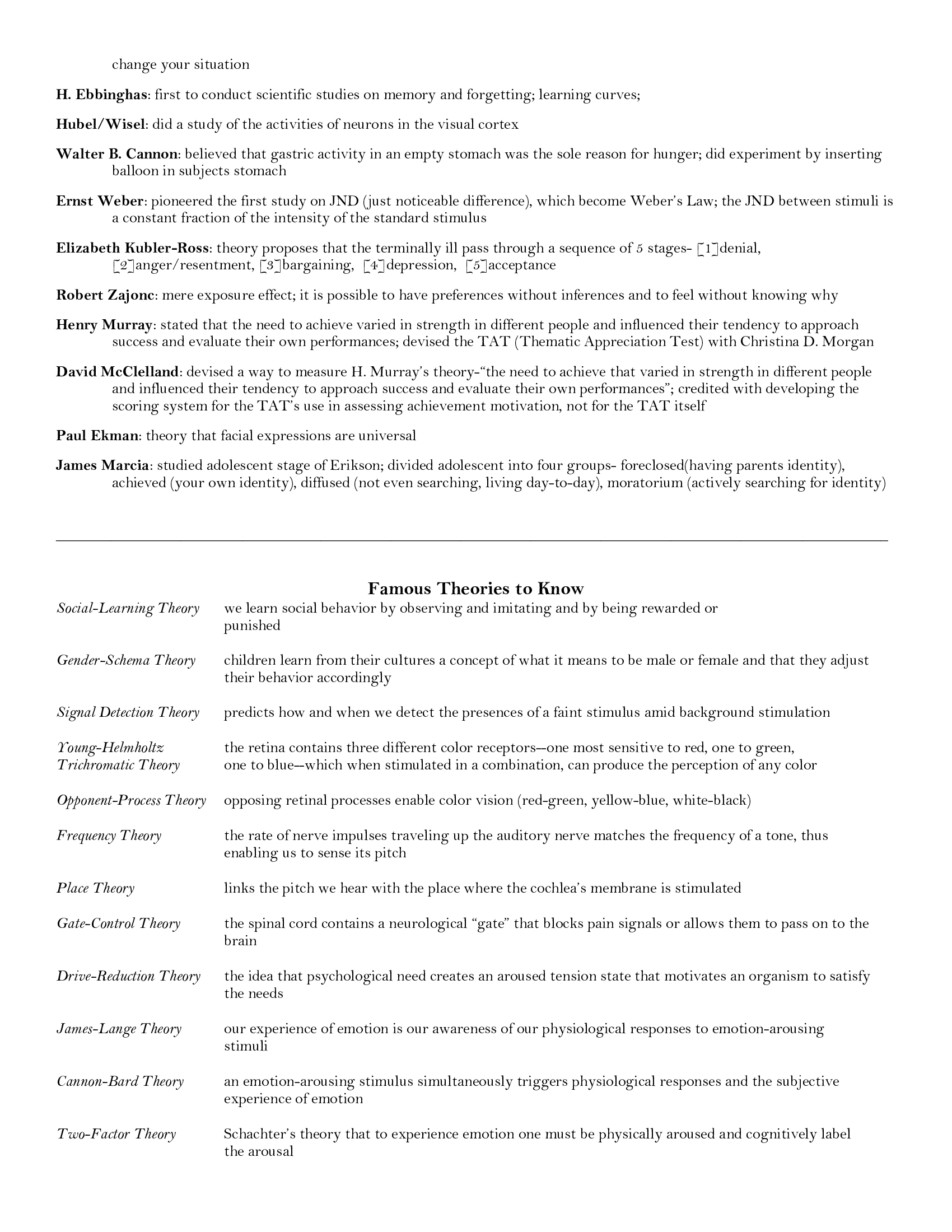
AP Psychology Exam Review Breakdown of Question Categories: 2-4% history – (prologue) 6-8% methods and approaches – (chapter 1) 8-10% biological bases of behavior – (chapter 2, 3, 14) 7-9% sensation and perception – (chapter 5, 6) 2-4% states of consciousness – (chapter 7) 7-9% learning – (chapter 8) 8-10% cognition – (chapter 9, 10) 7-9% motivation and emotion – (chapter 12, 13) 7-9% developmental psychology – (chapter 4) 6-8% personality – (chapter 15) 5-7% testing and individual differences – (chapter 11) 7-9% abnormal psychology – (chapter 16) 5-7% treatment of psychological disorders – (chapter 17) 7-9% social psychology – (chapter 18) __________________________________________________________________________________________________ Famous People to Know Frances Galton: maintained that personality and ability depend almost entirely on genetic inheritance (human traits are inherited) Charles Darwin: theory of evolution, survival of the fittest-origin of the species William Wundt: introspection-psychology became the scientific study of conscious experience (rather than science); father of modern or scientific psychology; structuralism was the approach and introspection was the methodology John Watson: founder of behaviorism; generalization; applied classical conditioning skills to advertising; most famous for Little Albert experiment, where he first trained Albert to be afraid of rats and then to generalize his fear to all small, white animals Alfred Adler: Neo-Freudian; believed that childhood social, not sexual, tensions are crucial for personality formation; believed that people are primarily searching or self-esteem and achieving the ideal self Carl Jung: disciple of Freud who extended his theories; believed in a collective unconscious as well as a personal unconscious that is aware of ancient archetypes which we inherit from our ancestors and we see in myths (young warrior, wise man of the village, loving mother, etc.); coined the terms introversion and extroversion Gordon Allport: three levels of traits-- 1. cardinal trait- dominant trait that characterizes your life, 2. central trait- common to all people, 3. secondary trait- surfaces in some situations and not in others Albert Ellis: father of Rational Emotive Therapy, which focuses on altering client’s patterns of irrational thinking to reduce maladaptive behavior and emotion (like, “if I fail the AP exam my life will come to an end”) Albert Maslow: humanist psychologist who said we have a series of needs which must be met; you can’t achieve the top level, selfactualization, unless the previous levels have been achieved; from bottom to top the levels are physiological needs, safety, belonging, self-esteem, self-actualization; lower needs dominate and individual’s motivation as long as they are unsatisfied Carl Rogers: humanistic psychologist who believed in unconditional positive regard; people will naturally strive for selfactualization and high self-esteem, unless society taints them; reflected back clients thoughts so that they developed a selfawareness or their feelings; client-centered therapy B.F. Skinner: operant conditioning-- techniques to manipulate the consequences of an organism’s behavior in order to observe the effects of subsequent behavior; Skinner box; believed psychology was not scientific enough; wanted it to be believed everyone is born tableau rosa (blank slate); NOT concerned with unconscious or cause, only behavior Ivan Pavlov: father of classical conditioning-- an unconditional stimulus naturally elicits a reflexive behavior called an unconditional response, but with repeated pairings with a neutral stimulus, the neutral stimulus will elicit the response Noam Chomsky: believed there are an infinite number of sentences in a language and that humans have an inborn native ability to develop language; words and concepts are learned but the brain is hardwired for grammar and language Jean Piaget: four-state theory of cognitive development-- sensorimotor, preoperational, concrete operational, formal operational; two basic processes (assimilation and accommodation) work in tandem to achieve cognitive growth Erik Erikson: people evolve through 8 states over the life span; each state is marked by psychological crisis that involves confronting “who am I” Lawrence Kohlberg: his theory states that there are 3 levels of moral reasoning (pre-conventional, conventional, post-conventional) and each level can be divided into 2 stages Carol Gilligan: maintained the Kohlberg’s work was developed only observing boys and overlooked potential differences between the habitual moral judgment of men and women Hans Eysenck: personality is determined to a large extent by genes; used the terms extroversion and introversion S. Schacter: believed that to experience emotions one must be physically aroused and must then label the arousal Mary Cover Jones: systemic desensitization; maintained that fear could be unlearned; Little Peter experiment Benjamin Whorf: his hypothesis is that language determines the way we think Robert Sternberg: triarchic theory of intelligence- [1] academic problem-solving intelligence [2] practical intelligence [3] creative intelligence Howard Gardner: theory of multiple intelligences Albert Bandura: observational learning- allows you to profit immediately from the mistakes and successes of others; his experiment had adult models punching BoBo dolls and then observed children whom watched begin to exhibit many of the same behaviors; social learning theory E.L. Thorndike: law of effect-the principle that behavior followed by favorable consequences becomes more likely and vice versa Alfred Binet: general I.Q. tests Lewis Terman: revised Binet’s I.Q. test and established norms for American children David Weschler: established an intelligence test especially for adults (Weschler Intelligence Test for Adults) Charles Spearman: found that specific mental talents were highly correlated; concluded that all cognitive abilities showed a common core which he labeled “g” for general ability H. Rorschach: developed one of the first projective tests, the Inkblot Test; subject reads the inkblots and projects to the observer aspects of their personality Philip Zimbardo: conducted the famous Stanford Prison Experiment; studied the power of social roles to influence peoples behavior; proved people’s behavior depends to a large extent on the roles they are asked to play; experiment had to be stopped because it got out of control David Rosenhan: conducted a hospital experiment to test the diagnosis that hospitals make on patients; wanted to see the impact of behavior on being a patient; proved that once you are diagnosed with a disorder, your care would not be very good in a mental hospital setting S. Asch: study of conformity; experiment had a subject unaware of his situation to test if he would conform if all the members of a group gave an obviously incorrect answer Stanley Milgram: conducted a study on obedience when he had a subject shock a patient to the extent that they would be seriously injuring the patient Harry Harlow: studied theory of attachment in infant Rhesus monkeys; also experimented on the effects of social isolation in young monkeys and observed that they become severely emotionally disturbed and never recover fully William Sheldon: theory that linked personality to physique on the grounds that both are governed by genetic endowment; endomorphic (large), mesomorphic (average), ectomorphic (skinny) Sigmund Freud: psychoanalytical theory that focuses on the unconscious; id, ego, superego; believed innate drives for sex and aggression are the primary motives for our behavior and personalities Karen Horney: criticized Freud; said that personality is continually molded by current fears and impulses rather than being determined solely by childhood experiences; saw humans as craving love and social interaction to drive their needs Martin Seligman: learned helplessness is the giving up reaction that occurs from the experience that whatever you do you cannot

Contact the Seller

Please Sign In to contact this seller.


  • 👎  Report Copyright Violation

Frequently Asked Questions

What Do I Get When I Buy This Study Material?

+

When you buy a study material on Passing Grades, an instant download link will be sent directly to your email, giving you access to the file anytime after payment is completed.

Is Passing Grades a Trusted Platform?

+

Yes, Passing Grades is a reputable students’ marketplace with a secure payment system and reliable customer support. You can trust us to ensure a safe and seamless transaction experience.

Will I Be Stuck with a Subscription?

+

No, all purchases on Passing Grades are one-time transactions. You only pay for the notes you choose to buy, with no subscriptions or hidden fees attached.

Who Am I Buying These Study Materials From?

+

Passing Grades is a marketplace, which means you are purchasing the document from an individual vendor, not directly from us. We facilitate the payment and delivery process between you and the vendor.

Does Passing Grades Offer Free Study Materials?

+

Yes, sellers on Passing Grades have uploaded numerous free test banks, exams, practice questions, and class notes that can be downloaded at no cost.

Pasinggrades - Quality Study Materials

USD 7

    • Quality checked by Pasing Grades
    • 100% satisfaction guarantee
    • Seller: mentor2000
Buy PDF $7

Seller Information

mentor2000

Member since April 2021

  • icon
  • icon
View Profile
  • total sales

    0
  • Favourites

    0
  • Comments

    0
    ( 0 Ratings )

Item Information

  • Uploaded

    08 May 2024

  • Updated

    29 September 2025

  • Category

    No category

  • Item Type

    exam

  • Tags

    AP Psychology Exam Review 2024

Related Exam Prep Guides by mentor2000

Test Bank for Essentials for Nursing Practice 8th Edition by Potter | All Chapters
View Document

Test Bank for Essent...

  • mentor2000

    mentor2000

  • exam

Master nursing concepts with this study material; Test Bank for Essentials for Nursing Practice, 8th...

7 USD

0

0

A &P 1 MA278 BSC2 Final Module II Questions & Answers 2026 Update
View Document

A &P 1 MA278 BSC2 Fi...

  • mentor2000

    mentor2000

  • exam

Prepare for success with A&P 1 MA278 BSC2 Final Module II 2024 Q&A. Boost your grades with this comp...

7 USD

0

0

ATI Comprehensive Predictor Exam 2026
View Document

ATI Comprehensive Pr...

  • mentor2000

    mentor2000

  • exam

Prepare for success with the ATI Comprehensive Predictor Exam 2026. Access key practice questions to...

7 USD

0

0

Purchase

Download link will be sent to this email immediately after purchase.

IMPORTANT LINKS

  • How To Upload Class Notes
  • Selling Tips
  • Passing Grades's Study Materials
  • Scholarships for International Students 2025

POPULAR CATEGORIES

  • Law
  • Accounting
  • English
  • Psychology
  • Business
  • Nursing
  • Computer Science
  • General

View Document

  • Blog
  • Contact
  • Delivery Policy
  • Latest Scholarships Around the World
  • How to Pass Bar Exams: Passing Grades’ Strategies
  • How to Study and Pass the CPA Exam
  • All Test Banks
  • Faq
  • Copyright Claims
  • Privacy Policy
  • Terms of Use

KNOWLEDGE BASE

  • How to Write A+ Grade Good Research Paper
  • How to Manage Stress During Exam Period
  • Best Time to Study
  • How to Pass NCLEX-RN Exam
  • How To Effectively Utilize Test Banks
  • Popular Shadow Health Exam Assessments
  • Popular HESI Case Studies
  • How to Prepare for a Nursing Career
  • The Importance Of Summaries in Exam Revisvion

© 2026 Pasing Grades. All rights reserved.