
Pasing Grades
  • Start Selling
  • Blog
  • Contact
  • 0

    Your cart is empty!

English

  • English
  • Spanish
  • Arabic
Create Account Sign In
  • Library
    • New Prep Guides
    • Featured Prep Guides
    • Free Exam Prep Guides
    • Best sellers
  • General
  • Nursing
    • Research Paper
    • Case Study
    • Discussion Post
    • Assignment
    • Exam
    • Practice Questions and Answers
    • Test Bank
    • solutions manual
  • Accounting
    • Case Study
    • Thesis
    • Study Guide
    • Summary
    • Research Paper
    • test bank
  • English
    • Creative Writing
    • Research Paper
    • Summary
    • Rhetorics
    • Literature
    • Journal
    • Exam
    • Grammar
    • Discussion Post
    • Essay
  • Psychology
    • Hesi
    • Presentation
    • Essay
    • Summary
    • Study Guide
    • Essay
    • Solution Manual
    • Final Exam Review
    • Class Notes
    • test bank
  • Business
    • Lecture Notes
    • Solution Manual
    • Presentation
    • Business Plan
    • Class Notes
    • Experiment
    • Summary
    • Practice Questions
    • Study Guide
    • Case Study
    • test bank
    • Exam
  • More
    • Computer Science
    • Economics
    • Statistics
    • Engineering
    • Biology
    • Religious Studies
    • Physics
    • Chemistry
    • Mathematics
    • History
    • Sociology
    • Science
    • Philosophy
    • Law
  • Pages
    • About Us
    • Selling Tips
    • Delivery Policy
    • Faq
    • Privacy Policy
  • Flash Sale
  • Home
  • AP Government and Politics Study Guide 2024

AP Government and Politics Study Guide 2024

Preview page 1 Preview page 2 Preview page 3
Add To Favorites

Share this item Share this item

  • Item Details
  • Comments (0)
  • Reviews (0)
  • Contact Seller

AP Government and Politics Study Guide 2024

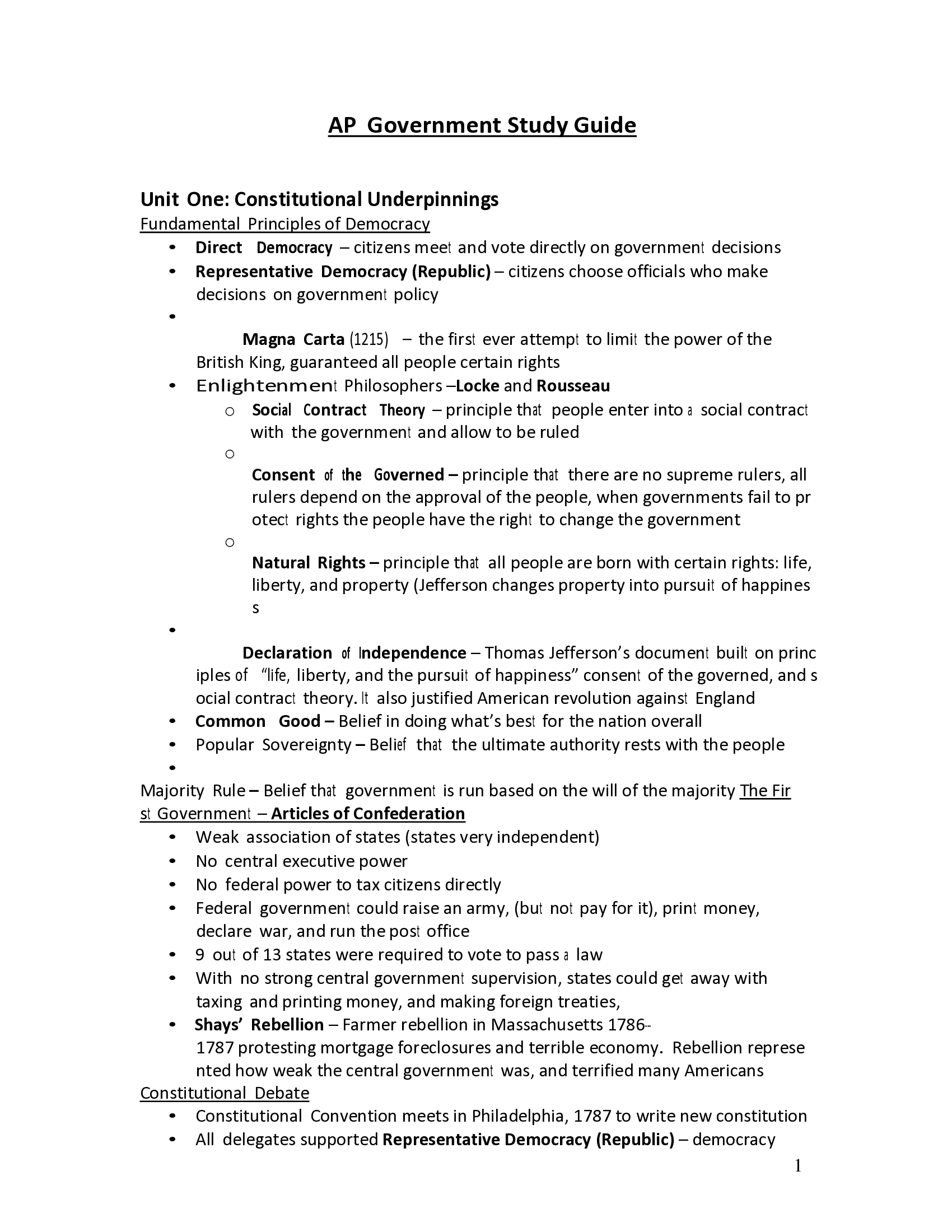
AP Government Study Guide Unit One: Constitutional Underpinnings Fundamental Principles of Democracy • Direct Democracy – citizens meet and vote directly on government decisions • Representative Democracy (Republic) – citizens choose officials who make decisions on government policy • Magna Carta (1215) – the first ever attempt to limit the power of the British King, guaranteed all people certain rights • Enlightenment Philosophers –Locke and Rousseau o Social Contract Theory – principle that people enter into a social contract with the government and allow to be ruled o Consent of the Governed – principle that there are no supreme rulers, all rulers depend on the approval of the people, when governments fail to pr otect rights the people have the right to change the government o Natural Rights – principle that all people are born with certain rights: life, liberty, and property (Jefferson changes property into pursuit of happines s • Declaration of Independence – Thomas Jefferson’s document built on princ iples of “life, liberty, and the pursuit of happiness” consent of the governed, and s ocial contract theory. It also justified American revolution against England • Common Good – Belief in doing what’s best for the nation overall • Popular Sovereignty – Belief that the ultimate authority rests with the people • Majority Rule – Belief that government is run based on the will of the majority The Fir st Government – Articles of Confederation • Weak association of states (states very independent) • No central executive power • No federal power to tax citizens directly • Federal government could raise an army, (but not pay for it), print money, declare war, and run the post office • 9 out of 13 states were required to vote to pass a law • With no strong central government supervision, states could get away with taxing and printing money, and making foreign treaties, • Shays’ Rebellion – Farmer rebellion in Massachusetts 1786-­­ 1787 protesting mortgage foreclosures and terrible economy. Rebellion represe nted how weak the central government was, and terrified many Americans Constitutional Debate • Constitutional Convention meets in Philadelphia, 1787 to write new constitution • All delegates supported Representative Democracy (Republic) – democracy 2 where people elect representatives who pass laws • Supported three branches – executive, legislative, and judicial 3 • Serious debate between Federalists vs. Anti-­­ Federalists, North vs. South, Big States vs. Small States over new government • North-­­South Compromises – 3/5 Compromise counted slaves as 3/5 of a person to give the south more representatives • Connecticut Compromise – (Bicameralism) – Established two equal bodies (House of Representatives and Senate) one based on population, one giving all sta tes equal representation. This was a compromise between big states (Virginia Pla n) and small states (New Jersey Plan) over the format of the Congress • Federalists (Hamilton, Madison) supported the Constitution because it gav e power to a strong central government. Anti-­­ federalists opposed the constitution because they thought the national governm ent would become tyrannical and take power away from the states • Federalist Papers – articles written by Madison, Hamilton, and Jay arguing for the constitution o Federalist Paper #10 – written by Madison, discusses importance of fac tions, factions are inevitable, but factions are best handled by a large rep ublic. o Federalist Paper #51 – written by Madison, discusses importance of checks and balances and the separation of powers in the constitution Weaknesses in the Articles of How the Constitution Fixed these Confederation Problems Congress could not tax, it relied on National government had power to tax contributions from states directly Congress couldn’t regulate interstate Interstate Commerce Clause gives trade Congress interstate regulatory power No chief executive to enforce the law Article II creates president who enforces the law No national judiciary to handle state Article III creates Supreme Court fights Each state was given only one vote Bicameral legislature represents states both by population, and equality The Constitution of the United States of America • Article I –Legislative Branch • Article II –Executive Branch • Article III –Judicial Branch • Article IV – Interstate relations • Article V – Amendment process • Separation of Powers – Each of the three branches has its own power and independence 1. Legislative Branch – Passes laws 2. Executive Branch – Executes laws 4 3. Judicial Branch – Interprets laws (this power comes from Supreme Court Case Marbury vs. Madison – set dogma of judicial review,

Contact the Seller

Please Sign In to contact this seller.


  • 👎  Report Copyright Violation

Frequently Asked Questions

What Do I Get When I Buy This Study Material?

+

When you buy a study material on Passing Grades, an instant download link will be sent directly to your email, giving you access to the file anytime after payment is completed.

Is Passing Grades a Trusted Platform?

+

Yes, Passing Grades is a reputable students’ marketplace with a secure payment system and reliable customer support. You can trust us to ensure a safe and seamless transaction experience.

Will I Be Stuck with a Subscription?

+

No, all purchases on Passing Grades are one-time transactions. You only pay for the notes you choose to buy, with no subscriptions or hidden fees attached.

Who Am I Buying These Study Materials From?

+

Passing Grades is a marketplace, which means you are purchasing the document from an individual vendor, not directly from us. We facilitate the payment and delivery process between you and the vendor.

Does Passing Grades Offer Free Study Materials?

+

Yes, sellers on Passing Grades have uploaded numerous free test banks, exams, practice questions, and class notes that can be downloaded at no cost.

Pasinggrades - Quality Study Materials

USD 7

    • Quality checked by Pasing Grades
    • 100% satisfaction guarantee
    • Seller: Eddah-Nafula
Buy PDF $7

Seller Information

Eddah-Nafula

Member since June 2021

  • icon
  • icon
  • icon
View Profile
  • total sales

    0
  • Favourites

    0
  • Comments

    0
    ( 0 Ratings )

Item Information

  • Uploaded

    05 May 2024

  • Updated

    24 October 2025

  • Category

    No category

  • Item Type

    exam

  • Tags

    AP Government and Politics Study Guide

Related Exam Prep Guides by Eddah-Nafula

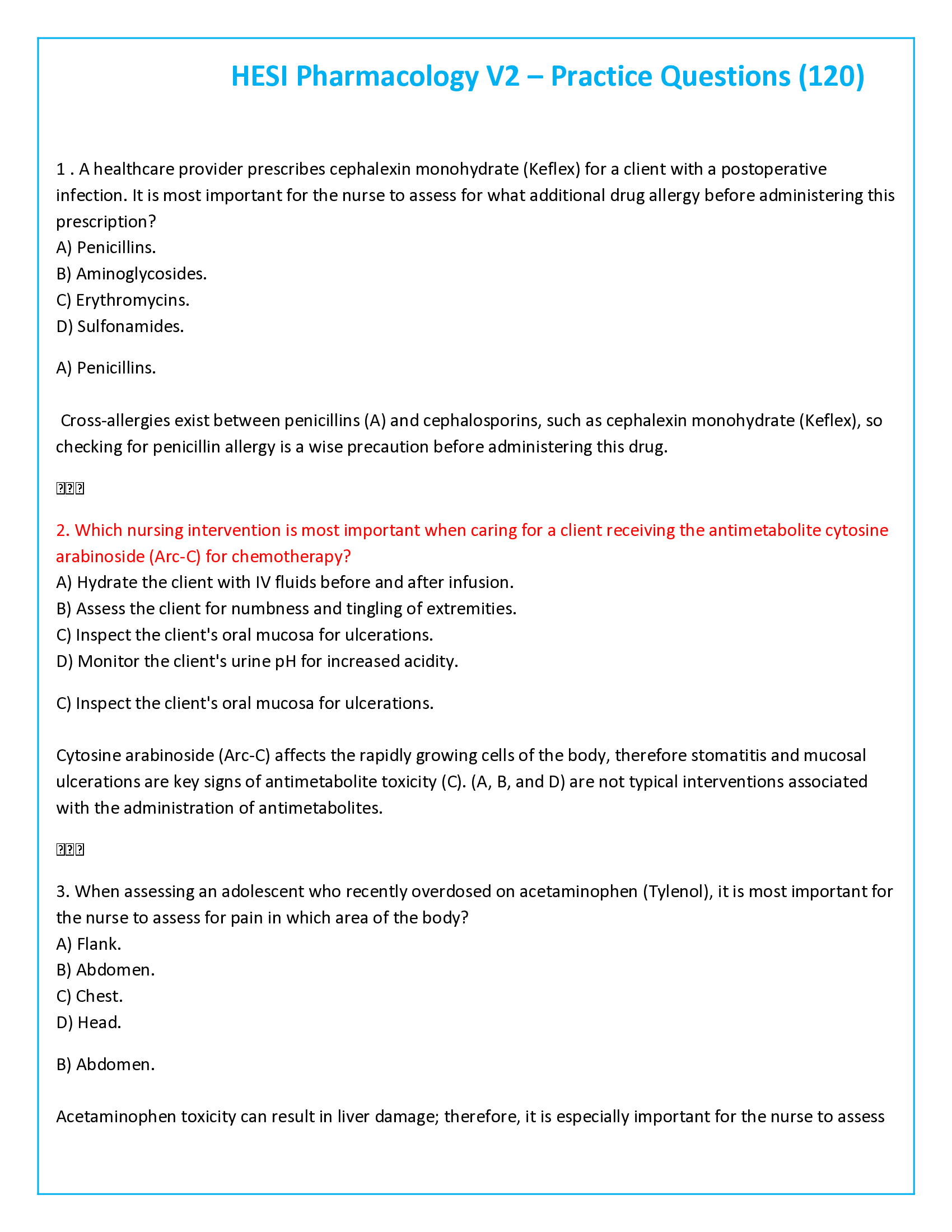
HESI Pharmacology V2 – Practice Questions (120) Latest 2026
View Document

HESI Pharmacology V2...

  • Eddah-Nafula

    Eddah-Nafula

  • exam

HESI Pharmacology V2 – Practice Questions (120) Latest 2025...

7 USD

0

0

AIN2601 ASSIGNMENT 1 QUESTIONS AND ANSWERS 100 CORRECT (2021)
View Document

AIN2601 ASSIGNMENT 1...

  • Eddah-Nafula

    Eddah-Nafula

  • exam

AIN2601 ASSIGNMENT 1 QUESTIONS AND ANSWERS 100 CORRECT (2021)...

7 USD

0

0

Ashley Davis patho objectives 5,6,7,20
View Document

Ashley Davis patho o...

  • Eddah-Nafula

    Eddah-Nafula

  • exam

Ashley Davis patho objectives 5,6,7,20...

7 USD

0

0

Purchase

Download link will be sent to this email immediately after purchase.

IMPORTANT LINKS

  • How To Upload Class Notes
  • Selling Tips
  • Passing Grades's Study Materials
  • Scholarships for International Students 2025

POPULAR CATEGORIES

  • Law
  • Accounting
  • English
  • Psychology
  • Business
  • Nursing
  • Computer Science
  • General

View Document

  • Blog
  • Contact
  • Delivery Policy
  • Latest Scholarships Around the World
  • How to Pass Bar Exams: Passing Grades’ Strategies
  • How to Study and Pass the CPA Exam
  • All Test Banks
  • Faq
  • Copyright Claims
  • Privacy Policy
  • Terms of Use

KNOWLEDGE BASE

  • How to Write A+ Grade Good Research Paper
  • How to Manage Stress During Exam Period
  • Best Time to Study
  • How to Pass NCLEX-RN Exam
  • How To Effectively Utilize Test Banks
  • Popular Shadow Health Exam Assessments
  • Popular HESI Case Studies
  • How to Prepare for a Nursing Career
  • The Importance Of Summaries in Exam Revisvion

© 2026 Pasing Grades. All rights reserved.