Pasing Grades
  • Start Selling
  • Blog
  • Contact
  • 0

    Your cart is empty!

English

  • English
  • Spanish
  • Arabic
Create Account Sign In
  • Library
    • New Prep Guides
    • Featured Prep Guides
    • Free Exam Prep Guides
    • Best sellers
  • General
  • Nursing
    • Research Paper
    • Case Study
    • Discussion Post
    • Assignment
    • Exam
    • Practice Questions and Answers
    • Test Bank
    • solutions manual
  • Accounting
    • Case Study
    • Thesis
    • Study Guide
    • Summary
    • Research Paper
    • test bank
  • English
    • Creative Writing
    • Research Paper
    • Summary
    • Rhetorics
    • Literature
    • Journal
    • Exam
    • Grammar
    • Discussion Post
    • Essay
  • Psychology
    • Hesi
    • Presentation
    • Essay
    • Summary
    • Study Guide
    • Essay
    • Solution Manual
    • Final Exam Review
    • Class Notes
    • test bank
  • Business
    • Lecture Notes
    • Solution Manual
    • Presentation
    • Business Plan
    • Class Notes
    • Experiment
    • Summary
    • Practice Questions
    • Study Guide
    • Case Study
    • test bank
    • Exam
  • More
    • Computer Science
    • Economics
    • Statistics
    • Engineering
    • Biology
    • Religious Studies
    • Physics
    • Chemistry
    • Mathematics
    • History
    • Sociology
    • Science
    • Philosophy
    • Law
  • Pages
    • About Us
    • Selling Tips
    • Delivery Policy
    • Faq
    • Privacy Policy
  • Flash Sale
  • Home
  • Ackley: Case Study Answers for Nursing Diagnosis Handbook 11th Edition

Ackley: Case Study Answers for Nursing Diagnosis Handbook 11th Edition

Preview page 1 Preview page 2 Preview page 3
Add To Favorites

Share this item Share this item

  • Item Details
  • Comments (0)
  • Reviews (0)
  • Contact Seller

Case Study Answers for Nursing Diagnosis Handbook 11th Edition by Ackley

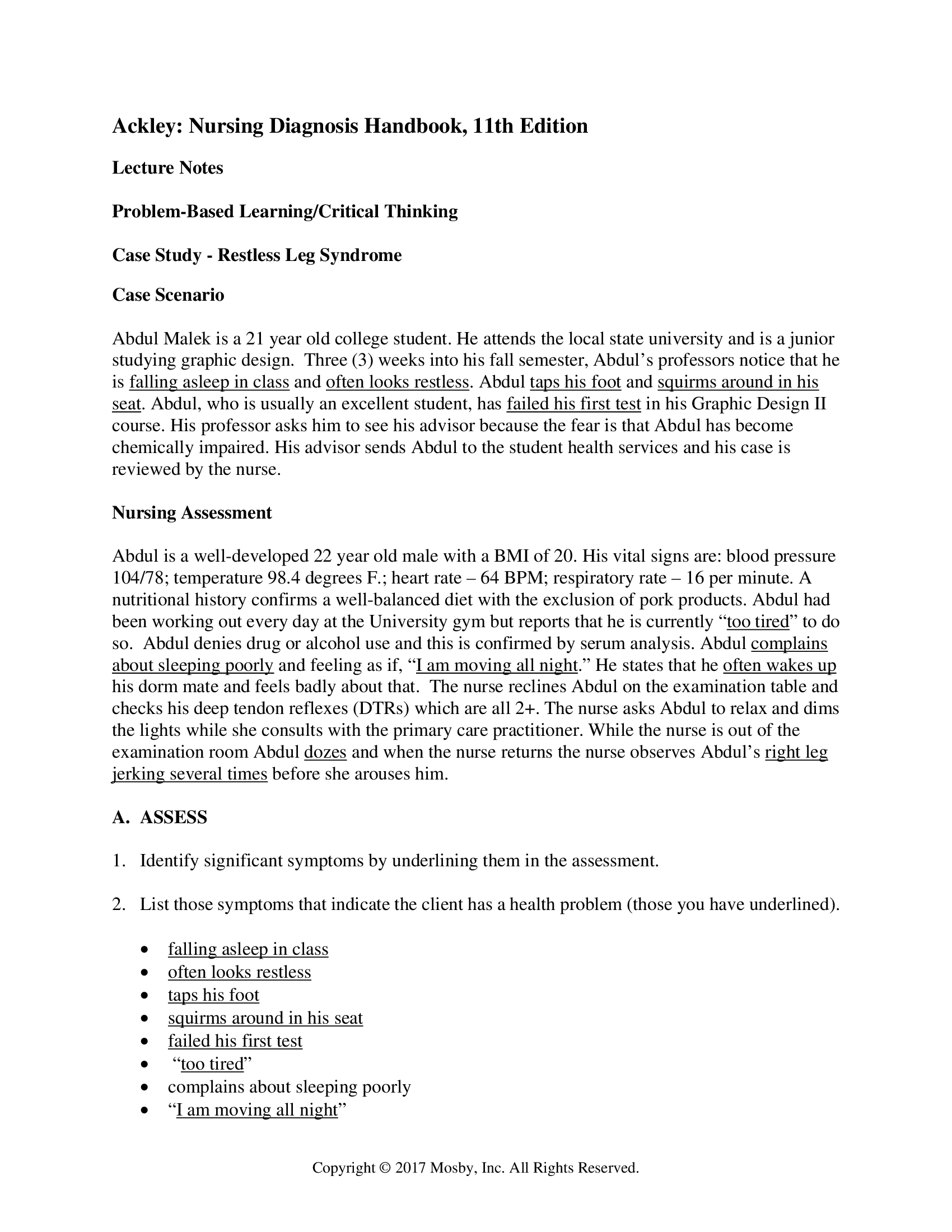
Ackley: Nursing Diagnosis Handbook, 11th Edition

Lecture Notes

Problem-Based Learning/Critical Thinking

Case Study - Restless Leg Syndrome Case Scenario

Abdul Malek is a 21 year old college student. He attends the local state university and is a junior studying graphic design.  Three (3) weeks into his fall semester, Abdul’s professors notice that he is falling asleep in class and often looks restless. Abdul taps his foot and squirms around in his seat. Abdul, who is usually an excellent student, has failed his first test in his Graphic Design II course. His professor asks him to see his advisor because the fear is that Abdul has become chemically impaired. His advisor sends Abdul to the student health services and his case is reviewed by the nurse.


Nursing Assessment


Abdul is a well-developed 22 year old male with a BMI of 20. His vital signs are: blood pressure 104/78; temperature 98.4 degrees F.; heart rate – 64 BPM; respiratory rate – 16 per minute. A nutritional history confirms a well-balanced diet with the exclusion of pork products. Abdul had been working out every day at the University gym but reports that he is currently “too tired” to do so.  Abdul denies drug or alcohol use and this is confirmed by serum analysis. Abdul complains about sleeping poorly and feeling as if, “I am moving all night.” He states that he often wakes up his dorm mate and feels badly about that.  The nurse reclines Abdul on the examination table and checks his deep tendon reflexes (DTRs) which are all 2+. The nurse asks Abdul to relax and dims the lights while she consults with the primary care practitioner. While the nurse is out of the examination room Abdul dozes and when the nurse returns the nurse observes Abdul’s right leg jerking several times before she arouses him. 

A. ASSESS 

1.      Identify significant symptoms by underlining them in the assessment.

2.      List those symptoms that indicate the client has a health problem (those you have underlined).

•        falling asleep in class 

•        often looks restless

•        taps his foot 

•        squirms around in his seat

•        failed his first test 

•        “too tired” 

•        complains about sleeping poorly

•        “I am moving all night” 

•        often wakes up

•        dozes 

•        right leg jerking several times 


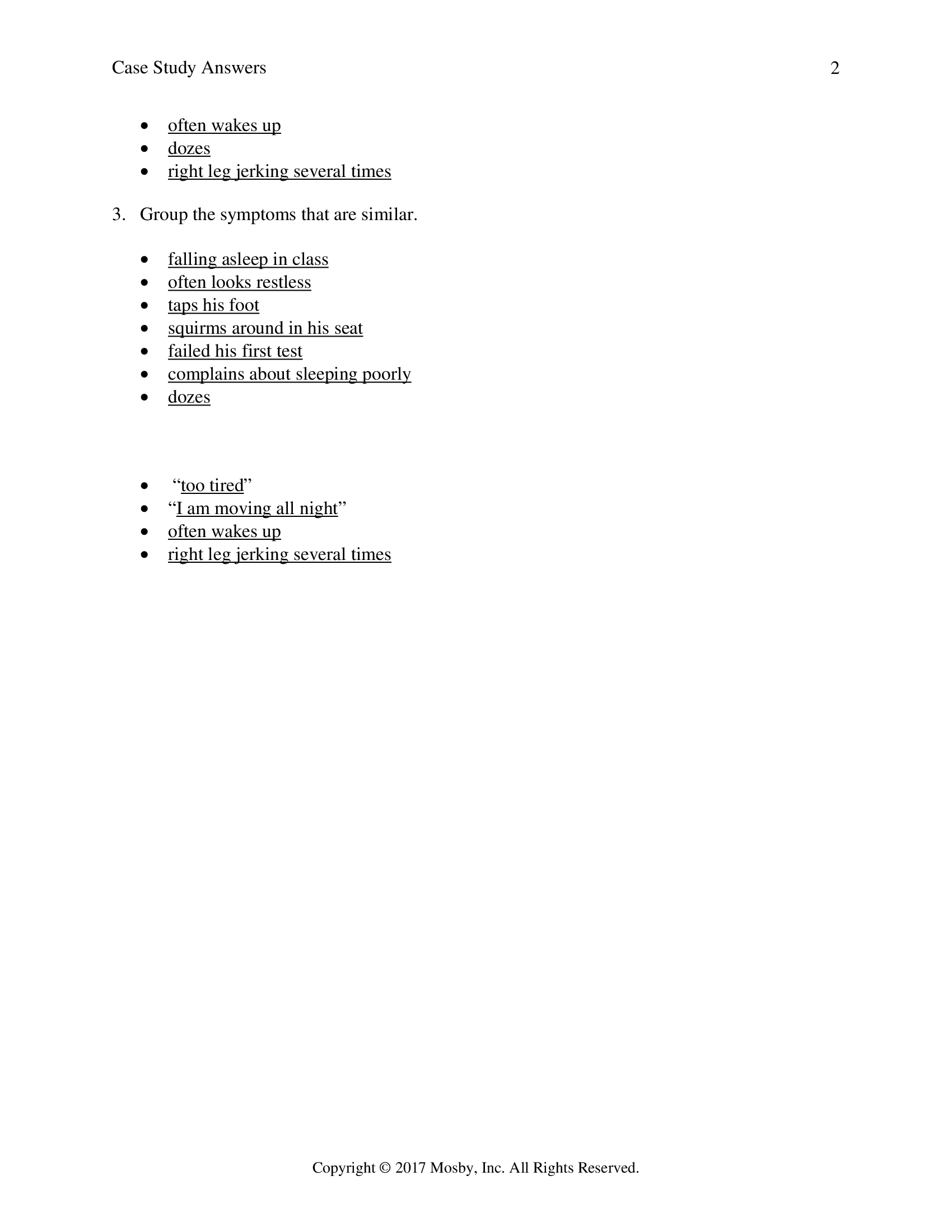
3.      Group the symptoms that are similar.


•        falling asleep in class 

•        often looks restless

•        taps his foot 

•        squirms around in his seat

•        failed his first test 

•        complains about sleeping poorly

•        dozes


•        “too tired” 

•        “I am moving all night” 

•        often wakes up

•        right leg jerking several times 


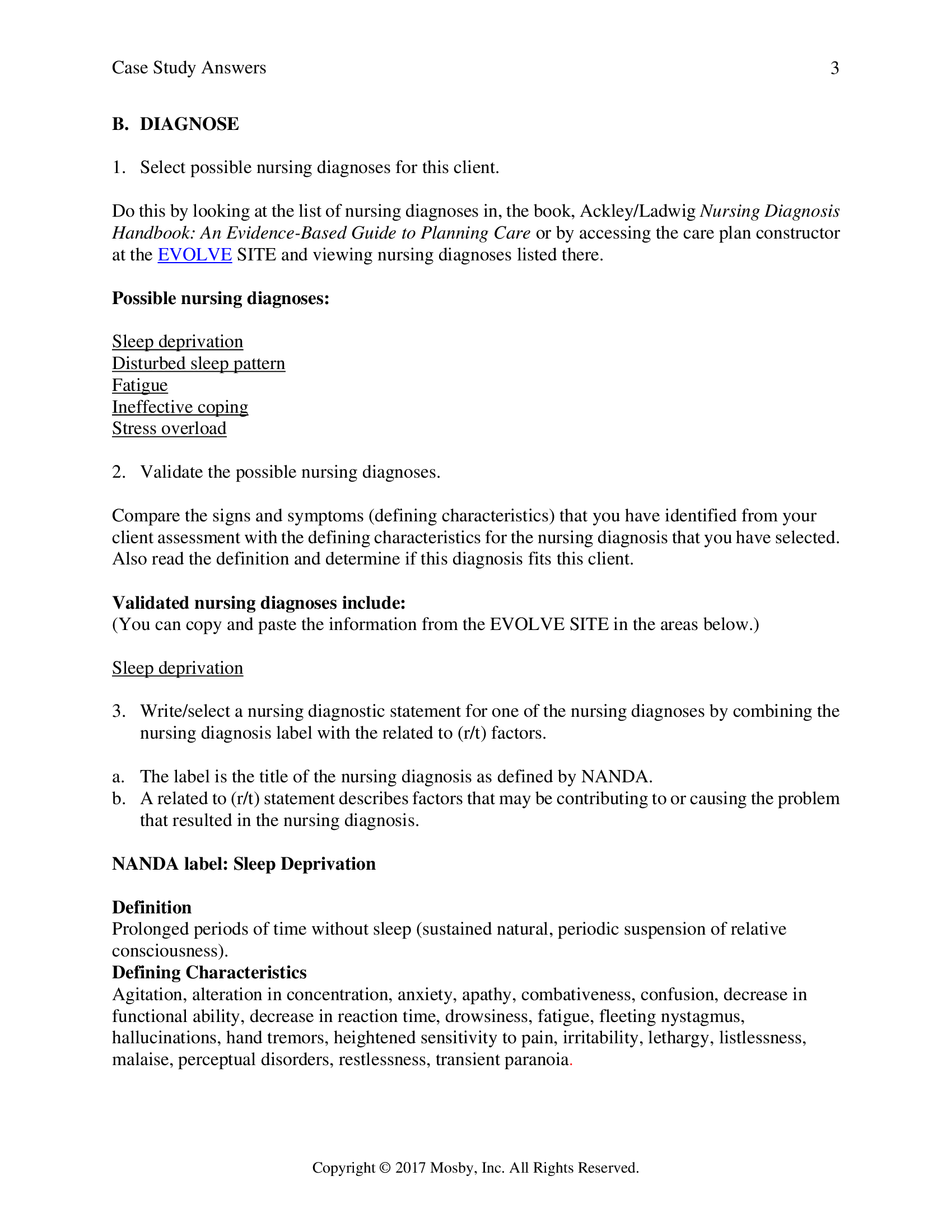
B. DIAGNOSE


1.      Select possible nursing diagnoses for this client.


Do this by looking at the list of nursing diagnoses in, the book, Ackley/Ladwig Nursing Diagnosis Handbook: An Evidence-Based Guide to Planning Care or by accessing the care plan constructor at the EVOLVE SITE and viewing nursing diagnoses listed there. 


Possible nursing diagnoses:


Sleep deprivation

Disturbed sleep pattern

Fatigue

Ineffective coping

Stress overload


2.      Validate the possible nursing diagnoses.


Compare the signs and symptoms (defining characteristics) that you have identified from your client assessment with the defining characteristics for the nursing diagnosis that you have selected. Also read the definition and determine if this diagnosis fits this client.


Validated nursing diagnoses include:

(You can copy and paste the information from the EVOLVE SITE in the areas below.)


Sleep deprivation


3.      Write/select a nursing diagnostic statement for one of the nursing diagnoses by combining the nursing diagnosis label with the related to (r/t) factors.


a.       The label is the title of the nursing diagnosis as defined by NANDA.

b.      A related to (r/t) statement describes factors that may be contributing to or causing the problem that resulted in the nursing diagnosis.


NANDA label: Sleep Deprivation


Definition

Prolonged periods of time without sleep (sustained natural, periodic suspension of relative consciousness).

Defining Characteristics

Agitation, alteration in concentration, anxiety, apathy, combativeness, confusion, decrease in functional ability, decrease in reaction time, drowsiness, fatigue, fleeting nystagmus, hallucinations, hand tremors, heightened sensitivity to pain, irritability, lethargy, listlessness, malaise, perceptual disorders, restlessness, transient paranoia.


Related factors (r/t): Age related sleep stage shifts, average daily physical activity is less than recommended for gender and age, conditions with periodic limb movement (e.g., restless leg syndrome, nocturnal myoclonus), dementia, environmental barrier, familial sleep paralysis, idiopathic central nervous system hypersomnolence, narcolepsy, nightmares, non-restorative sleep pattern (i.e., due to caregiver responsibilities, parenting practices, sleep partner), overstimulating environment, prolonged discomfort (e.g., physical, psychological), sleep apnea, sleep terror, sleep walking, sleep-related enuresis, sleep-related painful erections, Sundowners syndrome, sustained circadian asynchrony, sustained inadequate sleep hygiene, treatment regimen.  


The complete nursing diagnostic statement is:


Sleep deprivation r/t conditions with periodic limb movement


C.    PLAN


1. Select appropriate NOC outcome from Ackley/Ladwig text or from the EVOLVE Care Plan constructor. 


NOC outcome: Sleep  


Fill out the grid with NOC indicators and the appropriate Likert scale.

Select the appropriate point on the Likert scale to measure the client’s current status.


INDICATOR

1 = severelycompromised

2 = substantially compromised

3 = moderatelycompromised

4 = mildlycompromised

5 = notcompromised

Hours of sleep

1*

2

3

4

5

Sleep pattern

1*

2

3

4

5

Sleep quality

1*

2

3

4

5

Sleep efficiency

1*

2

3

4

5

Feels rejuvenated after sleep

1*

2

3

4

5

Sleeps through the night consistently

1*

2

3

4

5


2. Or write outcomes to help resolve the symptoms (defining characteristics). Refer to Section III of the Ackley/Ladwig text for the nursing diagnosis care plan or the EVOLVE Care Plan constructor.  

C. Outcomes: 

Client will within a week:

•      Verbalize plan that provides adequate time for sleep

•      Identify actions that can be taken to ensure adequate sleep time

•      Awaken refreshed once adequate time is spent sleeping

•      Be less sleepy during the day once adequate time is spent sleeping


3.      Select appropriate NIC interventions from Ackley/Ladwig text or care plan constructor.


NIC intervention: Sleep Enhancement

4.      Select appropriate NIC activities.


a.       Monitor/record client's sleep pattern and number of sleep hours 

b.      Encourage client to establish a schedule that allows age-appropriate hours of sleep with minimal environmental and personal disruptions


Note: The Ackley/Ladwig text and the care plan constructor gives sample NIC activities.


5. Select interventions from the Section III care plan or the care plan constructor that will enable the client to attain acceptable outcomes.


Nursing Interventions and Rationales:

•       Obtain a sleep history to identify the specific personal and environmental factors that may be depriving clients of the amount of sleep needed for optimal functioning.

Evidence-based (EB): Two detailed case studies by Salas & Gamaldo (2011) showed uniquely complex combinations of personal and environmental factors contribute to sleep deprivation.  Evidence-based Nursing (EBN): A systematic review of 17 studies of heart surgery patients showed factors that led to insufficient sleep during hospitalization were personal factors including pain, dyspnea, nocturia, anxiety, and depression and environmental factors including  noise, light, and provision of care (Liao, Huang, Huang, & Hwang, 2011).  

o   Minimize environmental factors that disturb the client's sleep. See Nursing Interventions and Rationales for Disturbed sleep pattern.

o   Minimize personal factors that disturb the client's sleep. See Nursing Interventions and Rationales for Insomnia.

•       Assess the amount of sleep obtained each night compared with the amount of sleep needed.  EB: A national survey of 10,896 adults found that over one-third (37.1%) sleep less than 7 hours per night, an amount at which physiological and neurobehavioral deficits manifest and become progressively worse under chronic conditions (Centers for Disease Control and Prevention, 2011).    

•       Assess for hypersensitivity to pain. EB:  In a repeated-measures sleep laboratory experiment with 18 adults, sleep deficiency lead to increased sensitivity to pain (Roehrs,

Harris, Randall, & Roth, 2012). EB: In laboratory study of 34 subjects, those with

shortened sleep due to chronic insomnia, were twice as likely as healthy controls with no sleep loss to report experiencing spontaneous pain; they also had lower pain thresholds for discomfort due to heat and pressure (Haack et al., 2012).

•       When daytime drowsiness occurs despite long, undisturbed periods of sleep, consider sleep apnea as a possible cause.   EB:  In a household survey of over 7000 adults, unexplained excessive daytime sleepiness was identified as a predictor of undiagnosed sleep apnea (Dosman et al., 2014). 

•       Encourage a regular schedule of napping as a way to compensate for sleep deficiency whenever severely restricted sleep amounts cannot be avoided. CEB:  In a study of 92 adults, naps of no more than 45 minutes were found to supplement rather than replace nighttime sleep (Floyd, 1995).  EB: In a pretest/posttest study of 22 older adults, a consistent regimen of daily napping for 45 minutes enhanced waking function without negatively affecting nighttime sleep (Campbell, Stanchina, Schlang, & Murphy,  2011).  

•       Monitor caffeine intake in clients who may use caffeinated drinks to overcome sleep deficiency.  EB:  In a double-blind, cross-over study of 63 adults, even a single cup of caffeinated coffee consumed before bedtime in real-life conditions caused a deterioration in the quality of sleep in caffeine-sensitive subjects (Lloret-Linares et al., 2012). Classic Evidence-based (CEB):  In an analysis of results from randomized controlled trails (RCTs) representing 156 subjects, caffeine abstinence for the whole day resulted in improved sleep quality at night (Sin, Ho, & Chung, 2008). 

•       If evidenced-based interventions are inadequate, consider and carefully evaluate unstudied--but commonly used countermeasures--for fighting drowsiness.  EB: A descriptive study of 77 middle-aged adults identified the following unstudied strategies as possibly effective interrupters of drowsiness: (a) Change physical position; (b) Change ventilation (e.g., get fresh air, turn on fan, open window);(c) Reduce air temperature (e.g., turn on air conditioning, turn on fan); (d) Increase auditory stimulation (e.g., play music, sing, engage in conversation, listen to debate);(e) Engage in interesting visual activity (e.g., board games, watching TV sports events, watching serial TV dramas) (Davidsson, 2012).

Multicultural

• Be aware of racial and ethnic disparities in sleep deprivation. EB: A national survey of 10,896 adults found that sleep deficiency is more common among non-Hispanic blacks (53.0%) than among non-Hispanic whites (34.5%), Mexican Americans (35.2%), and persons of other races/ethnicities (41.7%) (Centers for Disease control and Prevention, 2011).

Home Care

•      Teach family members about the short-term and long-term consequences of inadequate amounts of sleep for both clients and family caregivers. CEB: In an integrative review of 10 studies, insufficient sleep was associated with poor attention, decreased performance, increased mortality and morbidity, and cardiovascular risk factors including hypertension, insulin resistance, hormonal deregulation, and inflammation (Mullington, Haack, Toth, Serrador, Meier-Ewert, 2009).

•      Teach client/family caregivers about the need for those with chronic conditions to avoid schedules and commitments that interfere with obtaining adequate amounts of sleep. EBN:  In a study of 21 subjects with left-ventricular assist devices, clients obtained inadequate sleep persisting up to 6 months after surgery (Casida, Davis, Brewer, Smith, & Yarandi, 2011). 

•      Promote adoption of behaviors that ensure adequate amounts of sleep for all family members. See Nursing Interventions and Rationales for Readiness for enhanced Sleep.

•      Teach family members ways to avoid chronic sleep loss. See Nursing Interventions and Rationales for Disturbed Sleep pattern.

•      Advise against the sleep deprived client’s chronic use of caffeinated drinks to overcome daytime fatigue and or drowsiness; focus on elimination of factors that lead to chronic sleep loss. CEB:  In an integrative review of 26 controlled laboratory studies, caffeine was found helpful in the temporary management of sleepiness, but overuse and late-day use contributed to subsequent sleep disruption and caffeine habituation (Roehrs & Roth, 2008).  


D. IMPLEMENT


The next step in the nursing process is to give the nursing care utilizing the nursing interventions.


E. EVALUATE


After putting into effect the nursing interventions, the results of the care should be evaluated by determining if the outcomes were met. If the outcomes are acceptable, the care plan is resolved. If the outcomes are not acceptable, further assessment should be done to answer the following questions:


NOC Indicator

Rating at admission

Rating 4 days later

Rating 1 weeklater

Hours of sleep

1

2

4

Sleep pattern

1

2

3

Sleep quality

1

2

3

Sleep efficiency

1

2

4

Feels rejuvenated after sleep

1

3

4

Sleeps through the night consistently

1

2

3


•      Was the correct nursing diagnosis chosen? 

Yes, Abdul is suffering from sleep deprivation and his learning was being affected.

•      Was the outcome appropriate? 

Yes, the outcome is to promote better sleep quality and pattern.

•      Were the interventions appropriate in this situation? 

Yes, along with medication for his restless leg syndrome, the sleep deprivation interventions effectively reversed his poor sleeping habits. • What other interventions might have been helpful?  

Referral to a relaxation class such as yoga or meditation. 

Changes in the nursing diagnosis, outcomes, and interventions should be made as needed. This is continued use of critical thinking to ensure appropriate nursing care.

Contact the Seller

Please Sign In to contact this seller.


  • 👎  Report Copyright Violation

Frequently Asked Questions

What Do I Get When I Buy This Study Material?

+

When you buy a study material on Passing Grades, an instant download link will be sent directly to your email, giving you access to the file anytime after payment is completed.

Is Passing Grades a Trusted Platform?

+

Yes, Passing Grades is a reputable students’ marketplace with a secure payment system and reliable customer support. You can trust us to ensure a safe and seamless transaction experience.

Will I Be Stuck with a Subscription?

+

No, all purchases on Passing Grades are one-time transactions. You only pay for the notes you choose to buy, with no subscriptions or hidden fees attached.

Who Am I Buying These Study Materials From?

+

Passing Grades is a marketplace, which means you are purchasing the document from an individual vendor, not directly from us. We facilitate the payment and delivery process between you and the vendor.

Does Passing Grades Offer Free Study Materials?

+

Yes, sellers on Passing Grades have uploaded numerous free test banks, exams, practice questions, and class notes that can be downloaded at no cost.

Pasinggrades - Quality Study Materials

USD 12

    • Quality checked by Pasing Grades
    • 100% satisfaction guarantee
    • Seller: mentor2000
Buy PDF $12

Seller Information

mentor2000

Member since April 2021

  • icon
  • icon
View Profile
  • total sales

    0
  • Favourites

    0
  • Comments

    0
    ( 0 Ratings )

Item Information

  • Uploaded

    28 October 2021

  • Updated

    16 May 2025

  • Category

    Nursing

  • Item Type

    test bank

  • Tags

    Case Study Answers for Nursing Diagnosis Handbook 11th Edition by Ackley

Related Exam Prep Guides by mentor2000

Test Bank for Essentials for Nursing Practice 8th Edition by Potter | All Chapters
View Document

Test Bank for Essent...

  • mentor2000

    mentor2000

  • test bank

Master nursing concepts with this study material; Test Bank for Essentials for Nursing Practice, 8th...

12 USD

0

0

A &P 1 MA278 BSC2 Final Module II Questions & Answers 2026 Update
View Document

A &P 1 MA278 BSC2 Fi...

  • mentor2000

    mentor2000

  • test bank

Prepare for success with A&P 1 MA278 BSC2 Final Module II 2024 Q&A. Boost your grades with this comp...

12 USD

0

0

ATI Comprehensive Predictor Exam 2026
View Document

ATI Comprehensive Pr...

  • mentor2000

    mentor2000

  • test bank

Prepare for success with the ATI Comprehensive Predictor Exam 2026. Access key practice questions to...

12 USD

0

0

Purchase

Download link will be sent to this email immediately after purchase.

IMPORTANT LINKS

  • How To Upload Class Notes
  • Selling Tips
  • Passing Grades's Study Materials
  • Scholarships for International Students 2025

POPULAR CATEGORIES

  • Law
  • Accounting
  • English
  • Psychology
  • Business
  • Nursing
  • Computer Science
  • General

View Document

  • Blog
  • Contact
  • Delivery Policy
  • Latest Scholarships Around the World
  • How to Pass Bar Exams: Passing Grades’ Strategies
  • How to Study and Pass the CPA Exam
  • All Test Banks
  • Faq
  • Copyright Claims
  • Privacy Policy
  • Terms of Use

KNOWLEDGE BASE

  • How to Write A+ Grade Good Research Paper
  • How to Manage Stress During Exam Period
  • Best Time to Study
  • How to Pass NCLEX-RN Exam
  • How To Effectively Utilize Test Banks
  • Popular Shadow Health Exam Assessments
  • Popular HESI Case Studies
  • How to Prepare for a Nursing Career
  • The Importance Of Summaries in Exam Revisvion

© 2026 Pasing Grades. All rights reserved.