Pasing Grades
  • Start Selling
  • Blog
  • Contact
  • 0

    Your cart is empty!

English

  • English
  • Spanish
  • Arabic
Create Account Sign In
  • Library
    • New Prep Guides
    • Featured Prep Guides
    • Free Exam Prep Guides
    • Best sellers
  • General
  • Nursing
    • Research Paper
    • Case Study
    • Discussion Post
    • Assignment
    • Exam
    • Practice Questions and Answers
    • Test Bank
    • solutions manual
  • Accounting
    • Case Study
    • Thesis
    • Study Guide
    • Summary
    • Research Paper
    • test bank
  • English
    • Creative Writing
    • Research Paper
    • Summary
    • Rhetorics
    • Literature
    • Journal
    • Exam
    • Grammar
    • Discussion Post
    • Essay
  • Psychology
    • Hesi
    • Presentation
    • Essay
    • Summary
    • Study Guide
    • Essay
    • Solution Manual
    • Final Exam Review
    • Class Notes
    • test bank
  • Business
    • Lecture Notes
    • Solution Manual
    • Presentation
    • Business Plan
    • Class Notes
    • Experiment
    • Summary
    • Practice Questions
    • Study Guide
    • Case Study
    • test bank
    • Exam
  • More
    • Computer Science
    • Economics
    • Statistics
    • Engineering
    • Biology
    • Religious Studies
    • Physics
    • Chemistry
    • Mathematics
    • History
    • Sociology
    • Science
    • Philosophy
    • Law
  • Pages
    • About Us
    • Selling Tips
    • Delivery Policy
    • Faq
    • Privacy Policy
  • Flash Sale
  • Home
  • [eTextBook] [PDF] Instructor’s Solutions Manual Physics Ninth Edition John D. Cutnell Kenneth W. Johnson

[eTextBook] [PDF] Instructor’s Solutions Manual Physics Ninth Edition John D. Cutnell Kenneth W. Johnson

Preview page 1 Preview page 2 Preview page 3
Add To Favorites

Share this item Share this item

  • Item Details
  • Comments (0)
  • Reviews (0)
  • Contact Seller

[eTextBook] [PDF] Instructor’s Solutions Manual Physics Ninth Edition John D. Cutnell Kenneth W. Johnson

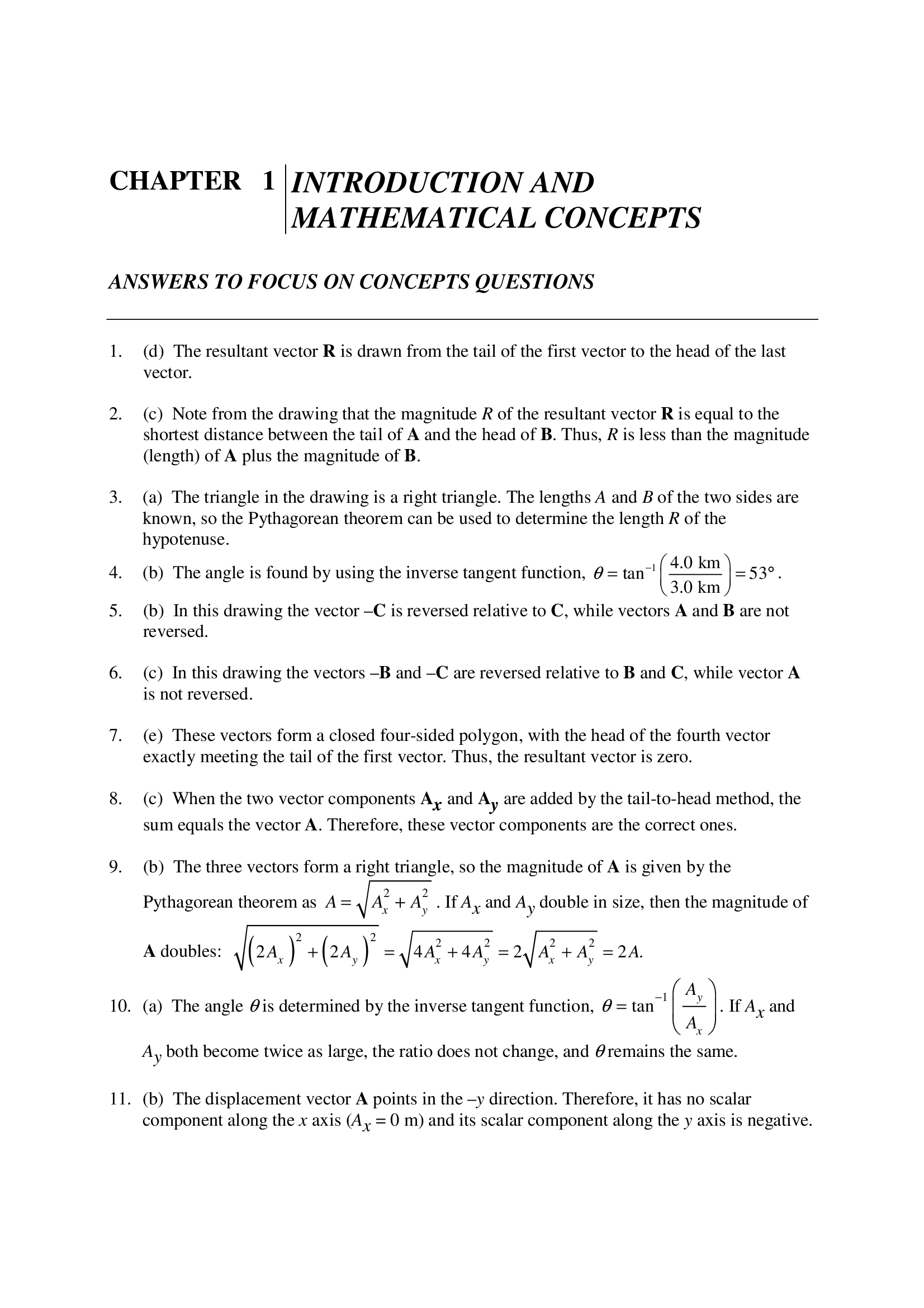
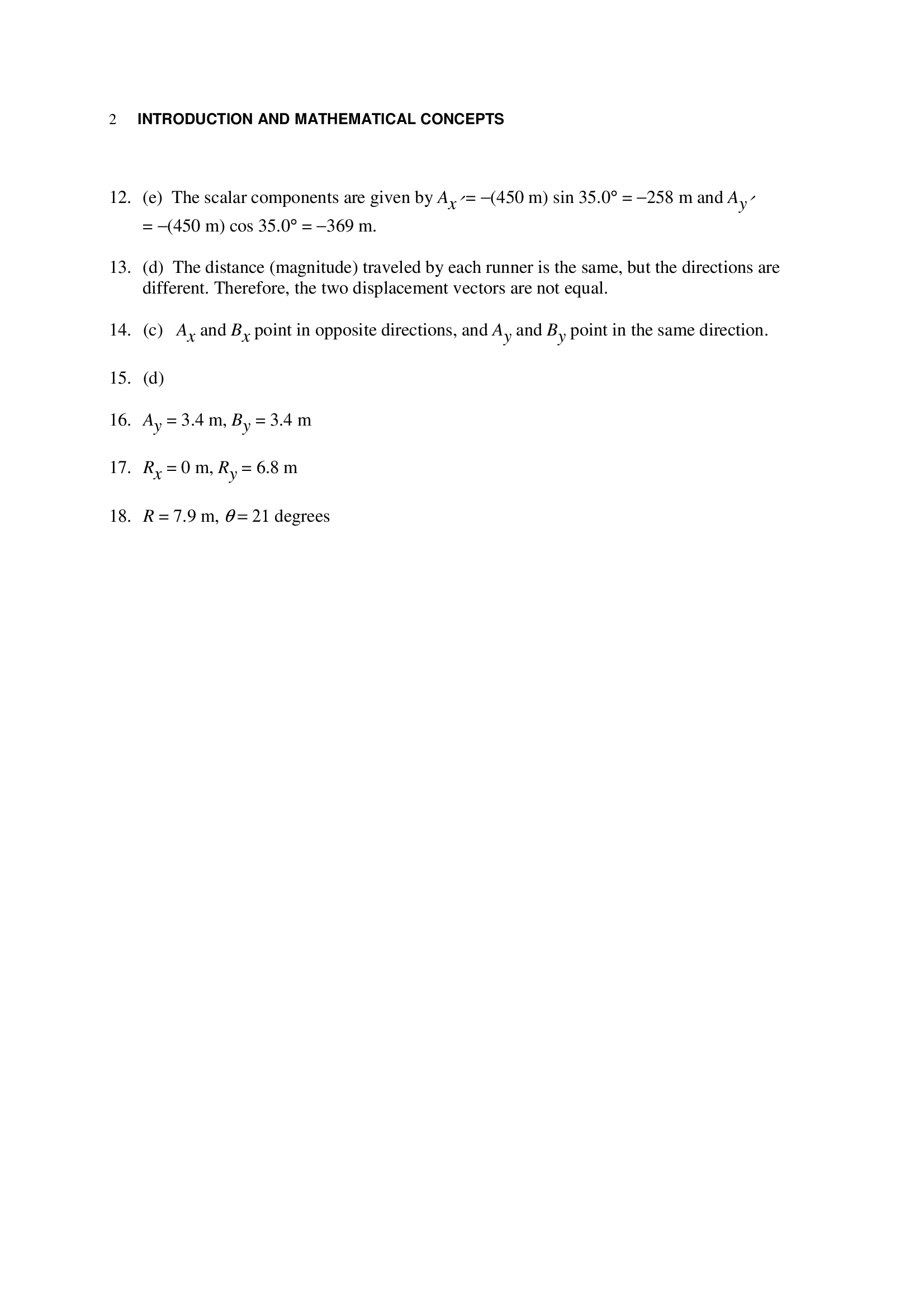
1. (d) The resultant vector R is drawn from the tail of the first vector to the head of the last vector. 2. (c) Note from the drawing that the magnitude R of the resultant vector R is equal to the shortest distance between the tail of A and the head of B. Thus, R is less than the magnitude (length) of A plus the magnitude of B. 3. (a) The triangle in the drawing is a right triangle. The lengths A and B of the two sides are known, so the Pythagorean theorem can be used to determine the length R of the hypotenuse. 4. (b) The angle is found by using the inverse tangent function, 1 4.0 km tan 53 3.0 km θ −   = = °     . 5. (b) In this drawing the vector –C is reversed relative to C, while vectors A and B are not reversed. 6. (c) In this drawing the vectors –B and –C are reversed relative to B and C, while vector A is not reversed. 7. (e) These vectors form a closed four-sided polygon, with the head of the fourth vector exactly meeting the tail of the first vector. Thus, the resultant vector is zero. 8. (c) When the two vector components Ax and Ay are added by the tail-to-head method, the sum equals the vector A. Therefore, these vector components are the correct ones. 9. (b) The three vectors form a right triangle, so the magnitude of A is given by the Pythagorean theorem as 2 2 x y A A A = + . If Ax and Ay double in size, then the magnitude of A doubles: ( ) ( ) 2 2 2 2 2 2 2 2 4 4 2 2 . x y x y x y A A A A A A A + = + = + = 10. (a) The angle θ is determined by the inverse tangent function, 1 tan y x A A θ − =       . If Ax and Ay both become twice as large, the ratio does not change, and θ remains the same. 11. (b) The displacement vector A points in the –y direction. Therefore, it has no scalar component along the x axis (Ax = 0 m) and its scalar component along the y axis is negative. 2 INTRODUCTION AND MATHEMATICAL CONCEPTS 12. (e) The scalar components are given by Ax′ = −(450 m) sin 35.0° = −258 m and Ay′ = −(450 m) cos 35.0° = −369 m. 13. (d) The distance (magnitude) traveled by each runner is the same, but the directions are different. Therefore, the two displacement vectors are not equal. 14. (c) Ax and Bx point in opposite directions, and Ay and By point in the same direction. 15. (d) 16. Ay = 3.4 m, By = 3.4 m 17. Rx = 0 m, Ry = 6.8 m 18. R = 7.9 m, θ = 21 degrees Chapter 1 Problems 3 CHAPTER 1 INTRODUCTION AND MATHEMATICAL CONCEPTS PROBLEMS ____________________________________________________________________________________________ 1. REASONING We use the fact that 1 m = 3.28 ft to form the following conversion factor: (1 m)/(3.28 ft) = 1. SOLUTION To convert ft2 into m2 , we apply the conversion factor twice: 2 Area = 1330 ft ( ) 1 m 3.28 ft 1 m 3.28 ft       2 124 m   =     _____________________________________________________________________________ 2. REASONING The word “per” indicates a ratio, so “0.35 mm per day” means 0.35 mm/d, which is to be expressed as a rate in ft/century. These units differ from the given units in both length and time dimensions, so both must be converted. For length, 1 m = 103 mm, and 1 ft = 0.3048 m. For time, 1 year = 365.24 days, and 1 century = 100 years. Multiplying the resulting growth rate by one century gives an estimate of the total length of hair a long-lived adult could grow over his lifetime. SOLUTION Multiply the given growth rate by the length and time conversion factors, making sure units cancel properly: mm Growth rate 0.35 = d 3 1 m 10 mm       1 ft 0.3048 m         365.24 d     1 y   100 y     42 ft/century century     =   ______________________________________________________________________________ 3. SSM REASONING We use the facts that 1 mi = 5280 ft, 1 m = 3.281 ft, and 1 yd = 3 ft. With these facts we construct three conversion factors: (5280 ft)/(1 mi) = 1, (1 m)/(3.281 ft) = 1, and (3 ft)/(1 yd) = 1. SOLUTION By multiplying by the given distance d of the fall by the appropriate conversion factors we find that d = ( ) 6 mi 5280 ft 1 mi 1 m 3.281 ft       551 yd     +   ( ) 3 ft 1 yd 1 m 3.281 ft         10 159 m     =   4 INTRODUCTION AND MATHEMATICAL CONCEPTS 4. REASONING a. To convert the speed from miles per hour (mi/h) to kilometers per hour (km/h), we need to convert miles to kilometers. This conversion is achieved by using the relation 1.609 km = 1 mi (see the page facing the inside of the front cover of the text). b. To convert the speed from miles per hour (mi/h) to meters per second (m/s), we must convert miles to meters and hours to seconds. This is accomplished by using the conversions 1 mi = 1609 m and 1 h = 3600 s. SOLUTION a. Multiplying the speed of 34.0 mi/h by a factor of unity, (1.609 km)/(1 mi) = 1, we find the speed of the bicyclists is ( ) mi mi Speed = 34.0 1 34.0 h   =     1.609km h 1 mi       km 54.7 h     =   b. Multiplying the speed of 34.0 mi/h by two factors of unity, (1609 m)/(1 mi) = 1 and (1 h)/(3600 s) = 1, the speed of the bicyclists is ( )( ) mi mi Speed = 34.0 1 1 34.0 h   =     h 1609 m 1 mi         1 h     m 15.2 3600s s     =   ______________________________________________________________________________ 5. REASONING In order to calculate d, the units of a and b must be, respectively, cubed and squared along with their numerical values, then combined algebraically with each other and the units of c. Ignoring the values and working first with the units alone, we have ( ) ( )( ) 3 3 3 2 2 m m = m/s s a d cb = → 2 ( ) m/ s 2 ⋅s 2 1 m = s Therefore, the units of d are m2 /s. SOLUTION With the units known, the numerical value may be calculated: ( ) ( )( ) 3 2 2 2 9.7 m /s 0.75 m /s 69 4.2 d = = 6. REASONING AND SOLUTION x has the dimensions of [L], v has the dimensions of [L]/[T], and a has the dimensions of [L]/[T]2. The equation under consideration is v n = 2ax. Chapter 1 Problems 5 The dimensions of the right hand side are L T L L T 2 2 2 = , while the dimensions of the left hand side are [ ] [ ] [ ] [ ] L L T T n n n     =     . The right side will equal the left side only when n = 2 . ____________________________________________________________________________________________ 7. SSM REASONING This problem involves using unit conversions to determine the number of magnums in one jeroboam. The necessary relationships are 1.0 magnum = 1.5 liters 1.0 jeroboam = 0.792 U. S. gallons 1.00 U. S. gallon = 3.785 ×10⁻³ m3 = 3.785 liters These relationships may be used to construct the appropriate conversion factors. SOLUTION By multiplying one jeroboam by the appropriate conversion factors we can determine the number of magnums in a jeroboam as shown below: ( ) 1.0 jeroboam 0.792 gallons 1.0 jeroboam 3.785 liters       1.0 gallon 1.0 magnum 1.5 liters       2.0 magnums     =   ____________________________________________________________________________________________ 8. REASONING In the expression for the volume flow rate, the dimensions on the left side of the equals sign are [L]3 /[T]. If the expression is to be valid, the dimensions on the right side of the equals sign must also be [L]3 /[T]. Thus, the dimensions for the various symbols on the right must combine algebraically to yield [L]3 /[T]. We will substitute the dimensions for each symbol in the expression and treat the dimensions of [M], [L], and [T] as algebraic variables, solving the resulting equation for the value of the exponent n. SOLUTION We begin by noting that the symbol π and the number 8 have no dimensions. It follows, then, that ( ) [ ] [ ] [ ] [ ] 3 2 1 M L L or 8 T n n R P P Q L π η − = = [ ][ ] [ ] 2 L T M [ ] L [ ] [ ] L T [ ] [ ] [ ][ ] [ ] [ ][ ] [ ] [ ] 2 3 L T L L T L T L T n n = = [ ] [ ] [ ] L L T n = [ ] [ ] [ ] [ ] [ ] [ ] [ ] 3 3 4 L or L or L L L L L n n = = = 6 INTRODUCTION AND MATHEMATICAL CONCEPTS Thus, we find that n = 4 . 9. REASONING AND SOLUTION a. F = [M][L]/[T]2; ma = [M][L]/[T]2 = [M][L]/[T]2 so F = ma is dimensionally correct . b. x = [L]; at3 = ([L]/[T]2)[T]3 = [L][T] so x = (1/2)at3 is not dimensionally correct . c. E = [M][L]2/[T]2; mv = [M][L]/[T] so E = (1/2)mv is not dimensionally correct . d. E = [M][L]2/[T]2; max = [M]([L]/[T]2)[L] = [M][L]2/[T]2 so E = max is dimensionally correct . e. v = [L]/[T]; (Fx/m) 1/2 = {([M][L]/[T]2)([L]/[M])}1/2 = {[L]2/[T]2} 1/2 = [L]/[T] so v = (Fx/m) 1/2 is dimensionally correct . ____________________________________________________________________________________________ 10. REASONING To convert from gallons to cubic meters, use the equivalence 1 U.S. gal = 3.785×10⁻³ m 3 . To find the thickness of the painted layer, we use the fact that the paint’s volume is the same, whether in the can or painted on the wall. The layer of paint on the wall can be thought of as a very thin “box” with a volume given by the product of the surface area (the “box top”) and the thickness of the layer. Therefore, its thickness is the ratio of the volume to the painted surface area: Thickness = Volume/Area. That is, the larger the area it’s spread over, the thinner the layer of paint. SOLUTION a. The conversion is ( ) 0.67 U.S. gallons 3 3 3.785 10 m U.S. gallons − × 3 3 2.5 10 m −     = ×   b. The thickness is the volume found in (a) divided by the area, 3 3 4 2 Volume 2.5 10 m Thickness 1.9 10 m Area 13 m − × − = = = × Chapter 1 Problems 7 11. SSM REASONING The dimension of the spring constant k can be determined by first solving the equation T m k = 2 / π for k in terms of the time T and the mass m. Then, the dimensions of T and m can be substituted into this expression to yield the dimension of k. SOLUTION Algebraically solving the expression above for k gives 2 2 k m T = 4 / π . The term 2 4π is a numerical factor that does not have a dimension, so it can be ignored in this analysis. Since the dimension for mass is [M] and that for time is [T], the dimension of k is [ ] [ ]2 M Dimension of T k = ____________________________________________________________________________________________ 12. REASONING The shortest distance between the tree and the termite mound is equal to the magnitude of the chimpanzee's displacement r. SOLUTION a. From the Pythagorean theorem, we have r = + = (51 m) (39 m) 64 m 2 2 b. The angle θ is given by θ = F HG I KJ= ° − tan 39 m 51 m 37 south of east 1 _____________________________________________________________________________________________ 13. SSM WWW REASONING The shortest distance between the two towns is along the line that joins them. This distance, h, is the hypotenuse of a right triangle whose other sides are ho = 35.0 km and ha = 72.0 km, as shown in the figure below. SOLUTION The angle θ is given by tanθ = ho / ha so that θ = tan −1 35.0 km 72.0 km     = 25.9° S of W We can then use the Pythagorean theorem to find h. h h h o a = + = + = 2 2 (35.0 km) km) km 

Contact the Seller

Please Sign In to contact this seller.


  • 👎  Report Copyright Violation

Frequently Asked Questions

What Do I Get When I Buy This Study Material?

+

When you buy a study material on Passing Grades, an instant download link will be sent directly to your email, giving you access to the file anytime after payment is completed.

Is Passing Grades a Trusted Platform?

+

Yes, Passing Grades is a reputable students’ marketplace with a secure payment system and reliable customer support. You can trust us to ensure a safe and seamless transaction experience.

Will I Be Stuck with a Subscription?

+

No, all purchases on Passing Grades are one-time transactions. You only pay for the notes you choose to buy, with no subscriptions or hidden fees attached.

Who Am I Buying These Study Materials From?

+

Passing Grades is a marketplace, which means you are purchasing the document from an individual vendor, not directly from us. We facilitate the payment and delivery process between you and the vendor.

Does Passing Grades Offer Free Study Materials?

+

Yes, sellers on Passing Grades have uploaded numerous free test banks, exams, practice questions, and class notes that can be downloaded at no cost.

Pasinggrades - Quality Study Materials

USD 20

    • Quality checked by Pasing Grades
    • 100% satisfaction guarantee
    • Seller: studypal
Buy PDF $20

Seller Information

studypal

Member since December 2021

  • icon
  • icon
View Profile
  • total sales

    0
  • Favourites

    0
  • Comments

    0
    ( 0 Ratings )

Item Information

  • Uploaded

    21 January 2025

  • Updated

    01 October 2025

  • Category

    Accounting

  • Item Type

    solution manual

  • Tags

    [eTextBook] [PDF] Instructor’s Solutions Manual Physics Ninth Edition John D. Cutnell Kenneth W. Johnson

Related Exam Prep Guides by studypal

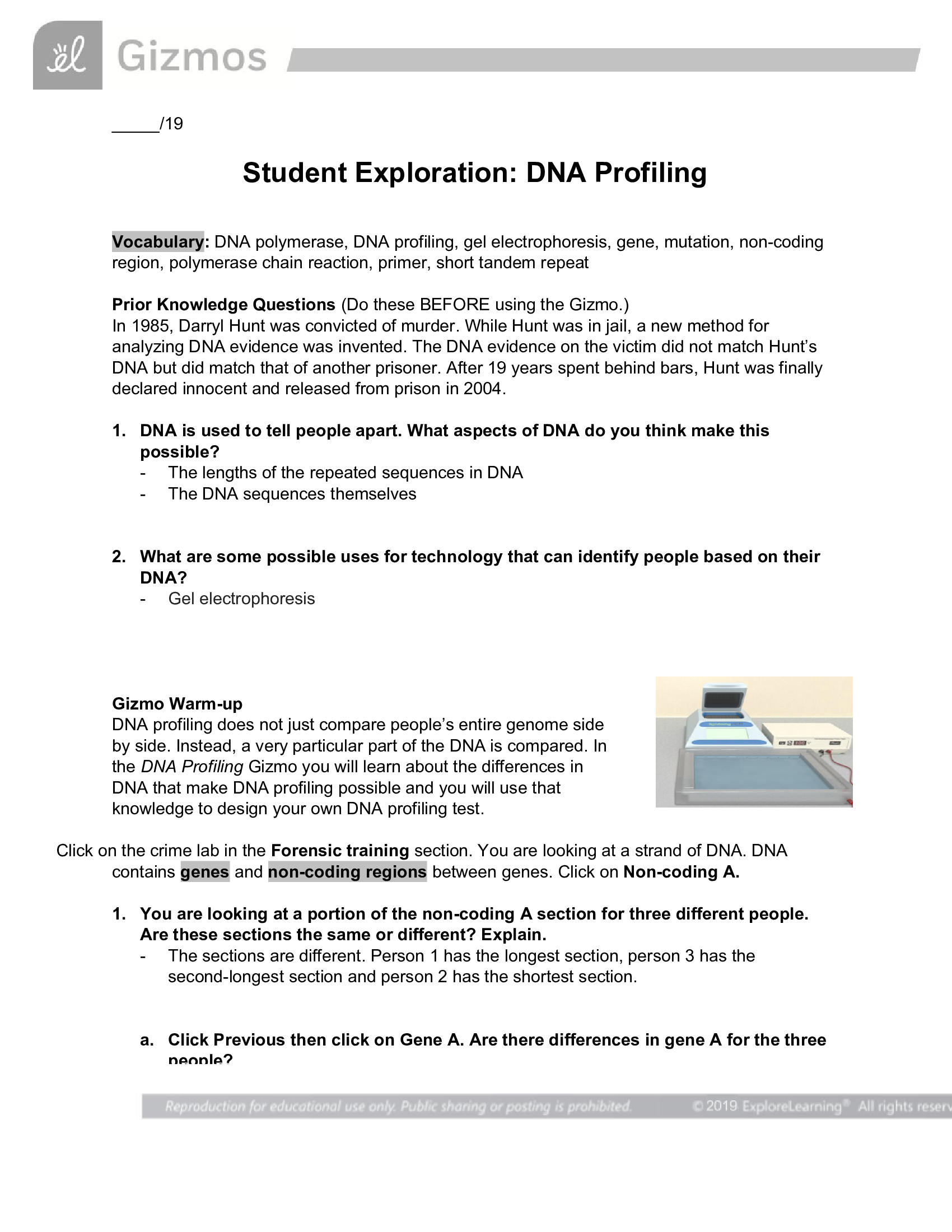
Gizmos - Student Exploration: DNA Profiling Answer key.
View Document

Gizmos - Student Exp...

  • studypal

    studypal

  • solution manual

Find comprehensive answers with the Gizmos Student Exploration: DNA Profiling Answer Key. Perfect fo...

20 USD

0

0

BIOD 152 Module 1 Exam- Portage Learning
View Document

BIOD 152 Module 1 Ex...

  • studypal

    studypal

  • solution manual

BIOD 152 Module 1 Exam- Portage Learning...

20 USD

0

0

Primary Professional Military Education (Enlisted) Block 1 to 7, PPME Block 1-7 TEST BANK
View Document

Primary Professional...

  • studypal

    studypal

  • solution manual

Primary Professional Military Education (Enlisted) Block 1 to 7, PPME Block 1-7 TEST BANK...

20 USD

0

0

Purchase

Download link will be sent to this email immediately after purchase.

IMPORTANT LINKS

  • How To Upload Class Notes
  • Selling Tips
  • Passing Grades's Study Materials
  • Scholarships for International Students 2025

POPULAR CATEGORIES

  • Law
  • Accounting
  • English
  • Psychology
  • Business
  • Nursing
  • Computer Science
  • General

View Document

  • Blog
  • Contact
  • Delivery Policy
  • Latest Scholarships Around the World
  • How to Pass Bar Exams: Passing Grades’ Strategies
  • How to Study and Pass the CPA Exam
  • All Test Banks
  • Faq
  • Copyright Claims
  • Privacy Policy
  • Terms of Use

KNOWLEDGE BASE

  • How to Write A+ Grade Good Research Paper
  • How to Manage Stress During Exam Period
  • Best Time to Study
  • How to Pass NCLEX-RN Exam
  • How To Effectively Utilize Test Banks
  • Popular Shadow Health Exam Assessments
  • Popular HESI Case Studies
  • How to Prepare for a Nursing Career
  • The Importance Of Summaries in Exam Revisvion

© 2026 Pasing Grades. All rights reserved.