
Summary of the dissertation
The study explores the impact online collaborative learning has on middle school students, particularly those taking science literacy and sense community. The primary reason for conducting the inquiry followed the fact that numerous studies have found collaborative learning to impact students’ academic achievement positively. Nevertheless, the advantages of engaging in face to face or online collaborative learning are different basing on the activity and degree of interaction among students. As a result, the study hypothesizes that the difference in the collaborative learning modes brings about questions of how to support student interaction in different learning environments effectively.
For this particular study, the aim was to find mechanisms that will help integrate collaborative learning in traditional and computer-mediated learning environments. Most of the research inquiries conducted in the past had focused on the impact that collaborative learning has on university and college students. This particular study aimed to examine the effects of computer-mediated collaborative learning has o middle school students, particularly those taking sciences and assessing their sense of community (Wendt & Rockinson‐Szapkiw 2014).
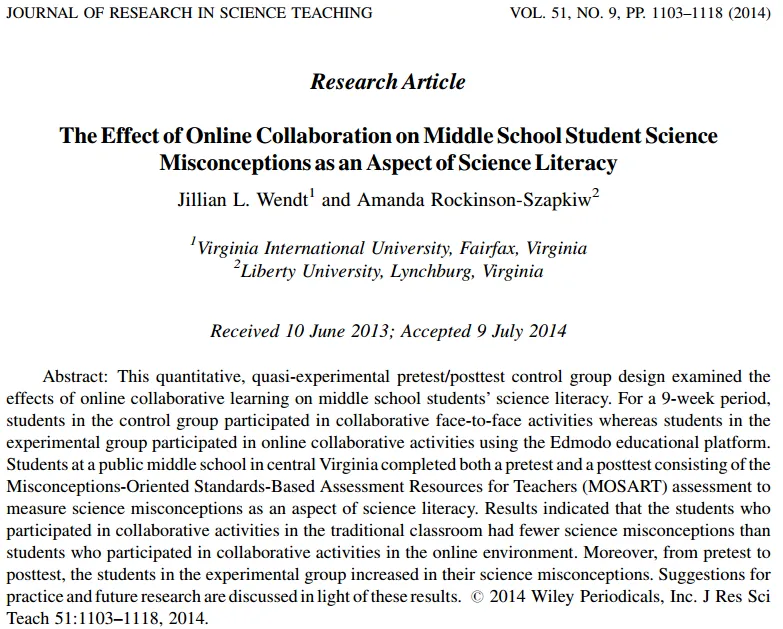
The inquiry was carried out in a rural public school district that is located in south-central Virginia. The research framework was based on three theories: the social development theory, the constructivism theory, and the community practice theory. The independent variable in the study was how traditional face to face or online collaborative learning.
In contrast, the study’s dependent variable was the sense of community that students have and their science literacy (Wendt & Rockinson‐Szapkiw 2014). The concept of science literacy, according to the study, refers to how the students comprehended the important scientific factors and frameworks, how science establishes explanations based on evidence, and the mechanisms that are essential in examining scientific claims while making decisions basing on the knowledge attained. Also, it entails how students deal with scientific misconceptions.
The study’s fundamental hypothesis is that there is a notable variation in misconnects of science among middle school students when they take part in online collaborative learning compared to when they take part in traditional collaborative learning. The control group for this study was students who had prior knowledge of both methods of collaborative learning. The second hypothesis states that there is a statistically notable variation in middle school students’ general sense of community when partaking in collaborative learning compared to when taking part in collaborative learning only.
Another assumption made by the researchers is that there is a difference among students’ level of connectedness when taking part in the two collaborative learning techniques. The study was essential since no single study has examined the effect that face-to-face or online collaborative learning has on science literacy (Wendt & Rockinson‐Szapkiw 2014).
However, it is commonly known that science knowledge is garnered via social constructivist activities that can be achieved through peer to peer collaboration. A quantitative approach was attained through the use of a quasi-experimental pretest and post-test control group design. The participants completed two tests; MOSART physical science evaluation and classroom community scale.
Analysis of the quality of the research conducted
The quantitative research was undertaken appropriately, following all the guidelines and requirements for operating scientific research. A responsible research process calls for correct, reliable methods ad enough control measures or instead variables. It is also essential for researchers to pay keen attention to detail. Furthermore, experiments ought to be correctly set up, and the outcomes of the study accurately recorded, decoded, and published (Efron & Ravid 2019). Drawing from the current inquiry, it is clear that the researchers abided by all the mentioned guidelines and regulations. Before commencing the study, the researchers kicked off by seeking approval from the Institution Review Board (IRB). Seeking IRB approval is mandatory for researching at the high institution level (Efron & Ravid 2019).
It can thus be asserted that the researchers applied professionalism in conducting this particular study. Another strength of this specific study can be drawn from the study approach and methods used. The researcher opted for quantitative research, which is the most suitable approach when the researcher’s interest is to quantify a problem through the generation of numerical data or data whose intention is to be transferred into statistics that is usable.
Through a quantitative research approach, the researcher in this study was able to quantify the defined variables such as attitudes, behavior, opinions, and other observations. The research also used the best tools when conducting surveys among the study participants who included middle school students taking science subjects. This study’s two instruments comprised the Misconceptions-Oriented Standards-Based Assessment Resources for Teachers (MOSART) Physical Science assessment and the Classroom Community Scale.
When validating the study’s findings, the researchers incorporated a control group with knowledge of collaborative learning in both environments; online and traditional classroom, whereby face-to-face interactions were involved (Wendt & Rockinson‐Szapkiw 2014). Apart from the actual testing, the researchers went ahead to incorporate a post-testing for cross-validating the findings (Rahman, 2017).
Therefore, it is correct to assert that the study was conducted appropriately and professionally from the technique employed. A limitation that can be noted from this study is that the participants of this study came from one region. Since the students were from a rural school, the findings might be questionable when one wants to apply the recommendations in a different setting, such as the case of urban schools. Even though there is the assumption that the majority of the students are aware of online learning, still the fact remains that they also need face to face interactions when learning since it has its advantages. Therefore, it could have been more appropriate if the researchers had drawn participants of the study from different regions around the country so that the study’s findings and recommendations can apply to a broader population. In the case that the course is to be conducted in the future, it will be essential to incorporate participants from both urban and rural areas.
Another limitation of this particular study was the lack of randomization. The absence of randomization made the study design week, and thus, its validity can be questioned. When conducting future studies, researchers need to incorporate randomization to avoid the internal threat to validity. The fact that the control group was made of students with prior knowledge can be a limitation for the study because the level of understanding differs. As a result, using such a variable when studying is dangerous as it poses a danger to the study’s internal validity. Future studies should use post-test research and follow up to control the dissertation to avoid internal validity threats.
Personal analysis and practical application discussion
The research was appropriately conducted, making its findings valid and reliable to be used as literature in future studies. Many lessons can be drawn from this particular research. One of the lessons garnered from the study is that there is a significant difference between students taking online collaborative learning and those taking collaborative learning in traditional classroom settings when examining misconceptions in science among students. The dissertation statistically proves that there is a need for interventions that will see the gap between these students have been eliminated. Also, many students have deferring notions of what the community entails. Moreover, it can be deduced from the study that the level of connection between students differs from the type of learning environment. The degree of association among students is an essential subject that should be examined in education to enhance schools’ academic achievement levels. Through this research, I realized that there is limited literature when it comes to studies that have examined the effectiveness of collaborative learning in different contexts.
However, it was clear from the dissertation that numerous studies have explored varied aspects of collaborative learning. A significant number of studies that have examined collaborative learning have concluded that collaborative learning is a useful method that can be employed to enhance academic success. Also, collaborative learning helps students to be connected and thus interact better both in academics and other facets (Wendt & Rockinson‐Szapkiw 2014).
Furthermore, the researcher used effective research designs, which will be crucial while carrying out my research. Through the systematic process in collecting data and analysis, I have learned a lot, and I believe that the knowledge garnered will play a crucial role when conducting my research. The study shows the significance of using a quantitative approach is evident through data computation and interpretation.
The study is relevant in education since it has a significant contribution to different sectors within education. First, this study’s research and findings will form a literature basis for future studies to drawn knowledge when examining other aspects of collaborative learning. Students and teachers can also benefit from reading this particular study. The dissertation provides an in-depth understanding of varied factors affecting the acquisition of scientific knowledge and processes.
Educational research has always faced a shortage of literature in science literacy, especially valid and reliable findings that can be translated into practice. The study will also enhance students’ understanding of science based on the fact that it has been proved that science students can learn better and more efficiently through collaboration rather than through individualism (Wendt & Rockinson‐Szapkiw 2014).
There have also been concerns in education that there is a lack of science literacy among many middle and high school students. Therefore, this study is vital in education since it builds upon the available knowledge relating to science literacy (Wendt & Rockinson‐Szapkiw 2014). Therefore, students who will read the study can better understand science literacy from this study. Moreover, teachers can use this study and its findings as a resource or preferably material for teaching. The ministry of education and its departments can also draw knowledge from the recommendations provided in this research to enhance teaching methods. Therefore, it can be concluded that this study is generally imperative in improving different sectors in education and contributing to students’ academic success.
References
Efron, S. E., & Ravid, R. (2019). Action research in education: A practical guide. Guilford Publications.
Rahman, M. S. (2017). The Advantages and Disadvantages of Using Qualitative and Quantitative Approaches and Methods in Language” Testing and Assessment” Research: A Literature Review. Journal of Education and Learning, 6(1), 102-112.
Wendt, J. L., & Rockinson‐Szapkiw, A. (2014). The effect of online collaboration on middle school student science misconceptions as an aspect of science literacy. Journal of Research in Science Teaching, 51(9), 1103-1118.
0
1344