
Radiator Technology and Its Critical Role in Automotive Engine Thermal Control
Thermal regulation is one of the most important engineering challenges in modern automotive design. Internal combustion engines operate through a sequence of controlled combustion events that release large quantities of heat along with useful mechanical energy. While a portion of this thermal energy contributes to engine efficiency, a significant amount must be removed in order to maintain stable operating conditions. Without effective heat dissipation, excessive temperatures can reduce lubrication performance, weaken metal structures, and ultimately compromise engine durability. Within the vehicle’s cooling architecture, car radiators serve as the central heat exchange component responsible for transferring thermal energy from engine coolant to the surrounding air.
Advances in automotive powertrain engineering have increased the demands placed on cooling systems. Modern engines often produce significantly higher power output from smaller displacement volumes through technologies such as forced induction, optimized combustion chamber geometry, and high-pressure fuel injection systems. These developments increase the thermal density within the engine, requiring cooling systems to operate with greater efficiency than ever before. As a result, radiator design has evolved into a highly optimized engineering discipline that balances thermodynamics, airflow dynamics, and material science.
The Structure of Modern Automotive Cooling Systems
Automotive cooling systems are designed to remove excess heat generated during combustion and mechanical friction. The process begins as coolant circulates through passages within the engine block and cylinder head. As the coolant moves through these channels, it absorbs heat from surrounding metal surfaces and transports that thermal energy away from critical components.
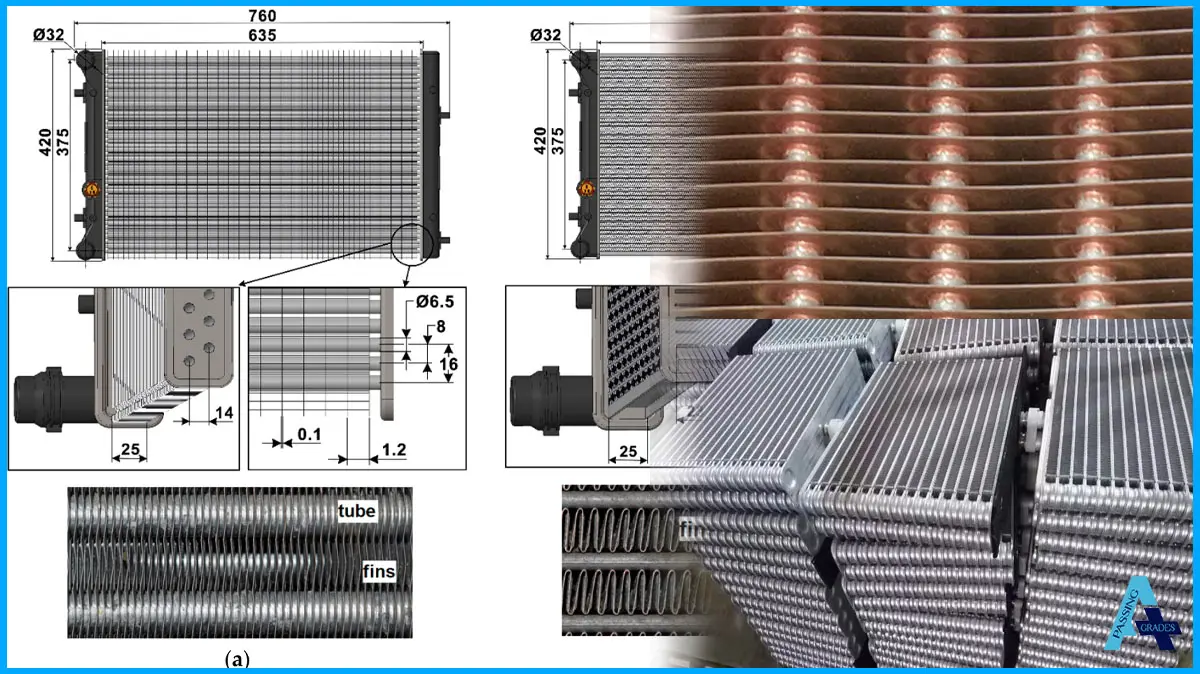
Once heated, the coolant exits the engine and travels toward the radiator assembly. Inside the radiator, the coolant flows through a network of thin tubes arranged across the radiator core. Attached to these tubes are numerous metal fins that significantly increase the surface area available for heat transfer.
Air moving through the radiator removes heat from the fins through convective heat transfer. This airflow is generated naturally as the vehicle moves forward, while electric cooling fans provide additional airflow when the vehicle is stationary or traveling at low speeds. After heat is removed from the coolant, the cooled fluid returns to the engine to repeat the process.
Thermodynamic Processes Governing Radiator Efficiency
The operation of a radiator is governed by several thermodynamic principles that dictate how heat moves between different materials and environments. Heat first transfers from the hot coolant to the radiator tube walls through conduction. Because radiator tubes are typically constructed from highly conductive metals, this heat moves quickly into the surrounding structure.
Once heat reaches the radiator fins, it spreads across the extended metal surfaces. These fins dramatically increase the surface area exposed to airflow, allowing a larger portion of heat to dissipate into the surrounding air. As air passes across the fins, convection removes heat from the radiator assembly.
The efficiency of this process depends on both airflow velocity and surface area. Higher airflow speeds allow more heat to be carried away from the radiator core. This is why vehicle speed often improves cooling performance during high-speed driving conditions.
Cooling System Demands in High Performance Vehicles
Performance vehicles typically operate under conditions that generate substantially greater heat than standard passenger vehicles. High compression ratios, aggressive ignition timing, and elevated engine speeds all contribute to increased thermal output. When engines operate near their performance limits, maintaining thermal stability becomes a critical engineering requirement.
Turbocharged engines introduce additional thermal challenges. Compressing intake air increases combustion pressure and temperature, which leads to higher thermal loads within the engine. If cooling capacity is insufficient, these elevated temperatures can lead to detonation, reduced engine efficiency, or accelerated component wear.
To address these challenges, performance vehicles often incorporate upgraded cooling components that increase heat dissipation capacity. Larger radiator cores, optimized airflow ducting, and enhanced coolant flow characteristics allow the cooling system to manage higher thermal loads. In these configurations, the effectiveness of the car radiator becomes a decisive factor in maintaining reliable engine operation.
Engineering Design Factors That Affect Radiator Performance
Radiator performance is influenced by a combination of structural design elements and airflow characteristics. Core thickness, tube configuration, and fin density all affect how efficiently heat moves from coolant into the surrounding air. Increasing the number of rows within the radiator core can increase heat exchange capacity, although this must be balanced with airflow considerations.
Airflow management plays a particularly important role in radiator efficiency. If incoming air bypasses the radiator instead of passing through it, the cooling system cannot operate effectively. Engineers therefore design fan shrouds and ducting structures that direct airflow through the radiator core as efficiently as possible.
Coolant flow distribution is another critical factor. Uniform flow ensures that all regions of the radiator participate in heat exchange. Proper internal channel design prevents areas of stagnant coolant that could otherwise reduce cooling efficiency.
Thermal Management as a Foundation of Engine Reliability
Stable engine temperatures are essential for maintaining long-term mechanical reliability. Excessive heat can degrade lubricating oils, increase thermal expansion within engine components, and accelerate fatigue in metal structures. Effective cooling systems therefore play a key role in protecting engines from thermal stress during demanding driving conditions.
Through continuous heat exchange and controlled coolant circulation, an automotive radiator ensures that engines operate within their intended temperature range. As automotive technology continues to advance and engines produce higher power densities, radiator engineering will remain a central element in achieving reliable and efficient vehicle performance.
0
15