
Pasing Grades
  • Start Selling
  • Blog
  • Contact
  • 0

    Your cart is empty!

English

  • English
  • Spanish
  • Arabic
Create Account Sign In
  • Library
    • New Prep Guides
    • Featured Prep Guides
    • Free Exam Prep Guides
    • Best sellers
  • General
  • Nursing
    • Research Paper
    • Case Study
    • Discussion Post
    • Assignment
    • Exam
    • Practice Questions and Answers
    • Test Bank
    • solutions manual
  • Accounting
    • Case Study
    • Thesis
    • Study Guide
    • Summary
    • Research Paper
    • test bank
  • English
    • Creative Writing
    • Research Paper
    • Summary
    • Rhetorics
    • Literature
    • Journal
    • Exam
    • Grammar
    • Discussion Post
    • Essay
  • Psychology
    • Hesi
    • Presentation
    • Essay
    • Summary
    • Study Guide
    • Essay
    • Solution Manual
    • Final Exam Review
    • Class Notes
    • test bank
  • Business
    • Lecture Notes
    • Solution Manual
    • Presentation
    • Business Plan
    • Class Notes
    • Experiment
    • Summary
    • Practice Questions
    • Study Guide
    • Case Study
    • test bank
    • Exam
  • More
    • Computer Science
    • Economics
    • Statistics
    • Engineering
    • Biology
    • Religious Studies
    • Physics
    • Chemistry
    • Mathematics
    • History
    • Sociology
    • Science
    • Philosophy
    • Law
  • Pages
    • About Us
    • Selling Tips
    • Delivery Policy
    • Faq
    • Privacy Policy
  • Flash Sale
  • Home
  • Test Bank for Biological Psychology, 13th Edition, James W. Kalat

Test Bank for Biological Psychology, 13th Edition, James W. Kalat

Preview page 1 Preview page 2 Preview page 3
Add To Favorites

Share this item Share this item

  • Item Details
  • Comments (0)
  • Reviews (1)
  • Contact Seller

Biological Psychology (13th Edition) – James W. Kalat – Test Bank Chapters 1–2 – Full Question Set with Answers

This document contains a comprehensive set of test bank questions for Chapters 1 and 2 of Biological Psychology (13th edition) by James W. Kalat. It includes true/false, multiple choice, and short answer questions with correct answers clearly indicated. Topics covered range from neuron structure and function, resting potential, and action potentials to synaptic transmission, summation, and neurotransmitter functions. Ideal for students preparing for exams or instructors designing assessments.

Sample Biological Psychology Kalat Questions and Answers

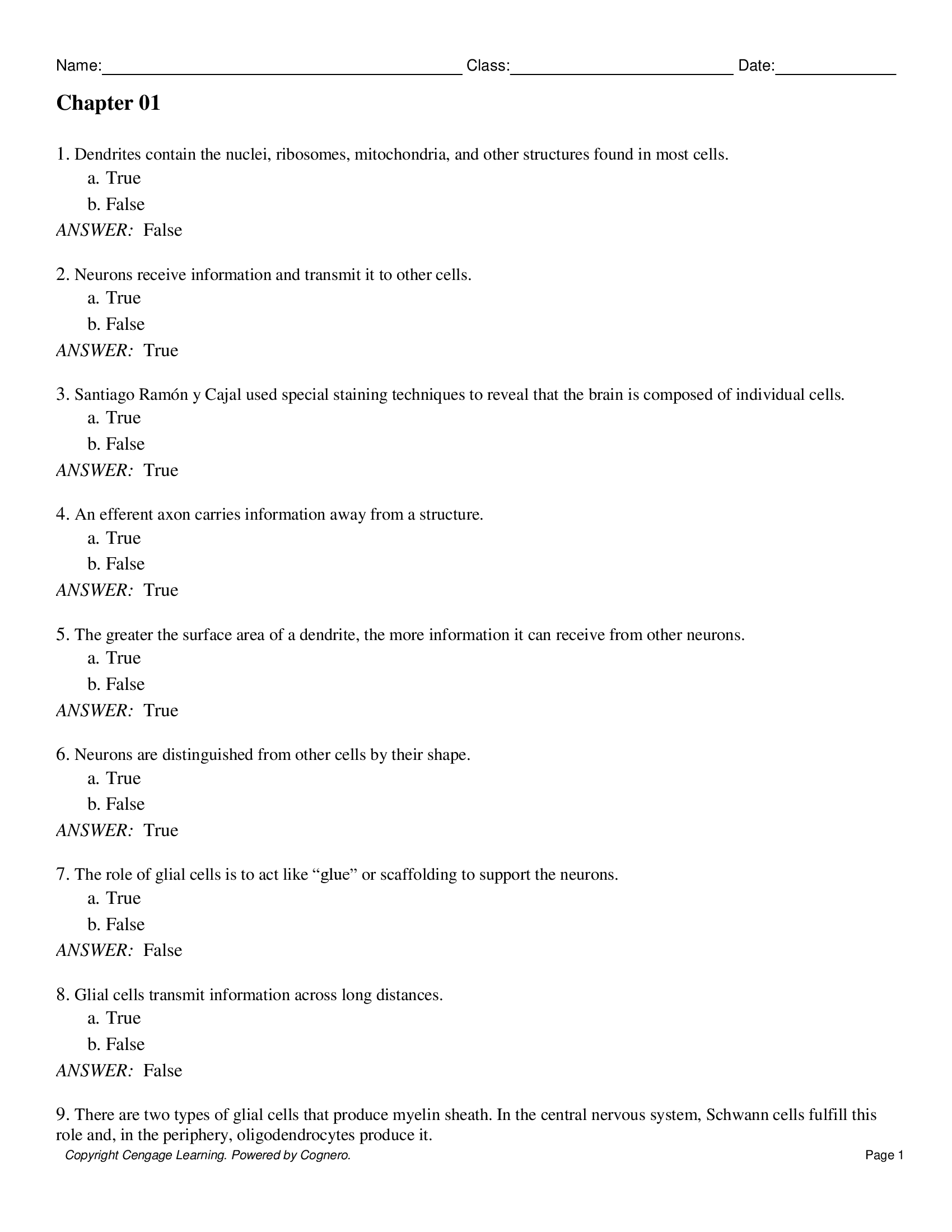
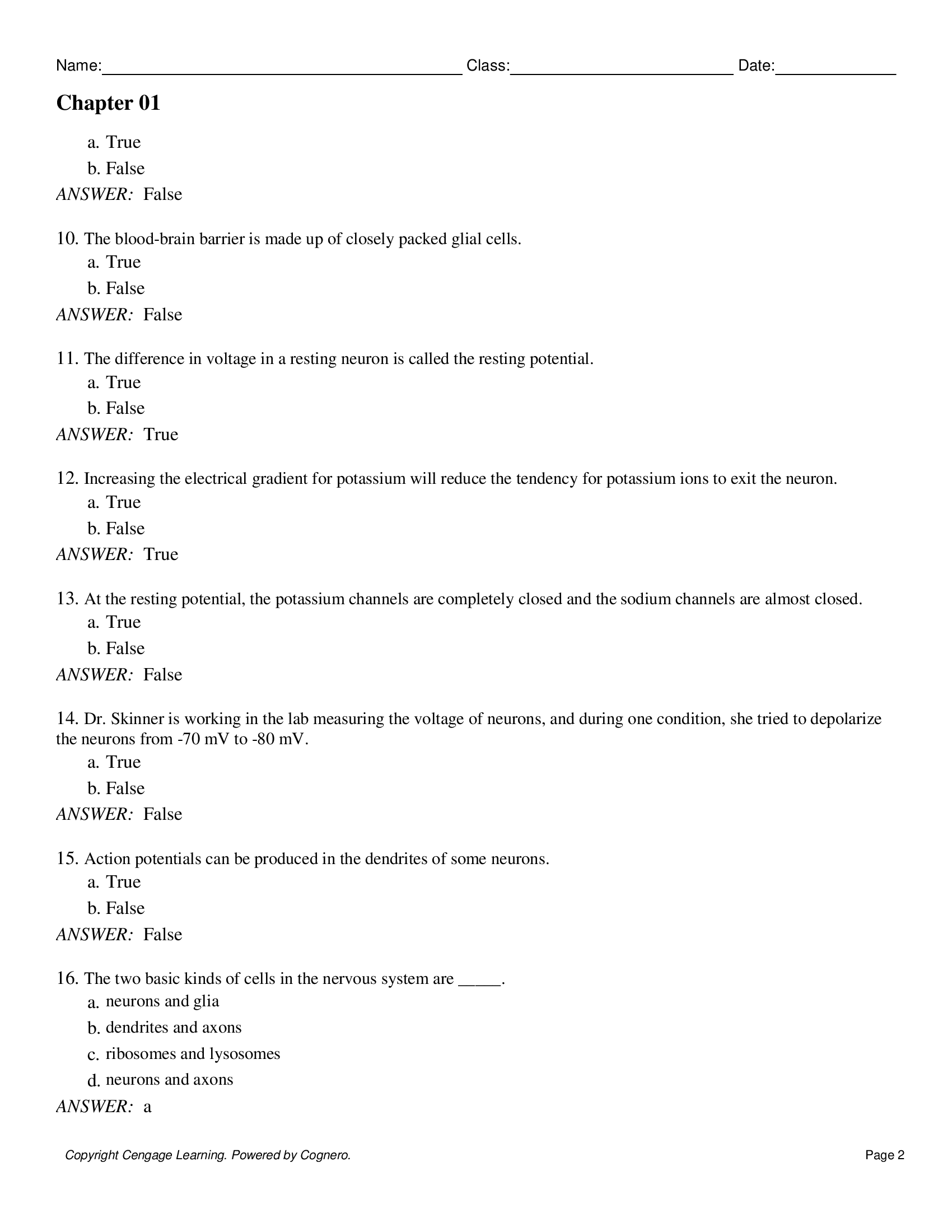
1. Dendrites contain the nuclei, ribosomes, mitochondria, and other structures found in most cells.

                a.            True

                b.            False

ANSWER:             False

2. Neurons receive information and transmit it to other cells.

                a.            True

                b.            False

ANSWER:             True

3. Santiago Ramón y Cajal used special staining techniques to reveal that the brain is composed of individual cells.

                a.            True

                b.            False

ANSWER:             True

4. An efferent axon carries information away from a structure.

                a.            True

                b.            False

ANSWER:             True

5. The greater the surface area of a dendrite, the more information it can receive from other neurons.

                a.            True

                b.            False

ANSWER:             True

6. Neurons are distinguished from other cells by their shape.

                a.            True

                b.            False


ANSWER:             True

7. The role of glial cells is to act like “glue” or scaffolding to support the neurons.

                a.            True

                b.            False


ANSWER:             False

8. Glial cells transmit information across long distances.

                a.            True

                b.            False


ANSWER:             False


9. There are two types of glial cells that produce myelin sheath. In the central nervous system, Schwann cells fulfill this role and, in the periphery, oligodendrocytes produce it.

                a.            True

                b.            False


ANSWER:             False

10. The blood-brain barrier is made up of closely packed glial cells.

                a.            True

                b.            False


ANSWER:             False

11. The difference in voltage in a resting neuron is called the resting potential.

                a.            True

                b.            False


ANSWER:             True

12. Increasing the electrical gradient for potassium will reduce the tendency for potassium ions to exit the neuron.

                a.            True

                b.            False


ANSWER:             True

13. At the resting potential, the potassium channels are completely closed and the sodium channels are almost closed.

                a.            True

                b.            False


ANSWER:             False

14. Dr. Skinner is working in the lab measuring the voltage of neurons, and during one condition, she tried to depolarize the neurons from -70 mV to -80 mV.

                a.            True

                b.            False


ANSWER:             False


15. Action potentials can be produced in the dendrites of some neurons.

                a.            True

                b.            False


ANSWER:             False

16. The two basic kinds of cells in the nervous system are _____.

                a.            neurons and glia

                b.            dendrites and axons

                c.             ribosomes and lysosomes

                d.            neurons and axons


ANSWER:             a

17. Santiago Ramon y Cajal demonstrated that ____.

                a.            at rest, the neuron has a negative charge inside its membrane

                b.            neurons are separate from one another

                c.             neurons communicate at specialized junctions called synapses

                d.            action potentials follow the all-or-none law


ANSWER:             b

18. Both ____ and ____ shared the Nobel Prize for Physiology or Medicine in 1906.

                a.            Golgi and Cajal

                b.            Cajal and Sherrington

                c.             Sherrington and Golgi

                d.            Cajal and Kalat


ANSWER:             a

19. Dr. Kimi studies the plasma membrane of neurons. He specifically researches the specialized _____ that allow in important things like water, oxygen, sodium, and so on.

                a.            lipid channels

                b.            protein channels

                c.             lipid receptors

                d.            protein receptors


ANSWER:             b

20. Neurons differ most strongly from other body cells in their ____.

                a.            temperature

                b.            shape

                c.             osmotic pressure

                d.            mitochondria


ANSWER:             b

21. What do neurons have that other cells do not?

                a.            A plasma membrane

                b.            Large, branching extensions

                c.             Protein channels

                d.            An endoplasmic reticulum


ANSWER:             b

22. Dr. McLaughlin’s lab studies how newly formed proteins are folded inside neurons. They would be most interested in studying the _____.

                a.            endoplasmic reticulum

                b.            mitochondria

                c.             ribosomes

                d.            nucleus


ANSWER:             c

23. Water, oxygen, and ____ freely flow across a cell membrane.

                a.            calcium

                b.            positively charged ions

                c.             magnesium

                d.            carbon dioxide


ANSWER:             d

24. The structure that contains a cell’s chromosomes is called the ____.

                a.            endoplasmic reticulum

                b.            nucleus

                c.             mitochondrion

                d.            ribosome

ANSWER:             b

25. Small, charged molecules can cross the cell membrane through ____.

                a.            diffusion

                b.            ribosomes

                c.             mitochondria

                d.            protein channels


ANSWER:             d

26. Professor Lopez studies the specialized _________ in the eye that detect light.

                a.            motor neurons

                b.            sensory neurons

                c.             glial cells

                d.            interneurons


ANSWER:             b

27. Ribosomes are the part of a cell that ____.

                a.            performs metabolic activities

                b.            breaks down harmful chemicals

                c.             transports proteins

                d.            synthesizes new proteins


ANSWER:             d

28. The endoplasmic reticulum is a ____.

                a.            network of thin tubes that transport newly synthesized proteins

                b.            site where the cell synthesizes new protein molecules

                c.             structure that separates the inside of the cell from the outside

                d.            structure that contains the chromosomes


ANSWER:             a

29. Dendrites ____.

                a.            contain the nucleus, ribosomes, and other structures found in most cells

                b.            are branching fibers that get narrower near their ends

                c.             are thin fibers of constant diameter

                d.            are an insulating material that cover an axon


ANSWER:             b

30. The branching fibers that form the information-receiving pole of the nerve cells are called _____.

                a.            motor neurons

                b.            dendrites

                c.             sensory neurons

                d.            axons


ANSWER:             b

31. Professor Xi studies the _____ located on the _____ of neurons in order to better understand how messages are received by the neuron.

                a.            synaptic receptors; dendrites

                b.            axons; somas

                c.             synaptic hillocks; dendrites

                d.            synaptic receptors; somas


ANSWER:             a

32. The tree-like branches of a neuron that receive information from other neurons are called _____.

                a.            axons

                b.            dendrites

                c.             soma

                d.            myelin


ANSWER:             b

33. Many dendrites contain short outgrowths called spines that _____.

                a.            increase the surface area available for synapses

                b.            increase the speed of transmission

                c.             eliminate cell waste products

                d.            increase the symmetry of the soma


ANSWER:             a

34. As compared to dendrites, axons usually ____.

                a.            form the information-receiving pole of the neuron

                b.            are shorter in length

                c.             are covered with myelin

                d.            taper in diameter toward their periphery


ANSWER:             c

35. The insulating material that covers many vertebrate axons is called the ____.

                a.            dendrite

                b.            myelin sheath

                c.             cell body or soma

                d.            presynaptic terminal


ANSWER:             b

36. Jasmine is in her physiology lab practicing labeling a neuron. When she gets to the nodes of Ranvier, she will be labeling ______.

                a.            the spiny outgrowths on dendrites

                b.            the myelin sheath

                c.             the swelling at the end of the axon

                d.            the gaps in the myelin sheath along the axon

ANSWER:             d

37. Gaps in the insulating material that surrounds axons are known as ____.

                a.            interpeduncular nuclei

                b.            nodes of Ranvier

                c.             myelin synapses

                d.            presynaptic terminals


ANSWER:             b

38. A presynaptic terminal is also known as ____.

                a.            an end bulb

                b.            a node of Ranvier

                c.             myelin

                d.            a spine


ANSWER:             a

39. An axon has many branches, each of which swells at its tip. These are known as ____.

                a.            presynaptic terminals

                b.            efferent axons

                c.             afferent axons

                d.            intrinsic neurons


ANSWER:             a

40. Professor Case studies how drugs of abuse change the amount of chemical that neurons release from the presynaptic terminal into the ______.

                a.            dendritic terminal

                b.            junction between neurons

                c.             afferent space

                d.            nucleus


ANSWER:             b

41. Neurons typically have one ____, but many ____.

                a.            dendrite; axons

                b.            axon; dendrites

                c.             cell body; axons

                d.            dendrite; cell bodies


ANSWER:             b

42. As a general rule, axons convey information ____.

                a.            toward dendrites of their own cell

                b.            toward their own cell body

                c.             away from their own cell body

                d.            to surrounding glia


ANSWER:             c

43. If you were to accidentally touch a hot stove with your hand, you would quickly pull your hand away. The information carried to the muscles in your arm to make them contract was carried by ____.

                a.            efferent neurons

                b.            afferent neurons

                c.             intrinsic neurons

                d.            sensory neurons


ANSWER:             a

44. If all of a neuron’s dendrites or axons were contained within the spinal cord, it would be considered a(n) ____ neuron.

                a.            efferent

                b.            afferent

                c.             intrinsic

                d.            Purkinje


ANSWER:             c

45. What type of neuron in the pons receives information only from other cells in the pons and sends information only to other cells in the pons?

                a.            Afferent

                b.            Efferent

                c.             Intrinsic

                d.            Inter-synaptic


ANSWER:             c

46. Professor Peach is lecturing in her class about glial cells. She will tell her class that glial cells ______.

                a.            are less common than neurons in the human nervous system.

                b.            are responsible for transmitting information within the peripheral nervous system.

                c.             are the “glue” that holds all of the neurons together in the brain.

                d.            are not as well studied as neurons but have been shown to perform many important functions in the nervous system.


ANSWER:             d

47. What type of glia helps to synchronize the activity of axons?

                a.            Oligodendrocytes

                b.            Astrocytes

                c.             Radial glia

                d.            Schwann cells


ANSWER:             b

48. Which type of glia remove waste material in the nervous system?

                a.            Astrocytes

                b.            Schwann cells

                c.             Oligodendrocytes

                d.            Radial glia


ANSWER:             a

49. What type of glial cells myelinate axons in the brain and spinal cord?

                a.            oligodendrocytes

                b.            Schwann cells

                c.             radial glia

                d.            astrocytes


ANSWER:             a

50. Which type of glia release chemicals that modify the activity of neighboring neurons?

                a.            Astrocytes

                b.            Schwann cells

                c.             Oligodendrocytes

                d.            Radial glia

ANSWER:             a

51. Which type of glia builds myelin sheaths around axons in the periphery of the body?

                a.            Astrocytes

                b.            Schwann cells

                c.             Oligodendrocytes

                d.            Radial glia

ANSWER:             b

52. ____ in the brain and spinal cord and ____ in the periphery are specialized types of glia that build the myelin sheaths that surround neurons.

                a.            Oligodendrocytes; Schwann cells

                b.            Schwann cells; oligodendrocytes

                c.             Microglia; oligodendrocytes

                d.            Radial glia; Schwann cells


ANSWER:             a

53. Dr. Pautz studies the immune system and has recently become interested in the glial cells that function similar to other cells in the immune system. What cells has Dr. Pautz started exploring?

                a.            Schwann cells

                b.            Microglia

                c.             Astrocytes

                d.            Radial glia


ANSWER:             b

54. Radial glia ____.

                a.            guide the migration of neurons during embryonic development

                b.            synchronize the activity of axons

                c.             wrap around the presynaptic terminals of several axons

                d.            build the myelin sheaths that surround and insulate certain axons


ANSWER:             a

55. What mechanism prevents or slows some chemicals from entering the brain, while allowing others to enter?

                a.            A threshold

                b.            A blood-brain barrier

                c.             An endoplasmic wall

                d.            A differential-drug inhibitor

ANSWER:             b

56. Andrew was exposed to the chicken pox virus as a child. What happened to that virus after it crossed the blood-brain barrier and entered Andrew’s brain?

                a.            Andrew’s natural killer cells were able to quickly destroy it.

                b.            The glia in his brain engulfed the virus and then natural killer cells destroyed them both.

                c.             Nothing happened since the chicken pox virus cannot cross the blood-brain barrier.

                d.            Nothing happened at first, but the virus remained there and caused negative effects for Andrew as he got older.

ANSWER:             d

57. Molecules that can cross the blood-brain barrier are usually ____.

                a.            large, uncharged molecules, such as lactose

                b.            large, charged molecules

                c.             neurotransmitters, such as dopamine

                d.            molecules that can dissolve in the fats of the capillary walls

ANSWER:             d

  • joeycham

    joeycham

    03 March 2022 13:42:41
    Presentation

    well presented

Contact the Seller

Please Sign In to contact this seller.


  • 👎  Report Copyright Violation

Frequently Asked Questions

What Do I Get When I Buy This Study Material?

+

When you buy a study material on Passing Grades, an instant download link will be sent directly to your email, giving you access to the file anytime after payment is completed.

Is Passing Grades a Trusted Platform?

+

Yes, Passing Grades is a reputable students’ marketplace with a secure payment system and reliable customer support. You can trust us to ensure a safe and seamless transaction experience.

Will I Be Stuck with a Subscription?

+

No, all purchases on Passing Grades are one-time transactions. You only pay for the notes you choose to buy, with no subscriptions or hidden fees attached.

Who Am I Buying These Study Materials From?

+

Passing Grades is a marketplace, which means you are purchasing the document from an individual vendor, not directly from us. We facilitate the payment and delivery process between you and the vendor.

Does Passing Grades Offer Free Study Materials?

+

Yes, sellers on Passing Grades have uploaded numerous free test banks, exams, practice questions, and class notes that can be downloaded at no cost.

Pasinggrades - Quality Study Materials

USD 15

    • Quality checked by Pasing Grades
    • 100% satisfaction guarantee
    • Seller: mentor2000
Buy PDF $15

Seller Information

mentor2000

Member since April 2021

  • icon
  • icon
View Profile
  • total sales

    2
  • Favourites

    0
  • Comments

    0
    ( 1 Ratings )

Item Information

  • Uploaded

    28 May 2022

  • Updated

    17 October 2025

  • Category

    Nursing

  • Item Type

    test bank

  • Tags

    Test Bank for Biological Psychology neurons action potential resting potential glial cells synapse neurotransmitters reflex arc spatial summation temporal summation dopamine L DOPA blood brain barrier sodium potassium pump myelin sheath inhibitory synapse excitatory postsynaptic potential IPSP EPSP

Related Exam Prep Guides by mentor2000

Test Bank for Essentials for Nursing Practice 8th Edition by Potter | All Chapters
View Document

Test Bank for Essent...

  • mentor2000

    mentor2000

  • test bank

Master nursing concepts with this study material; Test Bank for Essentials for Nursing Practice, 8th...

15 USD

0

2

A &P 1 MA278 BSC2 Final Module II Questions & Answers 2026 Update
View Document

A &P 1 MA278 BSC2 Fi...

  • mentor2000

    mentor2000

  • test bank

Prepare for success with A&P 1 MA278 BSC2 Final Module II 2024 Q&A. Boost your grades with this comp...

15 USD

0

2

ATI Comprehensive Predictor Exam 2026
View Document

ATI Comprehensive Pr...

  • mentor2000

    mentor2000

  • test bank

Prepare for success with the ATI Comprehensive Predictor Exam 2026. Access key practice questions to...

15 USD

0

2

Purchase

Download link will be sent to this email immediately after purchase.

IMPORTANT LINKS

  • How To Upload Class Notes
  • Selling Tips
  • Passing Grades's Study Materials
  • Scholarships for International Students 2025

POPULAR CATEGORIES

  • Law
  • Accounting
  • English
  • Psychology
  • Business
  • Nursing
  • Computer Science
  • General

View Document

  • Blog
  • Contact
  • Delivery Policy
  • Latest Scholarships Around the World
  • How to Pass Bar Exams: Passing Grades’ Strategies
  • How to Study and Pass the CPA Exam
  • All Test Banks
  • Faq
  • Copyright Claims
  • Privacy Policy
  • Terms of Use

KNOWLEDGE BASE

  • How to Write A+ Grade Good Research Paper
  • How to Manage Stress During Exam Period
  • Best Time to Study
  • How to Pass NCLEX-RN Exam
  • How To Effectively Utilize Test Banks
  • Popular Shadow Health Exam Assessments
  • Popular HESI Case Studies
  • How to Prepare for a Nursing Career
  • The Importance Of Summaries in Exam Revisvion

© 2026 Pasing Grades. All rights reserved.