Pasing Grades
  • Start Selling
  • Blog
  • Contact
  • 0

    Your cart is empty!

English

  • English
  • Spanish
  • Arabic
Create Account Sign In
  • Library
    • New Prep Guides
    • Featured Prep Guides
    • Free Exam Prep Guides
    • Best sellers
  • General
  • Nursing
    • Research Paper
    • Case Study
    • Discussion Post
    • Assignment
    • Exam
    • Practice Questions and Answers
    • Test Bank
    • solutions manual
  • Accounting
    • Case Study
    • Thesis
    • Study Guide
    • Summary
    • Research Paper
    • test bank
  • English
    • Creative Writing
    • Research Paper
    • Summary
    • Rhetorics
    • Literature
    • Journal
    • Exam
    • Grammar
    • Discussion Post
    • Essay
  • Psychology
    • Hesi
    • Presentation
    • Essay
    • Summary
    • Study Guide
    • Essay
    • Solution Manual
    • Final Exam Review
    • Class Notes
    • test bank
  • Business
    • Lecture Notes
    • Solution Manual
    • Presentation
    • Business Plan
    • Class Notes
    • Experiment
    • Summary
    • Practice Questions
    • Study Guide
    • Case Study
    • test bank
    • Exam
  • More
    • Computer Science
    • Economics
    • Statistics
    • Engineering
    • Biology
    • Religious Studies
    • Physics
    • Chemistry
    • Mathematics
    • History
    • Sociology
    • Science
    • Philosophy
    • Law
  • Pages
    • About Us
    • Selling Tips
    • Delivery Policy
    • Faq
    • Privacy Policy
  • Flash Sale
  • Home
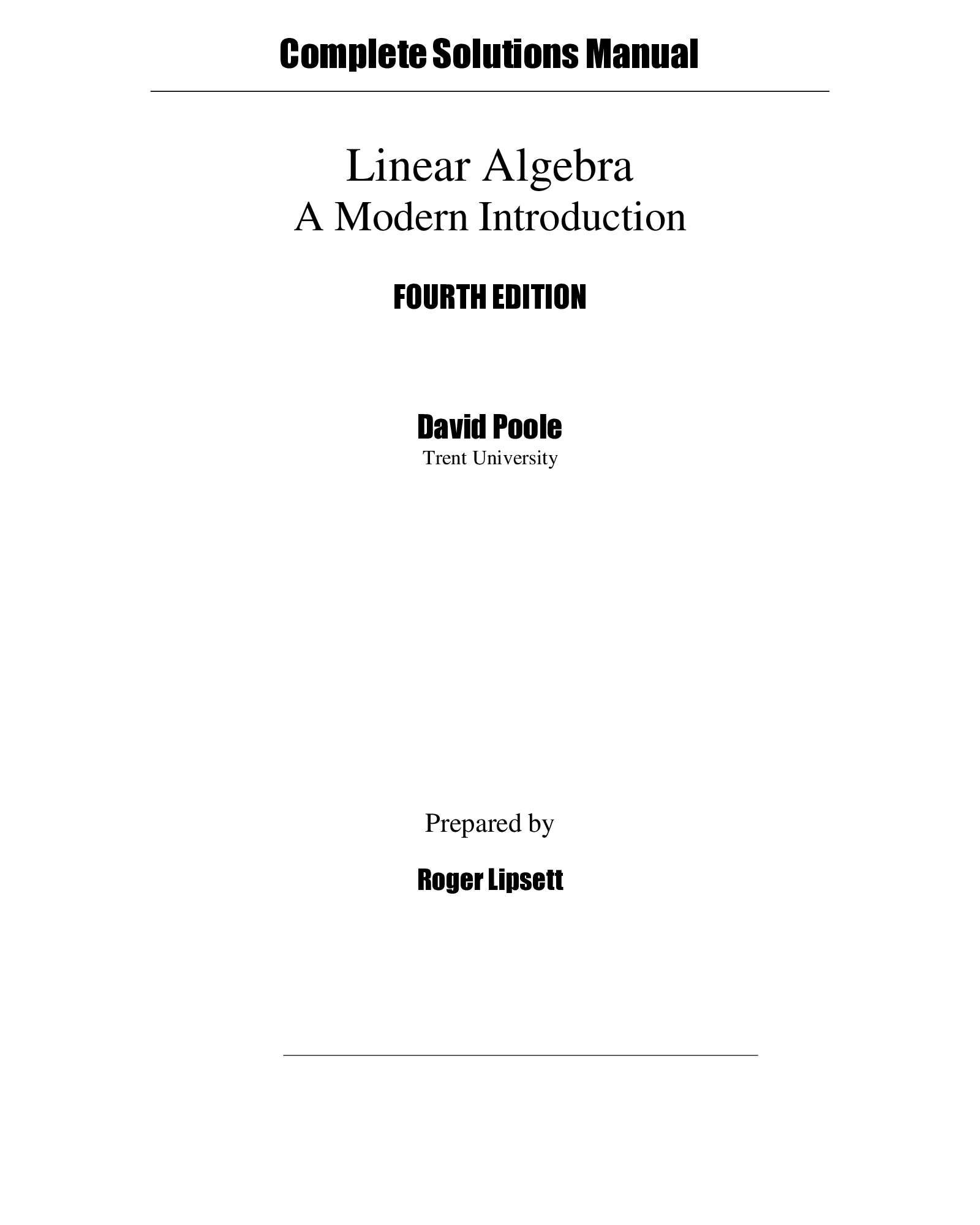
  • Linear Algebra A Modern Introduction 4th Edition David Poole Solutions Manual

Linear Algebra A Modern Introduction 4th Edition David Poole Solutions Manual

Preview page 1 Preview page 2 Preview page 3
Add To Favorites

Share this item Share this item

  • Item Details
  • Comments (0)
  • Reviews (0)
  • Contact Seller
LINEAR ALGEBRA A MODERN INTRODUCTION 4TH EDITION DAVID POOLE SOLUTIONS MANUAL Complete Solutions Manual Linear Algebra A Modern Introduction FOURTH EDITION David Poole Trent University Prepared by Roger Lipsett Contents 1 Vectors 3 1.1 The Geometry and Algebra of Vectors . . . . . . . . . . . . . . . . . . . . . . . . . . . . . . . 3 1.2 Length and Angle: The Dot Product . . . . . . . . . . . . . . . . . . . . . . . . . . . . . . . . 10 Exploration: Vectors and Geometry . . . . . . . . . . . . . . . . . . . . . . . . . . . . . . . . . . . 25 1.3 Lines and Planes . . . . . . . . . . . . . . . . . . . . . . . . . . . . . . . . . . . . . . . . . . . 27 Exploration: The Cross Product . . . . . . . . . . . . . . . . . . . . . . . . . . . . . . . . . . . . . 41 1.4 Applications . . . . . . . . . . . . . . . . . . . . . . . . . . . . . . . . . . . . . . . . . . . . . . 44 Chapter Review . . . . . . . . . . . . . . . . . . . . . . . . . . . . . . . . . . . . . . . . . . . . . . . 48 2 Systems of Linear Equations 1 53 2.1 Introduction to Systems of Linear Equations . . . . . . . . . . . . . . . . . . . . . . . . . . . 53 2.2 Direct Methods for Solving Linear Systems . . . . . . . . . . . . . . . . . . . . . . . . . . . . 58 Exploration: Lies My Computer Told Me . . . . . . . . . . . . . . . . . . . . . . . . . . . . . . . . 75 Exploration: Partial Pivoting . . . . . . . . . . . . . . . . . . . . . . . . . . . . . . . . . . . . . . . 75 Exploration: An Introduction to the Analysis of Algorithms . . . . . . . . . . . . . . . . . . . . . . 77 2.3 Spanning Sets and Linear Independence . . . . . . . . . . . . . . . . . . . . . . . . . . . . . . 79 2.4 Applications . . . . . . . . . . . . . . . . . . . . . . . . . . . . . . . . . . . . . . . . . . . . . . 93 2.5 Iterative Methods for Solving Linear Systems . . . . . . . . . . . . . . . . . . . . . . . . . . . 112 Chapter Review . . . . . . . . . . . . . . . . . . . . . . . . . . . . . . . . . . . . . . . . . . . . . . . 123 3 Matrices 129 3.1 Matrix Operations . . . . . . . . . . . . . . . . . . . . . . . . . . . . . . . . . . . . . . . . . . 129 3.2 Matrix Algebra . . . . . . . . . . . . . . . . . . . . . . . . . . . . . . . . . . . . . . . . . . . . 138 3.3 The Inverse of a Matrix . . . . . . . . . . . . . . . . . . . . . . . . . . . . . . . . . . . . . . . 150 3.4 The LU Factorization . . . . . . . . . . . . . . . . . . . . . . . . . . . . . . . . . . . . . . . . 164 3.5 Subspaces, Basis, Dimension, and Rank . . . . . . . . . . . . . . . . . . . . . . . . . . . . . . 176 3.6 Introduction to Linear Transformations . . . . . . . . . . . . . . . . . . . . . . . . . . . . . . 192 3.7 Applications . . . . . . . . . . . . . . . . . . . . . . . . . . . . . . . . . . . . . . . . . . . . . . 209 Chapter Review . . . . . . . . . . . . . . . . . . . . . . . . . . . . . . . . . . . . . . . . . . . . . . . 230 4 Eigenvalues and Eigenvectors 235 4.1 Introduction to Eigenvalues and Eigenvectors . . . . . . . . . . . . . . . . . . . . . . . . . . . 235 4.2 Determinants . . . . . . . . . . . . . . . . . . . . . . . . . . . . . . . . . . . . . . . . . . . . . 250 Exploration: Geometric Applications of Determinants . . . . . . . . . . . . . . . . . . . . . . . . . 263 4.3 Eigenvalues and Eigenvectors of n × n Matrices . . . . . . . . . . . . . . . . . . . . . . . . . . 270 4.4 Similarity and Diagonalization . . . . . . . . . . . . . . . . . . . . . . . . . . . . . . . . . . . 291 4.5 Iterative Methods for Computing Eigenvalues . . . . . . . . . . . . . . . . . . . . . . . . . . . 308 4.6 Applications and the Perron-Frobenius Theorem . . . . . . . . . . . . . . . . . . . . . . . . . 326 Chapter Review . . . . . . . . . . . . . . . . . . . . . . . . . . . . . . . . . . . . . . . . . . . . . . . 365 2 CONTENTS 5 Orthogonality 371 5.1 Orthogonality in R n . . . . . . . . . . . . . . . . . . . . . . . . . . . . . . . . . . . . . . . . . 371 5.2 Orthogonal Complements and Orthogonal Projections . . . . . . . . . . . . . . . . . . . . . . 379 5.3 The Gram-Schmidt Process and the QR Factorization . . . . . . . . . . . . . . . . . . . . . . 388 Exploration: The Modified QR Process . . . . . . . . . . . . . . . . . . . . . . . . . . . . . . . . . 398 Exploration: Approximating Eigenvalues with the QR Algorithm . . . . . . . . . . . . . . . . . . . 402 5.4 Orthogonal Diagonalization of Symmetric Matrices . . . . . . . . . . . . . . . . . . . . . . . . 405 5.5 Applications . . . . . . . . . . . . . . . . . . . . . . . . . . . . . . . . . . . . . . . . . . . . . . 417 Chapter Review . . . . . . . . . . . . . . . . . . . . . . . . . . . . . . . . . . . . . . . . . . . . . . . 442 6 Vector Spaces 451 6.1 Vector Spaces and Subspaces . . . . . . . . . . . . . . . . . . . . . . . . . . . . . . . . . . . . 451 6.2 Linear Independence, Basis, and Dimension . . . . . . . . . . . . . . . . . . . . . . . . . . . . 463 Exploration: Magic Squares . . . . . . . . . . . . . . . . . . . . . . . . . . . . . . . . . . . . . . . . 477 6.3 Change of Basis . . . . . . . . . . . . . . . . . . . . . . . . . . . . . . . . . . . . . . . . . . . . 480 6.4 Linear Transformations . . . . . . . . . . . . . . . . . . . . . . . . . . . . . . . . . . . . . . . 491 6.5 The Kernel and Range of a Linear Transformation . . . . . . . . . . . . . . . . . . . . . . . . 498 6.6 The Matrix of a Linear Transformation . . . . . . . . . . . . . . . . . . . . . . . . . . . . . . 507 Exploration: Tiles, Lattices, and the Crystallographic Restriction . . . . . . . . . . . . . . . . . . . 525 6.7 Applications . . . . . . . . . . . . . . . . . . . . . . . . . . . . . . . . . . . . . . . . . . . . . . 527 Chapter Review . . . . . . . . . . . . . . . . . . . . . . . . . . . . . . . . . . . . . . . . . . . . . . . 531 7 Distance and Approximation 537 7.1 Inner Product Spaces . . . . . . . . . . . . . . . . . . . . . . . . . . . . . . . . . . . . . . . . . 537 Exploration: Vectors and Matrices with Complex Entries . . . . . . . . . . . . . . . . . . . . . . . 546 Exploration: Geometric Inequalities and Optimization Problems . . . . . . . . . . . . . . . . . . . 553 7.2 Norms and Distance Functions . . . . . . . . . . . . . . . . . . . . . . . . . . . . . . . . . . . 556 7.3 Least Squares Approximation . . . . . . . . . . . . . . . . . . . . . . . . . . . . . . . . . . . . 568 7.4 The Singular Value Decomposition . . . . . . . . . . . . . . . . . . . . . . . . . . . . . . . . . 590 7.5 Applications . . . . . . . . . . . . . . . . . . . . . . . . . . . . . . . . . . . . . . . . . . . . . . 614 Chapter Review . . . . . . . . . . . . . . . . . . . . . . . . . . . . . . . . . . . . . . . . . . . . . . . 625 8 Codes 633 8.1 Code Vectors . . . . . . . . . . . . . . . . . . . . . . . . . . . . . . . . . . . . . . . . . . . . . 633 8.2 Error-Correcting Codes . . . . . . . . . . . . . . . . . . . . . . . . . . . . . . . . . . . . . . . 637 8.3 Dual Codes . . . . . . . . . . . . . . . . . . . . . . . . . . . . . . . . . . . . . . . . . . . . . . 641 8.4 Linear Codes . . . . . . . . . . . . . . . . . . . . . . . . . . . . . . . . . . . . . . . . . . . . . 647 8.5 The Minimum Distance of a Code . . . . . . . . . . . . . . . . . . . . . . . . . . . . . . . . . 650 H- 2, 3L 3 2 1 H2, 3L 3 H3, 0L 1 2 3 H3, - Chapter 1 Vectors 1.1 The Geometry and Algebra of Vectors 1. -2 -1 -1 2L -2 2. Since 2 + −3 3 0 5 = , −3 2 + −3 2 3 = 4 0 , 2 −3 + −2 3 0 = 0 , 2 + −3 3 = −2 5 , −5 plotting those vectors gives 1 2 3 4 5 -1 c b -2 a -3 d -4 -5 4 CHAPTER 1. VECTORS 1.1. THE GEOMETRY AND ALGEBRA OF VECTORS 4 c d a 1 2 3 4 b 3 2 1 c d a b 1 1 y 3. 2 z c 1 b -2 -1 0 0 - 2 1 0 a 3 2 x -1 d -2 4. Since the heads are all at (3, 2, 1), the tails are at 3 0 3 3 3 0 3 1 2 3 −1 4 2 − 2 = 0 , 2 − 2 = 0 , 2 − −2 = 4 , 2 − −1 = 3 . 1 0 1 # » 1 1 0 1 1 0 1 −2 3 5. The four vectors AB are 3 2 1 -1 -2 In standard position, the vectors are # » (a) AB = [4 − 1, 2 − (−1)] = [3, 3]. # » (b) AB = [2 − 0, −1 − (−2)] = [2, 1] # » (c) AB = 1 − 2, 3 − 3 = − 3 , 3 2 2 2 2 # » (d) AB = 1 − 1 , 1 − 1 = − 1 , 1 . 6 3 2 3 6 6 -1 1 2 3 1.1. THE GEOMETRY AND ALGEBRA OF VECTORS 5 5 CHAPTER 1. VECTORS 6. Recall the notation that [a, b] denotes a move of a units horizontally and b units vertically. Then during the first part of the walk, the hiker walks 4 km north, so a = [0, 4]. During the second part of the walk, the hiker walks a distance of 5 km northeast. From the components, we get √ √ b = [5 cos 45 ◦ , 5 sin 45 ◦ ] = Thus the net displacement vector is " 5 2 , 2 5 2 # . 2 √ √ 3 2 3 + 2 c = a + b = 5 " 5 2 2 3 , 4 + 5 2 # . 2 7. a + b = 0 + 3 = 0 + 3 = 3 . 2 a + b 1 b a 8. b−c = 2 3 −2 3 = 2 − (−2) = 3 − 3 4 0 . 1 2 3 4 5 3 2 b - c 1 b - c 9. d − c = 3 −2 −2 − 3 5 = . −5 1 2 3 4 1 2 3 4 5 -1 d -2 -3 d - c - c -4 10. a + d = 6 . 3 0 + 3 = −2 3 + 3 = 0 + (−2) -5 a 1 2 3 4 5 6 -1 d a + d −2 -2 11. 2a + 3c = 2[0, 2, 0] + 3[1, −2, 1] = [2 · 0, 2 · 2, 2 · 0] + [3 · 1, 3 · (−2), 3 · 1] = [3, −2, 3]. 12. 3b − 2c + d = 3[3, 2, 1] − 2[1, −2, 1] + [−1, −1, −2] = [3 · 3, 3 · 2, 3 · 1] + [−2 · 1, −2 · (−2), −2 · 1] + [−1, −1, −2] = [6, 9, −1]. 6 CHAPTER 1. VECTORS 1.1. THE GEOMETRY AND ALGEBRA OF VECTORS 6 13. u = [cos 60 ◦ , sin 60 ◦ ] = h 1 , √ 3 i , and v = [cos 210 ◦ , sin 210 ◦ ] = h √ 3 , 1 i , so that 2 2 − 2 − 2 " 1 u + v = 2 √ 3 √ 3 , 2 2 1 # " 1 2 , u − v = 2 + √ 3 √ 3 1 # , + . 2 2 2 # » 14. (a) AB = b − a. # » # » # » # » (b) Since OC = AB, we have BC = OC − b = (b − a) − b = −a. # » (c) AD = −2a. # » # » # » (d) C F = −2OC = −2AB = −2(b − a) = 2(a − b). # » # » # » (e) AC = AB + BC = (b − a) + (−a) = b − 2a. # » # » # » # » (f ) Note that F A and OB are equal, and that DE = −AB. Then # » # » # » # » # » BC + DE + F A = −a − AB + OB = −a − (b − a) + b = 0. 15. 2(a − 3b) + 3(2b + a) property e. distributivity = (2a − 6b) + (6b + 3a) property b. associativity = (2a + 3a) + (−6b + 6b) = 5a. 16. −3(a − c) + 2(a + 2b) + 3(c − b) property e. distributivity = (−3a + 3c) + (2a + 4b) + (3c − 3b) property b. associativity = (−3a + 2a) + (4b − 3b) + (3c + 3c) = −a + b + 6c. 17. x − a = 2(x − 2a) = 2x − 4a ⇒ x − 2x = a − 4a ⇒ −x = −3a ⇒ x = 3a. 18. x + 2a − b = 3(x + a) − 2(2a − b) = 3x + 3a − 4a + 2b ⇒ x − 3x = −a − 2a + 2b + b ⇒ −2x = −3a + 3b ⇒ 3 3 x = 2 a − 2 b. 19. We have 2u + 3v = 2[1, −1] + 3[1, 1] = [2 · 1 + 3 · 1, 2 · (−1) + 3 · 1] = [5, 1]. Plots of all three vectors are 2 1 w v v -1 1 2 3 4 5 6 v u -1 v u -2 1.1. THE GEOMETRY AND ALGEBRA OF VECTORS 7 7 CHAPTER 1. VECTORS - u - v 3 - u 2 w - v 1 u - 1 2 v 9 8 7 6 5 4 3 2 u 1 u w u v v v - 2 -1 1 2 3 4 5 6 7 20. We have −u − 2v = −[−2, 1] − 2[2, −2] = [−(−2) − 2 · 2, −1 − 2 · (−2)] = [−2, 3]. Plots of all three vectors are 2 -1 -1 -2 21. From the diagram, we see that w = 6 −2u + 4v. - u 5 - u 4 w v 3 v 2 v 1 v -1 1 2 3 4 5 6 u -1 22. From the diagram, we see that w = 2u + 3v. 23. Property (d) states that u + (−u) = 0. The first diagram below shows u along with −u. Then, as the diagonal of the parallelogram, the resultant vector is 0. Property (e) states that c(u + v) = cu + cv. The second figure illustrates this. 8 CHAPTER 1. VECTORS 1.1. THE GEOMETRY AND ALGEBRA OF VECTORS 8 cv u cu v cHu + vL cu u u + v u cv - u v 24. Let u = [u 1 , u 2 , . . . , u n ] and v = [v 1 , v 2 , . . . , v n ], and let c and d be scalars in R. Property (d): u + (−u) = [u 1 , u 2 , . . . , u n ] + (−1[u 1 , u 2 , . . . , u n ]) = [u 1 , u 2 , . . . , u n ] + [−u 1 , −u 2 , . . . , −u n ] = [u 1 − u 1 , u 2 − u 2 , . . . , u n − u n ] = [0, 0, . . . , 0] = 0. Property (e): c(u + v) = c ([u 1 , u 2 , . . . , u n ] + [v 1 , v 2 , . . . , v n ]) = c ([u 1 + v 1 , u 2 + v 2 , . . . , u n + v n ]) = [c(u 1 + v 1 ), c(u 2 + v 2 ), . . . , c(u n + v n )] = [cu 1 + cv 1 , cu 2 + cv 2 , . . . , cu n + cv n ] = [cu 1 , cu 2 , . . . , cu n ] + [cv 1 , cv 2 , . . . , cv n ] = c[u 1 , u 2 , . . . , u n ] + c[v 1 , v 2 , . . . , v n ] = cu + cv. Property (f ): (c + d)u = (c + d)[u 1 , u 2 , . . . , u n ] = [(c + d)u 1 , (c + d)u 2 , . . . , (c + d)u n ] = [cu 1 + du 1 , cu 2 + du 2 , . . . , cu n + du n ] = [cu 1 , cu 2 , . . . , cu n ] + [du 1 , du 2 , . . . , du n ] = c[u 1 , u 2 , . . . , u n ] + d[u 1 , u 2 , . . . , u n ] = cu + du. Property (g): c(du) = c(d[u 1 , u 2 , . . . , u n ]) = c[du 1 , du 2 , . . . , du n ] = [cdu 1 , cdu 2 , . . . , cdu n ] = [(cd)u 1 , (cd)u 2 , . . . , (cd)u n ] = (cd)[u 1 , u 2 , . . . , u n ] = (cd)u. 25. u + v = [0, 1] + [1, 1] = [1, 0]. 26. u + v = [1, 1, 0] + [1, 1, 1] = [0, 0, 1]. 1.1. THE GEOMETRY AND ALGEBRA OF VECTORS 9 9 CHAPTER 1. VECTORS + 0 1 2 3 · 0 1 2 3 0 0 1 2 3 0 0 0 0 0 1 1 2 3 0 1 0 1 2 3 2 2 3 0 1 2 0 2 0 2 3 3 0 1 2 3 0 3 2 1 + 0 1 2 3 4 · 0 1 2 3 4 0 0 1 2 3 4 0 0 0 0 0 0 1 1 2 3 4 0 1 0 1 2 3 4 2 2 3 4 0 1 2 0 2 4 1 3 3 3 4 0 1 2 3 0 3 1 4 2 4 4 0 1 2 3 4 0 4 3 2 1 3 3 4 3, 2 · 11 27. u + v = [1, 0, 1, 1] + [1, 1, 1, 1] = [0, 1, 0, 0]. 28. u + v = [1, 1, 0, 1, 0] + [0, 1, 1, 1, 0] = [1, 0, 1, 0, 0]. 29. 30. 31. 2 + 2 + 2 = 6 = 0 in Z 3 . 32. 2 · 2 · 2 = 3 · 2 = 0 in Z 3 . 33. 2(2 + 1 + 2) = 2 · 2 = 3 · 1 + 1 = 1 in Z 3 . 34. 3 + 1 + 2 + 3 = 4 · 2 + 1 = 1 in Z 4 . 35. 2 · 3 · 2 = 4 · 3 + 0 = 0 in Z 4 . 36. 3(3 + 3 + 2) = 4 · 6 + 0 = 0 in Z 4 . 37. 2 + 1 + 2 + 2 + 1 = 2 in Z 3 , 2 + 1 + 2 + 2 + 1 = 0 in Z 4 , 2 + 1 + 2 + 2 + 1 = 3 in Z 5 . 38. (3 + 4)(3 + 2 + 4 + 2) = 2 · 1 = 2 in Z 5 . 39. 8(6 + 4 + 3) = 8 · 4 = 5 in Z 9 . 40. 2 100 = 2 10 10 = (1024) 10 = 1 10 = 1 in Z . 41. [2, 1, 2] + [2, 0, 1] = [1, 1, 0] in Z 3 . 42. 2[2, 2, 1] = [2 · 2, 2 · 2, 2 · 1] = [1, 1, 2] in Z 3 . 43. 2([3, 1, 1, 2] + [3, 3, 2, 1]) = 2[2, 0, 3, 3] = [2 · 2, 2 · 0, 2 · 3, 2 · 3] = [0, 0, 2, 2] in Z 4 . 3] = [2, 3, 1, 1] in Z 4 5 . 44. x = 2 + (−3) = 2 + 2 = 4 in Z 5 . 45. x = 1 + (−5) = 1 + 1 = 2 in Z 6 46. x = 2 −1 = 2 in Z 3 . 47. No solution. 2 times anything is always even, so cannot leave a remainder of 1 when divided by 4. 48. x = 2 −1 = 3 in Z 5 . 49. x = 3 −1 4 = 2 · 4 = 3 in Z 5 . 50. No solution. 3 times anything is always a multiple of 3, so it cannot leave a remainder of 4 when divided by 6 (which is also a multiple of 3). 51. No solution. 6 times anything is always even, so it cannot leave an odd number as a remainder when divided by 8. 10 CHAPTER 1. VECTORS 1.2. LENGTH AND ANGLE: THE DOT PRODUCT 10 2 52. x = 8 −1 9 = 7 · 9 = 8 in Z 11 53. x = 2 −1 (2 + (−3)) = 3(2 + 2) = 2 in Z 5 . 54. No solution. This equation is the same as 4x = 2 − 5 = −3 = 3 in Z 6 . But 4 times anything is even, so it cannot leave a remainder of 3 when divided by 6 (which is also even). 55. Add 5 to both sides to get 6x = 6, so that x = 1 or x = 5 (since 6 · 1 = 6 and 6 · 5 = 30 = 6 in Z 8 ). 56. (a) All values. (b) All values. (c) All values. 57. (a) All a = 0 in Z 5 have a solution because 5 is a prime number. (b) a = 1 and a = 5 because they have no common factors with 6 other than 1. (c) a and m can have no common factors other than 1; that is, the greatest common divisor, gcd, of a and m is 1. 1.2 Length and Angle: The Dot Product 1. Following Example 1.15, u · v = 2. Following Example 1.15, u · v = −1 2 · 3 −2 · 3 1 4 6 = (−1) · 3 + 2 · 1 = −3 + 2 = −1. = 3 · 4 + (−2) · 6 = 12 − 12 = 0. 1 2 3. u · v = 2 · 3 = 1 · 2 + 2 · 3 + 3 · 1 = 2 + 6 + 3 = 11. 3 1 4. u · v = 3.2 · 1.5 + (−0.6) · 4.1 + (−1.4) · (−0.2) = 4.8 − 2.46 + 0.28 = 2.62. 1 4 √ √ 5. u · v = 2 − · 2 = 1 · 4 + √ 2 · (− √ 2) + √ 3 · 0 + 0 · (−5) = 4 − 2 = 2. √ 3 0 0 −5 1.12 −2.29 6. u · v = −3.25 · 1.72 = −1.12 · 2.29 − 3.25 · 1.72 + 2.07 · 4.33 − 1.83 · (−1.54) = 3.6265. 2.07 −1.83 4.33 −1.54 7. Finding a unit vector v in the same direction as a given vector u is called normalizing the vector u. Proceed as in Example 1.19: kuk = p (−1) 2 + 2 2 = √ 5, so a unit vector v in the same direction as u is 1 v = 1 " −1 # u = √ " 1 # = − √ 5 . kuk 5 2 √ 5 8. Proceed as in Example 1.19: 11 CHAPTER 1. VECTORS 1.2. LENGTH AND ANGLE: THE DOT PRODUCT 11 kuk = p 3 2 + (−2) 2 = √ 9 + 4 = √ 13, so a unit vector v in the direction of u is 1 v = kuk 1 u = √ 13 " 3 # = −2 " 3 # √ 13 . 2 − √ 13 1.2. LENGTH AND ANGLE: THE DOT PRODUCT 11 11 CHAPTER 1. VECTORS 6 3 3 1 2 9. Proceed as in Example 1.19: kuk = p 1 2 + 2 2 + 3 2 = √ 14, so a unit vector v in the direction of u is 1 1 1 1 √ 14 v = u = √ 2 = 2 . kuk 14 √ 14 3 3 √ 14 10. Proceed as in Example 1.19: kuk = p 3.2 2 + (−0.6) 2 + (−1.4) 2 = √ 10.24 + 0.36 + 1.96 = √ 12.56 ≈ 3.544, so a unit vector v in the direction of u is 1 1 1.5 0.903 v = u = 0.4 ≈ −0.169 . 11. Proceed as in Example 1.19: kuk r 3.544 2 −2.1 √ 2 −0.395 √ kuk = 1 2 + √ 2 + 3 + 0 2 = 6, so a unit vector v in the direction of u is 1 1 √ 6 1 √ 6 √ 6 6 1 1 √ 2 √ 2 1 √ 3 √ √ 3 3 v = u = √ √ = √ 6 = = √ kuk √ √ 6 0 0 2 0 2 0 12. Proceed as in Example 1.19: kuk = p 1.12 2 + (−3.25) 2 + 2.07 2 + (−1.83) 2 = √ 1.2544 + 10.5625 + 4.2849 + 3.3489 = √ 19.4507 ≈ 4.410, so a unit vector v in the direction of u is 1 v u = kuk 1 4.410 1.12 −3.25 2.07 −1.83 ≈ 0.254 −0.737 0.469 −0.415 . 13. Following Example 1.20, we compute: u − v = −1 2 q 3 1 2 = −4 1 , so d(u, v) = ku − vk = 3 (−4) 4 + 1 2 = √ 17. −1 14. Following Example 1.20, we compute: u − v = −2 − 6 = q 2 1.2. LENGTH AND ANGLE: THE DOT PRODUCT 12 12 CHAPTER 1. VECTORS 2 , so −8 2 √ d(u, v) = ku − vk = (−1) + (−8) = 65. 1 2 −1 15. Following Example 1.20, we compute: u − v = 2 − 3 = −1 , so d(u, v) = ku − vk = 3 q 2 (−1) 1 + (−1) 2 + 2 2 = √ 6. 12 CHAPTER 1. VECTORS 1.2. LENGTH AND ANGLE: THE DOT PRODUCT 12 4 3 · · √ √ p p 3.2 1.5 1.7 16. Following Example 1.20, we compute: u − v = −0.6 − 4.1 = −4.7 , so −1.4 −0.2 −1.2 d(u, v) = ku − vk = p 1.7 2 + (−4.7) 2 + (−1.2) 2 = √ 26.42 ≈ 5.14. 17. (a) u · v is a real number, so ku · vk is the norm of a number, which is not defined. (b) u · v is a scalar, while w is a vector. Thus u · v + w adds a scalar to a vector, which is not a defined operation. (c) u is a vector, while v · w is a scalar. Thus u · (v · w) is the dot product of a vector and a scalar, which is not defined. (d) c · (u + v) is the dot product of a scalar and a vector, which is not defined. 18. Let θ be the angle between u and v. Then u · v 3 · (−1) + 0 · 1 3 √ 2 cos θ = kuk kvk = 3 2 + 0 2 p (−1) 2 + 1 2 = = . 3 2 2 Thus cos θ < 0 (in fact, θ = 3π ), so the angle between u and v is obtuse. 19. Let θ be the angle between u and v. Then u · v 2 · 1 + (−1) · (−2) + 1 · (−1) 1 cos θ = kuk kvk = 2 2 + (−1) 2 + 1 2 = . p 1 2 + (−2) 2 + 1 2 2 Thus cos θ > 0 (in fact, θ = π ), so the angle between u and v is acute. 20. Let θ be the angle between u and v. Then u · v 4 · 1 + 3 · (−1) + (−1) · 1 0 cos θ = kuk kvk = 4 2 + 3 2 + (−1) 2 p 1 2 + (−1) 2 + 1 2 = √ 26 √ 3 = 0. Thus the angle between u and v is a right angle. 21. Let θ be the angle between u and v. Note that we can determine whether θ is acute, right, or obtuse by examining the sign of u·v , which is determined by the sign of u v. Since kukkvk u · v = 0.9 · (−4.5) + 2.1 · 2.6 + 1.2 · (−0.8) = 0.45 > 0, we have cos θ > 0 so that θ is acute. 22. Let θ be the angle between u and v. Note that we can determine whether θ is acute, right, or obtuse by examining the sign of u·v , which is determined by the sign of u v. Since kukkvk u · v = 1 · (−3) + 2 · 1 + 3 · 2 + 4 · (−2) = −3, we have cos θ < 0 so that θ is obtuse. 23. Since the components of both u and v are positive, it is clear that u · v > 0, so the angle between them is acute since it has a positive cosine. √ 24. From Exercise 18, cos θ = − 2 , so that θ = cos −1 √ 2 = 3π = 135 ◦ . 13 CHAPTER 1. VECTORS 1.2. LENGTH AND ANGLE: THE DOT PRODUCT 13 2 2 − 2 4 25. From Exercise 19, cos θ = 1 , so that θ = cos −1 1 = π = 60 ◦ . 2 2 3 26. From Exercise 20, cos θ = 0, so that θ = π = 90 ◦ is a right angle. 1.2. LENGTH AND ANGLE: THE DOT PRODUCT 13 13 CHAPTER 1. VECTORS 18 3 27. As in Example 1.21, we begin by calculating u · v and the norms of the two vectors: u · v = 0.9 · (−4.5) + 2.1 · 2.6 + 1.2 · (−0.8) = 0.45, kuk = p 0.9 2 + 2.1 2 + 1.2 2 = √ 6.66, kvk = p (−4.5) 2 + 2.6 2 + (−0.8) 2 = √ 27.65. So if θ is the angle between u and v, then u · v 0.45 0.45 so that cos θ = kuk kvk = √ √ 6.66 27.65 ≈ √ 182.817 , θ = cos −1 0.45 √ 182.817 ≈ 1.5375 ≈ 88.09 ◦ . Note that it is important to maintain as much precision as possible until the last step, or roundoff errors may build up. 28. As in Example 1.21, we begin by calculating u · v and the norms of the two vectors: u · v = 1 · (−3) + 2 · 1 + 3 · 2 + 4 · (−2) = −3, kuk = p 1 2 + 2 2 + 3 2 + 4 2 = √ 30, kvk = p (−3) 2 + 1 2 + 2 2 + (−2) 2 = √ 18. So if θ is the angle between u and v, then u · v 3 1 1 cos θ = kuk kvk = √ √ 30 = 2 √ 15 so that θ = cos −1 − 2 √ 15 ≈ 1.7 ≈ 97.42 ◦ . 29. As in Example 1.21, we begin by calculating u · v and the norms of the two vectors: u · v = 1 · 5 + 2 · 6 + 3 · 7 + 4 · 8 = 70, kuk = p 1 2 + 2 2 + 3 2 + 4 2 = √ 30, kvk = p 5 2 + 6 2 + 7 2 + 8 2 = √ 174. So if θ is the angle between u and v, then u · v 70 35 35 cos θ = kuk kvk = √ 30 √ = 174 3 √ 145 so that θ = cos −1 √ 145 ≈ 0.2502 ≈ 14.34 ◦ . 30. To show # th » at 4AB # C » is right, we # n » eed only show that one pair of its sides meets at a right angle. So let u = AB, v = BC , and w = AC . Then we must show that one of u · v, u · w or v · w is zero in order to show that one of these pairs is orthogonal. Then # » # » u = AB = [1 − (−3), 0 − 2] = [4, −2] , v = BC = [4 − 1, 6 − 0] = [3, 6] , # » w = AC = [4 − (−3), 6 − 2] = [7, 4] , and u · v = 4 · 3 + (−2) · 6 = 12 − 12 = 0. # » # » Since this dot product is zero, these two vectors are orthogonal, so that AB ⊥ BC and thus 4ABC is a right triangle. It is unnecessary to test the remaining pairs of sides. 14 CHAPTER 1. VECTORS 1.2. LENGTH AND ANGLE: THE DOT PRODUCT 14 1 2 k 2 + = 31. To show # th » at 4AB # C » is right, we # n » eed only show that one pair of its sides meets at a right angle. So let u = AB, v = BC , and w = AC . Then we must show that one of u · v, u · w or v · w is zero in order to show that one of these pairs is orthogonal. Then # » u = AB = [−3 − 1, 2 − 1, (−2) − (−1)] = [−4, 1, −1] , # » v = BC = [2 − (−3), 2 − 2, −4 − (−2)] = [5, 0, −2], # » w = AC = [2 − 1, 2 − 1, −4 − (−1)] = [1, 1, −3], and u · v = −4 · 5 + 1 · 0 − 1 · (−2) = −18 u · w = −4 · 1 + 1 · 1 − 1 · (−3) = 0. # » # » Since this dot product is zero, these two vectors are orthogonal, so that AB ⊥ AC and thus 4ABC is a right triangle. It is unnecessary to test the remaining pair of sides. 32. As in Example 1.22, the dimensions of the cube do not matter, so we work with a cube with side length 1. Since the cube is symmetric, we need only consider one diagonal and adjacent edge. Orient the cube as shown in Figure 1.34; take the diagonal to be [1, 1, 1] and the adjacent edge to be [1, 0, 0]. Then the angle θ between these two vectors satisfies 1 · 1 + 1← · 0 + 1 · 0 1 1 − ◦ cos θ = √ 3 √ 1 = √ 3 , so θ = cos √ 3 ≈ 54.74 . Thus the diagonal and an adjacent edge meet at an angle of 54.74 ◦ . 33. As in Example 1.22, the dimensions of the cube do not matter, so we work with a cube with side length 1. Since the cube is symmetric, we need only consider one pair of diagonals. Orient the cube as shown in Figure 1.34; take the diagonals to be u = [1, 1, 1] and v = [1, 1, 0] − [0, 0, 1] = [1, 1, −1]. Then the dot product is u · v = 1 · 1 + 1 · 1 + 1 · (−1) = 1 + 1 − 1 = 1 = 0. Since the dot product is nonzero, the diagonals are not orthogonal. 34. To show a parallelogram is a rhombus, it suffices to show that its diagonals are perpendicular (Euclid). But 2 1 d 1 · d 2 = 2 · −1 = 2 · 1 + 2 · (−1) + 0 · 3 = 0. 0 3 To determine its side length, note that since the diagonals are perpendicular, one half of each diagonal are the legs of a right triangle whose hypotenuse is one side of the rhombus. So we can use the Pythagorean Theorem. Since kd 1 k = 2 2 + 2 2 + 0 2 = 8, kd 2 2 = 1 2 + (−1) 2 + 3 2 = 11, we have for the side length s 2 = kd 1 k 2 2 kd 2 k 2 2 8 11 19 + = , 4 4 4 √ so that s = 19 ≈ 2.18. 35. Since ABC D is a rectangle, opposite sides BA and C D are parallel and congruent. So we ca # n » use the method of Example 1.1 in Section # 1. » 1 to find the coordinat # es » of vertex D: we compute BA = [1 − 3, 2 − 6, 3 − (−2)] = [−2, −4, 5]. If BA is then translated to C D, where C = (0, 5, −4), then D = (0 + (−2), 5 + (−4), −4 + 5) = (−2, 1, 1). 1.2. LENGTH AND ANGLE: THE DOT PRODUCT 15 15 CHAPTER 1. VECTORS 2 36. The resultant velocity of the airplane is the sum of the velocity of the airplane and the velocity of the wind: r = p + w = 200 0 + 0 −40 200 = . −40 37. Let the x direction be east, in the direction of the current, and the y direction be north, across the river. The speed of the boat is 4 mph north, and the current is 3 mph east, so the velocity of the boat is 0 v = 4 + 3 0 3 = 4 . 38. Let the x direction be the direction across the river, and the y direction be downstream. Since vt = d, use the given information to find v, then solve for t and compute d. Since the speed of the boat is 20 20 km/h and the speed of the current is 5 km/h, we have v = 5 . The width of the river is 2 km, and the distance downstream is unknown; call it y. Then d = 2 y . Thus vt = 20 5 t = 2 y . Thus 20t = 2 so that t = 0.1, and then y = 5 · 0.1 = 0.5. Therefore (a) Ann lands 0.5 km, or half a kilometer, downstream; (b) It takes Ann 0.1 hours, or six minutes, to cross the river. Note that the river flow does not increase the time required to cross the river, since its velocity is perpendicular to the direction of travel. 39. We want to find the angle between Bert’s resultant vector, r, and his velocity vector upstream, v. Let the first coordinate of the vector be the direction across the river, and the second be the direction x upstream. Bert’s velocity vector directly across the river is unknown, say u = 0 0 . His velocity vector upstream compensates for the downstream flow, so v = 1 . So the resultant vector is r = u + v = x 0 + 0 1 = x 1 . Since Bert’s speed is 2 mph, we have krk = 2. Thus x 2 + 1 = krk = 4, so that x = √ 3. If θ is the angle between r and v, then r · v √ 3 √ 3 ! cos θ = = krk kvk , so that θ = cos −1 2 2 = 60 ◦ . 1.2. LENGTH AND ANGLE: THE DOT PRODUCT 16 16 CHAPTER 1. VECTORS 40. We have u · v (−1) · (−2) + 1 · 4 −1 = 3 −1 = −3 . proj u v = u · u u = (−1) · (−1) + 1 · 1 1 1 3 A graph of the situation is (with proj u v in gray, and the perpendicular from v to the projection also drawn) 16 CHAPTER 1. VECTORS 1.2. LENGTH AND ANGLE: THE DOT PRODUCT 16 4 v 3 proj u HvL 2 1 u 3 4 3 1 1 1 2 5 4 2 4 4 3 -3 -2 -1 41. We have u · v · 1 + − · 2 " # 1 proj u v = u · u u = 3 3 + 5 − 4 · − 4 5 = − − 1 u = −u. 5 · 5 5 5 5 A graph of the situation is (with proj u v in gray, and the perpendicular from v to the projection also drawn) 2 1 proj u HvL v 1 u 42. We have u · v 1 · 2 − · 2 − · (−2) 2 1 8 2 4 3 proj u v = u · u u = 1 1 4 2 1 1 1 1 1 = − 1 = − 2 . 43. We have 2 · 2 + − 4 − 4 + − 2 − 2 1 − 2 1 3 1 − 2 1 4 − 3 3 2 u · v 1 · 2 + (−1) · (−3) + 1 · (−1) + (−1) · (−2) −1 6 −1 − 3 3 proj u v = u · u u = 1 · 1 + (−1) · (−1) + 1 · 1 + (−1) · (−1) 1 4 1 3 2 = = = u. 17 CHAPTER 1. VECTORS 1.2. LENGTH AND ANGLE: THE DOT PRODUCT 17 44. We have −1 −1 2 3 − 2 u · v 0.5 · 2.1 + 1.5 · 1.2 0.5 = 2.85 0.5 = 0.57 = 1.14u. proj u v = u · u u = 0.5 · 0.5 + 1.5 · 1.5 1.5 2.5 1.5 1.71 1.2. LENGTH AND ANGLE: THE DOT PRODUCT 17 17 CHAPTER 1. VECTORS 2.52 4 5 = . u 5 45. We have u · v 3.01 · 1.34 − 0.33 · 4.25 + 2.52 · (−1.66) 3.01 proj u v = u · u u = 3.01 · 3.01 − 0.33 · (−0.33) + 2.52 · 2.52 −0.33 1.5523 3.01 −0.301 1 = − 15.5194 −0.33 ≈ 2.52 0.033 ≈ − 10 u. −0.252 # » 46. Let u = AB = 2 − 1 2 − (−1) 1 = 3 # » and v = AC = 4 − 1 0 − (−1) 3 = 1 . (a) To compute the projection, we need 1 3 1 1 Thus u · v = 3 · 1 = 6, u · u = 3 · 3 = 10. u · v 3 " 1 # " 3 # 5 so that proj u v = u · u u = 5 3 = 9 , Then v − proj u v = " 3 # 1 " 3 # 5 9 5 " 12 # 5 4 − 5 kuk = p 1 2 + 3 2 = √ 10, kv − proj so that finally vk = s 12 2 5 4 2 + 5 √ 10 = , 5 1 1 √ √ 4 10 A = 2 kuk kv − proj u vk = 2 10 · = 4. 5 (b) We already know u · v = 6 and kuk = √ 10 from part (a). Also, kvk = √ 3 2 + 1 2 = √ 10. So u · v 6 3 so that cos θ = kuk kvk = √ √ = , 10 10 s 3 2 Thus sin θ = p 1 cos 2 θ = 1 = 4 . 5 5 1 1 √ √ 4 A = 2 kuk kvk sin θ = 2 10 10 · 5 = 4. # » 4 − 3 1 # » 5 − 3 2 47. Let u = AB = −2 − (−1) = −1 and v = AC = 0 − (−1) = 1 . 1.2. LENGTH AND ANGLE: THE DOT PRODUCT 18 18 CHAPTER 1. VECTORS 6 − 4 2 2 − 4 −2 (a) To compute the projection, we need 1 2 1 1 u · v = −1 · 1 = −3, u · u = −1 · −1 = 6. Thus 2 −2 u · v 1 3 2 2 1 − 2 1 proj u v = u · u u = − 6 −1 = 2 , 2 −1 18 CHAPTER 1. VECTORS 1.2. LENGTH AND ANGLE: THE DOT PRODUCT 18 t 3 " 1 u ! 6 # = . 3 so that 2 1 − 2 5 2 v − proj u v = 1 − 1 = 1 Then 2 −2 −1 2 −1 kuk = p 1 2 + (−1) 2 + 2 2 = √ 6, kv − proj so that finally vk = s 5 2 2 1 2 + 2 √ + (−1) 2 = √ 30 , 2 1 1 √ √ 30 3 5 A = 2 kuk kv − proj u vk = 2 6 · 2 = 2 . (b) We already know u · v = −3 and kuk = √ 6 from part (a). Also, kvk = p 2 2 + 1 2 + (−2) 2 = 3. So cos θ = u · v = −3 √ √ 6 = − , so that kuk kvk 3 6 6 v u √ 2 sin θ = p 1 − cos 2 θ = u 1 − 6 √ 30 = . 6 Thus 1 1 √ √ √ 30 5 A = 2 kuk kvk sin θ = 2 6 · 3 · 6 = 2 . 48. Two vectors u and v are orthogonal if and only if their dot product u · v = 0. So we set u · v = 0 and solve for k: u · v = 2 3 k + 1 · k − 1 1 = 0 ⇒ 2(k + 1) + 3(k − 1) = 0 ⇒ 5k − 1 = 0 ⇒ k = 5 . Substituting into the formula for v gives v = 5 + 1 1 " 6 # 5 4 As a check, we compute " 2 # 5 − 1 " 6 # − 5 12 12 5 u · v = · 4 − 5 and the vectors are indeed orthogonal. = 5 − 5 = 0, 49. Two vectors u and v are orthogonal if and only if their dot product u · v = 0. So we set u · v = 0 and solve for k: 1 k 2 u · v = −1 · k = 0 ⇒ k 2 − k − 6 = 0 ⇒ (k + 2)(k − 3) = 0 ⇒ k = 2, −3. 2 −3 Substituting into the formula for v gives (−2) 2 4 19 CHAPTER 1. VECTORS 1.2. LENGTH AND ANGLE: THE DOT PRODUCT 19 3 2 9 k = 2 : v 1 = −2 = −2 , k = −3 : v 2 = 3 = 3 . As a check, we compute −3 −3 −3 −3 1 4 1 9 u · v 1 = −1 · −2 = 1 · 4 − 1 · (−2) + 2 · (−3) = 0, u · v 2 = −1 · 3 = 1 · 9 − 1 · 3 + 2 · (−3) = 0 2 −3 2 −3 and the vectors are indeed orthogonal. 1.2. LENGTH AND ANGLE: THE DOT PRODUCT 19 19 CHAPTER 1. VECTORS b a b " # 50. Two vectors u and v are orthogonal if and only if their dot product u · v = 0. So we set u · v = 0 and solve for y in terms of x: u · v = 3 1 x · y = 0 ⇒ 3x + y = 0 ⇒ y = −3x. Substituting y = −3x back into the formula for v gives x v = −3x 1 = x . −3 Thus any vector orthogonal to 3 1 is a multiple of 1 −3 . As a check, u · v = 3 1 · x −3x = 3x − 3x = 0 for any value of x, so that the vectors are indeed orthogonal. 51. As noted in the remarks just prior to Example 1.16, the zero vector 0 is orthogonal to all vectors in R 2 . So if a b = 0, any vector x y will do. Now assume that a b = 0; that is, that either a or b is nonzero. Two vectors u and v are orthogonal if and only if their dot product u · v = 0. So we set u · v = 0 and solve for y in terms of x: u · v = a b x · y = 0 ⇒ ax + by = 0. First assume b = 0. Then y = − a x, so substituting back into the expression for v we get " x v = a # " 1 # = x a = x " b # . − b x − b b −a Next, if b = 0, then a = 0, so that x = − b y, and substituting back into the expression for v gives v = − a y y " b # = y − a 1 y = − a " b # . −a So in either case, a vector orthogonal to check, note that a b , if it is not the zero vector, is a multiple of b −a . As a a b rb · −ra = rab − rab = 0 for all values of r. 52. (a) The geometry of the vectors in Figure 1.26 suggests that if ku + vk = kuk + kvk, then u and v point in the same direction. This means that the angle between them must be 0. So we first prove Lemma 1. For all vectors u and v in R 2 or R 3 , u · v = kuk kvk if and only if the vectors point in the same direction. Proof. Let θ be the angle between u and v. Then 1.2. LENGTH AND ANGLE: THE DOT PRODUCT 20 20 CHAPTER 1. VECTORS cos θ = u · v , kuk kvk so that cos θ = 1 if and only if u · v = kuk kvk. But cos θ = 1 if and only if θ = 0, which means that u and v point in the same direction. 20 CHAPTER 1. VECTORS 1.2. LENGTH AND ANGLE: THE DOT PRODUCT 20 k k k k k 2 2 2 2 2 2 2 We can now show Theorem 2. For all vectors u and v in R 2 or R 3 , ku + vk = kuk + kvk if and only if u and v point in the same direction. Proof. First assume that u and v point in the same direction. Then u · v = kuk kvk, and thus ku + vk =u · u + 2u · v + v · v By Example 1.9 = ku 2 2 + 2u · v + kv 2 2 Since w · w = kwk for any vector w = kuk + 2 kuk kvk + kvk 2 By the lemma = (kuk + kvk) . Since ku + vk and kuk+kvk are both nonnegative, taking square roots gives ku + vk = kuk+kvk. For the other direction, if ku + vk = kuk + kvk, then their squares are equal, so that (kuk + kvk) 2 = kuk + 2 kuk kvk + kvk and ku + vk = u · u + 2u · v + v · v are equal. But ku 2 = u · u and similarly for v, so that canceling those terms gives 2u · v = 2 kuk kvk and thus u · v = kuk kvk. Using the lemma again shows that u and v point in the same direction. (b) The geometry of the vectors in Figure 1.26 suggests that if ku + vk = kuk − kvk, then u and v point in opposite directions. In addition, since ku + vk ≥ 0, we must also have kuk ≥ kvk. If they point in opposite directions, the angle between them must be π. This entire proof is exactly analogous to the proof in part (a). We first prove Lemma 3. For all vectors u and v in R 2 or R 3 , u · v = − kuk kvk if and only if the vectors point in opposite directions. Proof. Let θ be the angle between u and v. Then cos θ = u · v , kuk kvk so that cos θ = −1 if and only if u · v = − kuk kvk. But cos θ = −1 if and only if θ = π, which means that u and v point in opposite directions. We can now show Theorem 4. For all vectors u and v in R 2 or R 3 , ku + vk = kuk − kvk if and only if u and v point in opposite directions and kuk ≥ kvk. Proof. First assume that u and v point in opposite directions and kuk ≥ kvk. Then u · v = − kuk kvk, and thus ku + vk =u · u + 2u · v + v · v By Example 1.9 = ku 2 2 + 2u · v + kv 2 2 Since w · w = kwk for any vector w = kuk − 2 kuk kvk + kvk 2 By the lemma = (kuk − kvk) . 21 CHAPTER 1. VECTORS 1.2. LENGTH AND ANGLE: THE DOT PRODUCT 21 Now, since kuk ≥ kvk by assumption, we see that both ku + vk and kuk − kvk are nonnegative, so that taking square roots gives ku + vk = kuk − kvk. For the other direction, if ku + vk = 1.2. LENGTH AND ANGLE: THE DOT PRODUCT 21 21 CHAPTER 1. VECTORS k 2 2 kuk − kvk, then first of all, since the left-hand side is nonnegative, the right-hand side must be as well, so that kuk ≥ kvk. Next, we can square both sides of the equality, so that (kuk − kvk) 2 = ku 2 − 2 kuk kvk + kvk and ku + vk 2 = u · u + 2u · v + v · v are equal. But kuk = u · u and similarly for v, so that canceling those terms gives 2u · v = −2 kuk kvk and thus u · v = − kuk kvk. Using the lemma again shows that u and v point in opposite directions. 53. Prove Theorem 1.2(b) by applying the definition of the dot product: u · v = u 1 (v 1 + w 1 ) + u 2 (v 2 + w 2 ) + · · · + u n (v n + w n ) = u 1 v 1 + u 1 w 1 + u 2 v 2 + u 2 w 2 + · · · + u n v n + u n w n = (u 1 v 1 + u 2 v 2 + · · · + u n v n ) + (u 1 w 1 + u 2 w 2 + · · · + u n w n ) = u · v + u · w. 54. Prove the three parts of Theorem 1.2(d) by applying the definition of the dot product and various properties of real numbers: Part 1: For any vector u, we must show u · u ≥ 0. But u · u = u 1 u 1 + u 2 u 2 + · · · + u n u n = u 2 + u 2 + · · · + u 2 . 1 2 n Since for any real number x we know that x 2 ≥ 0, it follows that this sum is also nonnegative, so that u · u ≥ 0. Part 2: We must show that if u = 0 then u · u = 0. But u = 0 means that u i = 0 for all i, so that u · u = 0 · 0 + 0 · 0 + · · · + 0 · 0 = 0. Part 3: We must show that if u · u = 0, then u = 0. From part 1, we know that u · u = u 2 + u 2 + · · · + u 2 , 1 2 n and that u 2 ≥ 0 for all i. So if the dot product is to be zero, each u 2 must be zero, which means i i that u i = 0 for all i and thus u = 0. 55. We must show d(u, v) = ku − vk = kv − uk = d(v, u). By definition, d(u, v) = ku − vk. Then by Theorem 1.3(b) with c = −1, we have k−wk = kwk for any vector w; applying this to the vector u − v gives ku − vk = k−(u − v)k = kv − uk , which is by definition equal to d(v, u). 56. We must show that for any vectors u, v and w that d(u, w) ≤ d(u, v) + d(v, w). This is equivalent to showing that ku − wk ≤ ku − vk + kv − wk. Now substitute u − v for x and v − w for y in Theorem 1.5, giving ku − wk = k(u − v) + (v − w)k ≤ ku − vk + kv − wk . 57. We must show that d(u, v) = ku − vk = 0 if and only if u = v. This follows immediately from Theorem 1.3(a), kwk = 0 if and only if w = 0, upon setting w = u − v. 58. Apply the definitions: u · cv = [u 1 , u 2 , . . . , u n ] · [cv 1 , cv 2 , . . . , cv n ] = u 1 cv 1 + u 2 cv 2 + · · · + u n cv n = cu 1 v 1 + cu 2 v 2 + · · · + cu n v n = c(u 1 v 1 + u 2 v 2 + · · · + u n v n ) = c(u · v). 22 CHAPTER 1. VECTORS 1.2. LENGTH AND ANGLE: THE DOT PRODUCT 22 k 2 k k 2 2 k k k k 2 k 4 2 2 2 2 2 2 2 59. We want to show that ku − vk ≥ kuk − kvk. This is equivalent to showing that kuk ≤ ku − vk + kvk. This follows immediately upon setting x = u − v and y = v in Theorem 1.5. 60. If u · v = u · w, it does not follow that v = w. For example, since 0 · v = 0 for every vector v in R n , the zero vector is orthogonal to every vector v. So if u = 0 in the above equality, we know nothing about v and w. (as an example, 0 · [1, 2] = 0 · [−17, 12]). Note, however, that u · v = u · w implies that u · v − u · w = u(v − w) = 0, so that u is orthogonal to v − w. 61. We must show that (u + v)(u − v) = ku 2 2 − kvk for all vectors in R n . Recall that for any w in R n that w · w = kwk , and also that u · v = v · u. Then (u + v)(u − v) = u · u + v · u − u · v − v · v = ku 2 62. (a) Let u, v ∈ R n . Then + u · v − u · v − kv 2 = kuk − kvk . ku + vk + ku − v 2 = (u + v) · (u + v) + (u − v) · (u − v) = (u · u + v · v + 2u · v) + (u · u + v · v − 2u · v) = ku 2 = 2 ku 2 + kv 2 + 2 kvk 2 + 2u · v + . kuk + kv 2 − 2u · v (b) Part (a) tells us that the sum of the squares of the lengths of the diagonals of a parallelogram is equal to the sum of the squares of the lengths of its four sides. u - v u + v u v 63. Let u, v ∈ R n . Then 1 2 1 2 1 4 ku + vk − 4 ku − vk = [(u + v) · (u + v) − ((u − v) · (u − v)] 1 = 4 [(u · u + v · v + 2u · v) − (u · u + v · v − 2u · v)] = 1 h 4 kuk 2 − kuk + kvk 2 − kvk i + 4u · v = u · v. 64. (a) Let u, v ∈ R n . Then using the previous exercise, ku + vk = ku − vk ⇔ ku + vk = ku − vk ⇔ ku + vk − ku − vk = 0 1 2 1 2 ⇔ 4 ku + vk ⇔ u · v = 0 − 4 ku − vk = 0 24 CHAPTER 1. VECTORS 1.2. LENGTH AND ANGLE: THE DOT PRODUCT 24 ⇔ u and v are orthogonal. 1.2. LENGTH AND ANGLE: THE DOT PRODUCT 23 23 CHAPTER 1. VECTORS 2 (b) Part (a) tells us that a parallelogram is a rectangle if and only if the lengths of its diagonals are equal. u + v u - v u v 2 2 2 2 65. (a) By Exercise 55, (u+v)·(u−v) = kuk −kvk . Thus (u+v)·(u−v) = 0 if and only if kuk It follows immediately that u + v and u − v are orthogonal if and only if kuk = kvk. (b) Part (a) tells us that the diagonals of a = kvk . parallelogram are perpendicular if and only if the lengths of its sides are equal, i.e., if and only if it is a rhombus. u + v u - v u v 2 2 2 2 66. From Example 1.9 and the fact that w · w = kwk , we have ku + vk = kuk + 2u · v + kvk . Taking the square root of both sides yields ku + vk = values kuk = 2, kvk = √ 3, and u · v = 1, giving q kuk + 2u · v + kvk 2 . Now substitute in the given r 2 √ ku + vk = 2 2 + 2 · 1 + √ 3 = √ 4 + 2 + 3 = 9 = 3. 67. From Theorem 1.4 (the Cauchy-Schwarcz inequality), we have |u · v| ≤ kuk kvk. If kuk = 1 and kvk = 2, then |u · v| ≤ 2, so we cannot have u · v = 3. 68. (a) If u is orthogonal to both v and w, then u · v = u · w = 0. Then u · (v + w) = u · v + u · w = 0 + 0 = 0, so that u is orthogonal to v + w. (b) If u is orthogonal to both v and w, then u · v = u · w = 0. Then u · (sv + tw) = u · (sv) + u · (tw) = s(u · v) + t(u · w) = s · 0 + t · 0 = 0, so that u is orthogonal to sv + tw. 69. We have u · (v − proj u v) = u · v − u · v u u · u = u · v − u · u · v u u · u = u · v − u · v u · u (u · u) 1.2. LENGTH AND ANGLE: THE DOT PRODUCT 25 25 CHAPTER 1. VECTORS = u · v − u · v = 0. 24 CHAPTER 1. VECTORS u 70. (a) proj u (proj u v) = proj u u·v u = u·v proj u u = u·v u = proj u v. (b) Using part (a), u·u u·u u · v u·u u · v u · v proj u (v − proj u v) = proj u v − u · u u = u u · u u · u proj u u = u · v u − u · v u = 0. (c) From the diagram, we see that proj u vku, so that proj u (proj u v) = proj u v. Also, (v − proj u v) ⊥ u, so that proj u (v − proj u v) = 0. u u · u u · u proj u HvL v v - proj u HvL - proj u HvL 71. (a) We have (u 2 + u 2 )(v 2 + v 2 ) − (u 1 v 1 + u 2 v 2 ) 2 = u 2 v 2 + u 2 v 2 + u 2 v 2 + u 2 v 2 − u 2 v 2 − 2u 1 v 1 u 2 v 2 − u 2 v 2 1 2 1 2 1 1 1 2 2 1 2 2 1 1 2 2 = u 2 v 2 + u 2 v 2 − 2u 1 u 2 v 1 v 2 1 2 2 1 = (u 1 v 2 − u 2 v 1 ) 2 . But the final expression is nonnegative since it is a square. Thus the original expression is as well, showing that (u 2 + u 2 )(v 2 + v 2 ) − (u 1 v 1 + u 2 v 2 ) 2 ≥ 0. (b) We have 1 2 1 2 (u 2 + u 2 + u 2 )(v 2 + v 2 + v 2 ) − (u 1 v 1 + u 2 v 2 + u 3 v 3 ) 2 1 2 3 1 2 3 = u 2 v 2 + u 2 v 2 + u 2 v 2 + u 2 v 2 + u 2 v 2 + u 2 v 2 + u 2 v 2 + u 2 v 2 + u 2 v 2 1 1 1 2 1 3 2 1 2 2 2 3 3 1 3 2 3 3 − u 2 v 2 − 2u 1 v 1 u 2 v 2 − u 2 v 2 − 2u 1 v 1 u 3 v 3 − u 2 v 2 − 2u 2 v 2 u 3 v 3 1 1 2 2 3 3 = u 2 v 2 + u 2 v 2 + u 2 v 2 + u 2 v 2 + u 2 v 2 + u 2 v 2 1 2 1 3 2 1 2 3 3 1 3 2 − 2u 1 u 2 v 1 v 2 − 2u 1 v 1 u 3 v 3 − 2u 2 v 2 u 3 v 3 = (u 1 v 2 − u 2 v 1 ) 2 + (u 1 v 3 − u 3 v 1 ) 2 + (u 3 v 2 − u 2 v 3 ) 2 . But the final expression is nonnegative since it is the sum of three squares. Thus the original expression is as well, showing that (u 2 + u 2 + u 2 )(v 2 + v 2 + v 2 ) − (u 1 v 1 + u 2 v 2 + u 3 v 3 ) 2 ≥ 0. 72. (a) Since proj v = u·v u, we have u·u 1 2 3 1 2 u · v 3 u · v proj u v · (v − proj u v) = u · u u · u · v v − u · u u u · v = u · u u · v u · v u · u u · u = u · u (u · v − u · v) 25 CHAPTER 1. VECTORS = 0, 2 u k · 2 # » 2 2 2 Exploration: Vectors and Geometry 25 so that proj u v is orthogonal to v − proj u v. Since their vector sum is v, those three vectors form a right triangle with hypotenuse v, so by Pythagoras’ Theorem, kproj u vk ≤ kproj u vk + kv − proj v 2 = kvk . (b) Since norms are always nonnegative, taking square roots gives kproj u vk ≤ kvk. kproj u vk ≤ kvk ⇐⇒ u v u ≤ kvk u · u u · v ! ⇐⇒ kuk 2 u ≤ kvk u · v ⇐⇒ kuk kuk ≤ kvk |u · v| ⇐⇒ kuk ≤ kvk which is the Cauchy-Schwarcz inequality. ⇐⇒ |u · v| ≤ kuk kvk , ckuk u·v 73. Suppose proj u v = cu. From the figure, we see that cos θ = two expressions are equal, i.e., kvk . But also cos θ = kukkvk . Thus these c kuk = u · v u · v u · v u · v kvk kuk kvk ⇒ c kuk = kuk ⇒ c = kuk kuk = u · u . 74. The basis for induction is the cases n = 1 and n = 2. The n = 1 case is the assertion that kv 1 k ≤ kv 2 k, which is obviously true. The n = 2 case is the Triangle Inequality, which is also true. Now assume the statement holds for n = k ≥ 2; that is, for any v 1 , v 2 , . . . , v k , kv 1 + v 2 + · · · + v k k ≤ kv 1 k + kv 2 k + · · · + kv k k . Let v 1 , v 2 , . . . , v k , v k+1 be any vectors. Then kv 1 + v 2 + · · · + v k + v k+1 k = kv 1 + v 2 + · · · + (v k + v k+1 )k ≤ kv 1 k + kv 2 k + · · · + kv k + v k+1 k using the inductive hypothesis. But then using the Triangle Inequality (or the case n = 2 in this theorem), kv k + v k+1 k ≤ kv k k + kv k+1 k. Substituting into the above gives kv 1 + v 2 + · · · + v k + v k+1 k ≤ kv 1 k + kv 2 k + · · · + kv k + v k+1 k ≤ kv 1 k + kv 2 k + · · · + kv k k + kv k+1 k , which is what we were trying to prove. Exploration: Vectors and Geometry # » # » # » 1. As in Example 1.25, let p = OP . Then p − a = AP = 1 AB = 1 (b − a), so that p = a + 1 (b − a) = 3 3 # » 1 1 3 # » 3 (2a + b). More generally, if P is the point n of the way from A to B along AB, then p − a = AP = 1 AB = 1 (b − a), so that p = a + 1 (b − a) = 1 ((n − 1)a + b). n n n n # » 2. Use the notation that the vector OX is written x. Then from exercise 1, we have p = 1 (a + c) and 2 q = 1 (b + c), so that # » 1 1 1 1 # » P Q = q − p = 2 (b + c) − 2 (a + c) = 2 (b − a) = 2 AB. 26 CHAPTER 1. VECTORS 1.3. LINES AND PLANES 26 2 # » # » # » # » # » 3. Draw AC . Then from exercise 2, we have P Q = 1 AB = SR. Also draw BD. Again from exercise 2, # » # » # » 2 we have P S = 1 BD = QR. Thus opposite sides of the quadrilateral P QRS are equal. They are also parallel: indeed, 4BP Q and 4BAC are similar, since they share an angle and BP : BA = BQ : BC . Thus ∠BP Q = ∠BAC ; since these angles are equal, P QkAC . Similarly, SRkAC so that P QkSR. In a like manner, we see that P SkRQ. Thus P QRS is a parallelogram. 4. Following the hint, we find m, the point that is two-thirds of the distance from A to P . From exercise 1, we have 1 p = (b + c), so that m = 2 1 (2p + a) = 3 1 3 2 · 1 (b + c) + a = 2 1 (a + b + c). 3 Next we find m 0 , the point that is two-thirds of the distance from B to Q. Again from exercise 1, we 1 q = (a + c), so that m 0 = 2 1 (2q + b) = 3 1 3 2 · 1 (a + c) + b 2 1 = (a + b + c). 3 Finally we find m 00 , the point that is two-thirds of the distance from C to R. Again from exercise 1, we have 1 r = (a + b), so that m 00 = 2 1 (2r + c) = 3 1 3 2 · 1 (a + b) + c 2 1 = (a + b + c). 3 Since m = m 0 = m 00 , all three medians intersect at the centroid, G. # » # » # » # » 5. W # i » th notation as in t # he » figure, we # k » now # t » hat AH is orthogonal to B # C » ; th # at » is, AH · BC = 0. Also BH is orthogonal to AC ; that is, BH · AC = 0. We must show that C H · AB = 0. But # » # » AH · BC = 0 ⇒ (h − a) · (b − c) = 0 ⇒ h · b − h · c − a · b + a · c = 0 # » # » BH · AC = 0 ⇒ (h − b) · (c − a) = 0 ⇒ h · c − h · a − b · c + b · a = 0. Adding these two equations together and canceling like terms gives # » # » 0 = h · b − h · a − c · b + a · c = (h − c) · (b − a) = C H · AB, so that these two are orthogonal. Thus all the altitudes intersect at the orthocenter H . # » # » # » # » 6. W # e » are given that QK # » is orthogonal to AC and that P K is orthogonal to C B, and must show that RK is orthogonal to AB. By exercise 1, we have q = 1 (a + c), p = 1 (b + c), and r = 1 (a + b). Thus # » # » 2 2 2 1 QK · AC = 0 ⇒ (k − q) · (c − a) = 0 ⇒ k − 2 (a + c) · (c − a) = 0 # » # » 1 P K · C B = 0 ⇒ (k − p) · (b − c) = 0 ⇒ Expanding the two dot products gives k − 2 (b + c) · (b − c) = 0. 1 1 1 1 k · c − k · a − 2 a · c + 2 a · a − 2 c · c + 2 a · c = 0 1 1 1 1 k · b − k · c − 2 b · b + 2 b · c − 2 c · b + 2 c · c = 0. Add these two together and cancel like terms to get 1 1 1 # » # » 27 CHAPTER 1. VECTORS 1.3. LINES AND PLANES 27 0 = k · b − k · a − 2 b · b + 2 a · a = k − 2 (b + a) · (b − a) = (k − r) · (b − a) = RK · AB. # » # » Thus RK and AB are indeed orthogonal, so all the perpendicular bisectors intersect at the circumcen- ter. 1.3. LINES AND PLANES 27 27 CHAPTER 1. VECTORS k k 2 2 7. Let O, the center of the circle, be the # o » rigin. Then b = −a # a » nd ka 2 of the circle. We want to show that AC is orthogonal to BC . But = kc 2 = r 2 where r is the radius # » # » AC · BC = (c − a) · (c − b) = (c − a) · (c + a) 2 2 = kck + c · a − kak − a · c = (a · c − c · a) + (r 2 − r 2 ) = 0. Thus the two are orthogonal, so that ∠AC B is a right angle. 8. As in exercise 5, we first find m, the point that is halfway from P to R. We have p = 1 (a + b) and r = 1 (c + d), so that m = 1 (p + r) = 1 1 (a + b) + 1 (c + d) 1 = (a + b + c + d). 2 2 2 2 4 Similarly, we find m 0 , the point that is halfway from Q to S. We have q = 1 (b + c) and s = 1 (a + d), so that m 0 = 1 (q + s) = 1 1 (b + c) + 1 (a + d) 2 2 1 = (a + b + c + d). 2 2 2 2 4 # » # » Thus m = m 0 , so that P R and QS intersect at their mutual midpoints; thus, they bisect each other. 1.3 Lines and Planes 1. (a) The normal form is n · (x − p) = 0, or x 3 2 · 0 x − 0 = 0. (b) Letting x = y , we get 3 2 · x y 0 0 3 = 2 x · y = 3x + 2y = 0. The general form is 3x + 2y = 0. 2. (a) The normal form is n · (x − p) = 0, or x 3 −4 · 1 x − 2 = 0. (b) Letting x = y , we get 3 −4 x · y 1 − 2 3 = −4 x − 1 = 3(x 1) · y − 2 − − 4(y − 2) = 0. Expanding and simplifying gives the general form 3x − 4y = −5. 1 −1 3. (a) In vector form, the equation of the line is x = p + td, or x = 0 + t 3 . (b) Letting x = x y and expanding the vector form from part (a) gives x y = 1 − t 3t , which yields 1.3. LINES AND PLANES 28 28 CHAPTER 1. VECTORS the parametric form x = 1 − t, y = 3t. 4. (a) In vector form, the equation of the line is x = p + td, or x = x −4 4 1 + t 1 . (b) Letting x = y = 4 + t. y and expanding the vector form from part (a) gives the parametric form x = −4+t, 28 CHAPTER 1. VECTORS 1.3. LINES AND PLANES 28 0 1 5. (a) In vector form, the equation of the line is x = p + td, or x = 0 + t −1 . 0 4 x (b) Letting x = y and expanding the vector form from part (a) gives the parametric form x = t, z y = −t, z = 4t. 3 2 6. (a) In vector form, the equation of the line is x = p + td, or x = 0 + t 5 . x −2 0 x 3 + 2t (b) Letting x = y and expanding the vector form from part (a) gives y = 5t , which z yields the parametric form x = 3 + 2t, y = 5t, z = −2. z −2 3 0 7. (a) The normal form is n · (x − p) = 0, or 2 · x − 1 = 0. 1 0 x (b) Letting x = y , we get z 3 x 0 3 x 2 · y − 1 = 2 · y − 1 = 3x + 2(y − 1) + z = 0. 1 z 0 1 z Expanding and simplifying gives the general form 3x + 2y + z = 2. 2 3 8. (a) The normal form is n · (x − p) = 0, or 5 · x − 0 0 = 0. −2 x (b) Letting x = y , we get z 2 x 3 2 x − 3 5 · y − 0 = 5 · y = 2(x − 3) + 5y = 0. 0 z −2 0 z + 2 Expanding and simplifying gives the general form 2x + 5y = 6. 9. (a) In vector form, the equation of the line is x = p + su + tv, or 0 2 −3 29 CHAPTER 1. VECTORS 1.3. LINES AND PLANES 29 x = 0 + s 1 + t 2 . x 0 2 1 (b) Letting x = y and expanding the vector form from part (a) gives z x 2s − 3t y = s + 2t z 2s + t which yields the parametric form the parametric form x = 2s − 3t, y = s + 2t, z = 2s + t. 1.3. LINES AND PLANES 29 29 CHAPTER 1. VECTORS 10. (a) In vector form, the equation of the line is x = p + su + tv, or 6 0 −1 x = −4 + s 1 + t 1 . x −3 1 1 (b) Letting x = y and expanding the vector form from part (a) gives the parametric form x = 6 − t, z y = −4 + s + t, z = −3 + s + t. 11. Any pair of points on ` determine a direction vector, so we use P # a » nd Q. We choose P to represent the point on the line. Then a direction vector for the line is d = P Q = (3, 0) − (1, −2) = (2, 2). The vector equation for the line is x = p + td, or x = 1 −2 2 + t 2 . 12. Any pair of points on ` determine a direction vector, so we use # P » and Q. We choose P to represent the point on the line. Then a direction vector for the line is d = P Q = (−2, 1, 3) − (0, 1, −1) = (−2, 0, 4). 0 −2 The vector equation for the line is x = p + td, or x = 1 + t −1 0 . 4 13. We must find two direction vectors, u and v. Since P , Q, and R lie in a plane, we compute We get two direction vectors # » u = P Q = q − p = (4, 0, 2) − (1, 1, 1) = (3, −1, 1) # » v = P R = r − p = (0, 1, −1) − (1, 1, 1) = (−1, 0, −2). Since u and v are not scalar multiples of each other, they will serve as direction vectors (if they were parallel to each other, we would have not a plane but a line). So the vector equation for the plane is 1 3 −1 x = p + su + tv, or x = 1 + s −1 + t 0 . 1 1 −2 14. We must find two direction vectors, u and v. Since P , Q, and R lie in a plane, we compute We get two direction vectors # » u = P Q = q − p = (1, 0, 1) − (1, 1, 0) = (0, −1, 1) # » v = P R = r − p = (0, 1, 1) − (1, 1, 0) = (−1, 0, 1). Since u and v are not scalar multiples of each other, they will serve as direction vectors (if they were parallel to each other, we would have not a plane but a line). So the vector equation for the plane is 1 0 −1 x = p + su + tv, or x = 1 + s −1 + t 0 . 0 1 1 15. The parametric and associated vector forms x = p + td found below are not unique. (a) As in the remarks prior to Example 1.20, we start by letting x = t. Substituting x = t into y = 3x − 1 gives y = 3t − 1. So we get parametric equations x = t, y = 3t − 1, and corresponding vector form x y 0 = −1 1 + t 3 . 1.3. LINES AND PLANES 30 30 CHAPTER 1. VECTORS 2 2 (b) In this case since the coefficient of y is 2, we start by letting x = 2t. Substituting x = 2t into 3x + 2y = 5 gives 3 · 2t + 2y = 5, which gives y = −3t + 5 . So we get parametric equations x = 2t, y = 5 − 3t, with corresponding vector equation " x # = y " 0 # 5 2 " 2 # + t . −3 30 CHAPTER 1. VECTORS 1.3. LINES AND PLANES 30 2 3 3 Note that the equation was of the form ax + by = c with a = 3, b = 2, and that a direction vector b was given by . This is true in general. −a 16. Note that x = p + t(q − p) is the line that passes through p (when t = 0) and q (when t = 1). We write d = q − p; this is a direction vector for the line through p and q. (a) As noted above, the line p + td passes through P at t = 0 and through Q at t = 1. So as t varies from 0 to 1, the line describes the line segment P Q. (b) As shown in Exploration: Vectors and Geometry, to find # th » e midpoint of P Q, we start at P and travel half the length of P Q in the direction of the vector P Q = q − p. That is, the midpoint of P Q is the head of the vector p + 1 (q − p). Since x = p + t(q − p), we see that this line passes through the midpoint at t = 1 , and that the midpoint is in fact p + 1 (q − p) = 1 (p + q). 2 2 2 (c) From part (b), the midpoint is 1 ([2, −3] + [0, 1]) = 1 [2, −2] = [1, −1]. 2 2 (d) From part (b), the midpoint is 1 ([1, 0, 1] + [4, 1, −2]) = 1 [5, 1, −1] = 5 , 1 , − 1 . 2 2 2 2 2 (e) Again from Exploration: Vectors and Geometry, the vector whose head is 1 of the way from P to Q along P Q is x 1 = 1 (2p + q). Similarly, the vector whose head is 2 of the way from P to 3 3 Q along P Q is also the vector one third of the way from Q to P along QP ; applying the same formula gives for this point x 2 = 1 (2q + p). When p = [2, −3] and q = [0, 1], we get 1 1 4 5 x 1 = 3 (2[2, −3] + [0, 1]) = 3 [4, −5] = 3 , 3 1 1 2 1 x 2 = 3 (2[0, 1] + [2, −3]) = 3 [2, −1] = 3 , 3 . (f ) Using the formulas from part (e) with p = [1, 0, −1] and q = [4, 1, −2] gives 1 1 1 4 x 1 = 3 (2[1, 0, −1] + [4, 1, −2]) = 3 [6, 1, −4] = 2, , 3 3 1 1 2 5 x 2 = 3 (2[4, 1, −2] + [1, 0, −1]) = 3 [9, 2, −5] = 3, , . 3 3 17. A line ` 1 with slope m 1 has equation y = m 1 x + b 1 , or −m 1 x + y = b 1 . Similarly, a line ` 2 with slope −m 1 m 2 has equation y = m 2 x + b 2 , or −m 2 x + y = b 2 . Thus the normal vector for ` 1 is n 1 = −m 2 1 , and the normal vector for ` 2 is n 2 = 1 . Now, ` 1 and ` 2 are perpendicular if and only if their normal vectors are perpendicular, i.e., if and only if n 1 · n 2 = 0. But n 1 · n 2 = −m 1 1 · −m 2 1 = m 1 m 2 + 1, so that the normal vectors are perpendicular if and only if m 1 m 2 + 1 = 0, i.e., if and only if m 1 m 2 = −1. 18. Suppose the line ` has direction vector d, and the plane P has normal vector n. Then if d · n = 0 (d and n are orthogonal), then the line ` is parallel to the plane P . If on the other hand d and n are parallel, so that d = n, then ` is perpendicular to P . (a) Since the general form of P is 2x + 3y − z = 1, its normal vector is n = see that ` is perpendicular to P . 2 3 . Since d = 1n, we −1 1.3. LINES AND PLANES 31 31 CHAPTER 1. VECTORS 4 (b) Since the general form of P is 4x − y + 5z = 0, its normal vector is n = −1 . Since 5 2 4 d · n = 3 · −1 = 2 · 4 + 3 · (−1) − 1 · 5 = 0, ` is parallel to P . −1 5 1 (c) Since the general form of P is x − y − z = 3, its normal vector is n = −1 . Since −1 2 1 d · n = 3 · −1 = 2 · 1 + 3 · (−1) − 1 · (−1) = 0, ` is parallel to P . −1 −1 4 (d) Since the general form of P is 4x + 6y − 2z = 0, its normal vector is n = 6 . Since −2 2 1 4 1 ` is perpendicular to P . d = 3 = 2 −1 6 = 2 n, −2 19. Suppose the plane P 1 has normal vector n 1 , and the plane P has normal vector n. Then if n 1 · n = 0 (n 1 and n are orthogonal), then P 1 is perpendicular to P . If on the other hand n 1 and n are parallel, so that n 1 = cn, then P 1 is parallel to P . Note that in this exercise, P 1 has the equation 4 4x − y + 5z = 2, so that n 1 = −1 . 5 2 (a) Since the general form of P is 2x + 3y − z = 1, its normal vector is n = 3 . Since −1 4 2 n 1 · n = −1 · 5 3 = 4 · 2 − 1 · 3 + 5 · (−1) = 0, −1 the normal vectors are perpendicular, and thus P 1 is perpendicular to P . 4 (b) Since the general form of P is 4x − y + 5z = 0, its normal vector is n = −1 . Since n 1 = n, 5 P 1 is parallel to P . 1 (c) Since the general form of P is x − y − z = 3, its normal vector is n = −1 . Since −1 4 1 n 1 · n = −1 · −1 = 4 · 1 − 1 · (−1) + 5 · (−1) = 0, 1.3. LINES AND PLANES 32 32 CHAPTER 1. VECTORS 5 −1 the normal vectors are perpendicular, and thus P 1 is perpendicular to P . 32 CHAPTER 1. VECTORS 1.3. LINES AND PLANES 32 (d) Since the general form of P is 4x + 6y − 2z = 0, its normal vector is n = 4 6 . Since −2 4 4 n 1 · n = −1 · 5 6 = 4 · 4 − 1 · 6 + 5 · (−2) = 0, −2 the normal vectors are perpendicular, and thus P 1 is perpendicular to P . 20. Since the vector form is x = p + td, we use the given information to determine p and d. The general 2 equation of the given line is 2x − 3y = 1, so its normal vector is n = 2 . Our line is perpendicular −3 to that line, so it has direction vector d = n = 2 . Furthermore, since our line passes through the −3 point P = (2, 1), we have p = −1 through the point P = (2, −1) is . Thus the vector form of the line perpendicular to 2x − 3y = 1 x y 2 = −1 2 + t . −3 21. Since the vector form is x = p + td, we use the given information to determine p and d. The general 2 equation of the given line is 2x − 3y = 1, so its normal vector is n = 3 . Our line is parallel to that −3 line, so it has direction vector d = 2 2 (note that d · n = 0). Since our line passes through the point P = (2, −1), we have p = the point P = (2, −1) is , so that the vector equation of the line parallel to 2x 3y = 1 through −1 x y = 2 −1 3 + t 2 . 22. Since the vector form is x = p + td, we use the given information to determine p and d. A line is perpendicular to a plane if its direction vector d is the normal vector n of the plane. The general 1 equation of the given plane is x − 3y + 2z = 5, so its normal vector is n = −3 . Thus the direction 2 1 vector of our line is d = −3 . Furthermore, since our line passes through the point P = (−1, 0, 3), we 2 −1 have p = is 0 . So the vector form of the line perpendicular to x − 3y + 2z = 5 through P = (−1, 0, 3) 3 x −1 1 y = 0 + t −3 . z 3 2 33 CHAPTER 1. VECTORS 1.3. LINES AND PLANES 33 23. Since the vector form is x = p + td, we use the given information to determine p and d. Since the given line has parametric equations x 1 −1 x = 1 − t, y = 2 + 3t, z = −2 − t, it has vector form y = z 2 + t −2 3 . −1 1.3. LINES AND PLANES 33 33 CHAPTER 1. VECTORS −1 So its direction vector is 3 , and this must be the direction vector d of the line we want, which is −1 −1 parallel to the given line. Since our line passes through the point P = (−1, 0, 3), we have p = So the vector form of the line parallel to the given line through P = (−1, 0, 3) is 0 . 3 x −1 −1 y = z 0 + t 3 3 . −1 24. Since the normal form is n · x = n · p, we use the given information to determine n and p. Note that a plane is parallel to a given plane if their normal vectors are equal. Since the general form of the 6 given plane is 6x − y + 2z = 3, its normal vector is n = −1 , so this must be a normal vector of the 2 desired plane as well. Furthermore, since our plane passes through the point P = (0, −2, 5), we have 0 p = −2 . So the normal form of the plane parallel to 6x − y + 2z = 3 through (0, −2, 5) is 5 6 x 6 0 6 x −1 · y = −1 · −2 or −1 · y = 12. 2 z 2 5 2 z 25. Using Figure 1.34 in Section 1.2 for reference, we will find a normal vector n and a point vector p for each of the sides, then substitute into n · x = n · p to get an equation for each plane. (a) Start with P 1 determined by the face of the cube in the xy-plane. Clearly a normal vector for 1 P 1 is n = 0 , or any vector parallel to the x-axis. Also, the plane passes through P = (0, 0, 0), 0 0 so we set p = 0 . Then substituting gives 0 1 x 1 0 0 · y = 0 · 0 or x = 0. 0 z 0 0 So the general equation for P 1 is x = 0. Applying the same argument above to the plane P 2 determined by the face in the xz-plane gives a general equation of y = 0, and similarly the plane P 3 determined by the face in the xy-plane gives a general equation of z = 0. Now consider P 4 , the plane containing the face parallel to the face in the yz-plane but passing 1 through (1, 1, 1). Since P 4 is parallel to P 1 , its normal vector is also 0 ; since it passes through 0 1 (1, 1, 1), we set p = 1 . Then substituting gives 1 1 x 1 1 1.3. LINES AND PLANES 34 34 CHAPTER 1. VECTORS 0 · y = 0 · 1 or x = 1. 0 z 0 1 So the general equation for P 4 is x = 1. Similarly, the general equations for P 5 and P 6 are y = 1 and z = 1. 34 CHAPTER 1. VECTORS 1.3. LINES AND PLANES 34 x (b) Let n = y be a normal vector for the desired plane P . Since P is perpendicular to the z xy-plane, their normal vectors must be orthogonal. Thus x 0 y · 0 = x · 0 + y · 0 + z · 1 = z = 0. z 1 x Thus z = 0, so the normal vector is of the form n = y . But the normal vector is also 0 perpendicular to the plane in question, by definition. Since that plane contains both the origin and (1, 1, 1), the normal vector is orthogonal to (1, 1, 1) − (0, 0, 0): x 1 y · 1 = x · 1 + y · 1 + z · 0 = x + y = 0. 0 1 x Thus x + y = 0, so that y = −x. So finally, a normal vector to P is given by n = −x for 0 1 any nonzero x. We may as well choose x = 1, giving n = −1 . Since the plane passes through 0 (0, 0, 0), we let p = 0. Then substituting in n · x = n · p gives 1 x 1 0 −1 · y = −1 · 0 , or x − y = 0. 0 z 0 0 Thus the general equation for the plane perpendicular to the xy-plane and containing the diagonal from the origin to (1, 1, 1) is x − y = 0. (c) As in Example 1.22 (Figure 1.34) in Section 1.2, use u = [0, 1, 1] and v = [1, 0, 1] as two vectors x in the required plane. If n = y is a normal vector to the plane, then n · u = 0 = n · v: z x 0 x 1 n · u = y · 1 = y + z = 0 ⇒ y = −z, n · v = y · 0 = x + z = 0 ⇒ x = −z. z 1 z 1 −z 1 Thus the normal vector is of the form n = −z for any z. Taking z = −1 gives n = z Now, the side diagonals pass through (0, 0, 0), so set p = 0. Then n · x = n · p yields 1 . −1 1 x 1 0 1 · y = 1 · 0 , or x + y − z = 0. −1 z −1 0 35 CHAPTER 1. VECTORS 1.3. LINES AND PLANES 35 The general equation for the plane containing the side diagonals is x + y − z = 0. 26. Finding the distance between points A and B is equivalent to finding d(a, b), where a is the vector from the origin to A, and similarly for b. Given x = [x, y, z], p = [1, 0, −2], and q = [5, 2, 4], we want to solve d(x, p) = d(x, q); that is, d(x, p) = p (x − 1) 2 + (y − 0) 2 + (z + 2) 2 = p (x − 5) 2 + (y − 2) 2 + (z − 4) 2 = d(x, q). 1.3. LINES AND PLANES 35 35 CHAPTER 1. VECTORS √ 2 2 Squaring both sides gives (x − 1) 2 + (y − 0) 2 + (z + 2) 2 = (x − 5) 2 + (y − 2) 2 + (z − 4) 2 ⇒ x 2 − 2x + 1 + y 2 + z 2 + 4z + 4 = x 2 − 10x + 25 + y 2 − 4y + 4 + z 2 − 8z + 16 ⇒ 8x + 4y + 12z = 40 ⇒ 2x + y + 3z = 10. Thus all such points (x, y, z) lie on the plane 2x + y + 3z = 10. 27. To calculate d(Q, `) = |ax 0 +by 0 −c| , we first put ` into general form. With d = a +b since then n · d = 0. Then we have 1 −1 , we get n = 1 1 1 x 1 −1 n · x = n · p ⇒ 1 · y = 1 2 = 1. Thus x + y = 1 and thus a = b = c = 1. Since Q = (2, 2) = (x 0 , y 0 ), we have √ d(Q, `) = |1 · 2 + 1 · 2 − 1| 3 3 2 √ 1 2 + 1 2 = √ 2 = 2 . −2 28. Comparing the given equation to x = p + td, we get P = (1, 1, 1) and d = # » 0 . As suggested by 3 Figure 1.63, we need to calculate # th » e length of RQ, where R is the point on the line at the foot of the perpendicular from Q. So if v = P Q, then # » P R = proj d v, # » RQ = v − proj d v. # » 0 1 −1 Now, v = P Q = q − p = 1 − 1 = 0 , so that 0 1 d · v −1 −2 · (−1) + 3 · (−1) −2 2 13 proj d v = d = d · d −2 · (−2) + 3 · 3 0 = 3 0 . 3 − 13 Thus −1 2 13 15 − 13 v − proj d v = 0 − 0 = 0 . Then the distance d(Q, `) from Q to ` is −1 3 − 13 10 − 13 1.3. LINES AND PLANES 36 36 CHAPTER 1. VECTORS √ a 2 +b 2 +c 2 3 √ 5 5 p 2 2 5 13 kv − proj d vk = 13 0 = 13 3 + 2 = . 13 2 29. To calculate d(Q, P ) = |ax 0 +by 0 +cz 0 −d| , we first note that the plane has equation x + y − z = 0, so that a = b = 1, c = −1, and d = 0. Also, Q = (2, 2, 2), so that x 0 = y 0 = z 0 = 2. Hence √ d(Q, P ) = |1 · 2 + 1 · 2 − 1 · 2 − 0| = 2 = 2 3 . p 1 2 + 1 2 + (−1) 2 √ 3 3 36 CHAPTER 1. VECTORS 1.3. LINES AND PLANES 36 √ a 2 +b 2 +c 2 1 + 3 . 30. To calculate d(Q, P ) = |ax 0 +by 0 +cz 0 −d| , we first note that the plane has equation x − 2y + 2z = 1, so that a = 1, b = −2, c = 2, and d = 1. Also, Q = (0, 0, 0), so that x 0 = y 0 = z 0 = 0. Hence d(Q, P ) = |1 · 0 − 2 · 0 + 2 · 0 − 1| = 1 . p 1 2 + (−2) 2 + 2 2 3 # » # » 31. Figure 1.66 suggests that we let v = P Q; then w = P R = proj d v. Comparing the given line ` to x = p + td, we get P = (−1, 2) and d = 1 −1 # » . Then v = P Q = q − p = 2 2 −1 − 2 = 3 0 . Next, d · v 1 · 3 + (−1) · 0 1 = 3 1 . w = proj d v = So d = d · d 1 · 1 + (−1) · (−1) −1 2 −1 # » r = p + P R = p + proj d v = p + w = So the point R on ` that is closest to Q is 1 , 1 . " # " 3 # − 2 = 2 − 2 " 1 # 2 1 2 2 2 # » # » 32. Figure 1.66 suggests that we let v = P Q; then P R = proj d v. Comparing the given line ` to x = p + td, −2 # » 0 1 −1 we get P = (1, 1, 1) and d = 0 . Then v = P Q = q − p = 1 − 1 = 0 . Next, 3 d · v 0 −2 · (−1) + 3 · (−1) 1 −2 −1 2 13 proj d v = d = d · d (−2) 2 + 3 2 So # » 1 2 13 0 = 3 15 13 0 . 3 − 13 r = p + P R = p + proj d v = 1 + 0 = 1 . 1 So the point R on ` that is closest to Q is 15 , 1, 10 . 3 10 − 13 13 13 13 # » # » 33. Figure 1.67 suggests we let v = P Q, where P is some point on the plane; then QR = proj n v. The equation of the plane is x + y − z = 0, so n = on the plane. Then 1 1 . Setting y = 0 shows that P = (1, 0, 1) is a point −1 # » 2 1 1 v = P Q = q − p = 2 − 0 = 2 , so that 2 1 1 1 2 37 CHAPTER 1. VECTORS 1.3. LINES AND PLANES 37 3 proj n v = n · v n = n · n 1 · 1 + 1 · 1 − 1 · 1 1 2 + 1 2 + (−1) 2 3 2 Finally, 1 = 3 . −1 − 2 # » # » 1 1 2 3 4 3 r = p + P Q + P R = p + v − proj n v = 0 + 2 − 2 = 4 . 1 1 Therefore, the point R in P that is closest to Q is 4 , 4 , 8 . 3 2 − 3 3 8 3 3 3 3 1.3. LINES AND PLANES 37 37 CHAPTER 1. VECTORS − 9 9 # » # » 34. Figure 1.67 suggests we let v = P Q, where P is some point on the plane; then QR = proj n v. The 1 equation of the plane is x − 2y + 2z = 1, so n = −2 . Setting y = z = 0 shows that P = (1, 0, 0) is a 2 point on the plane. Then # » 0 1 −1 v = P Q = q − p = 0 − 0 = 0 , so that 0 0 0 1 1 proj n v = n · v n = n · n 1 · (−1) 2 1 2 + (−2) 2 + 2 2 9 Finally, −2 = . 2 − 2 # » # » 1 −1 1 − 9 1 − 9 r = p + P Q + P R = p + v − proj n v = 0 + 0 − 2 2 . 0 0 9 2 − 9 = 9 2 − 9 Therefore, the point R in P that is closest to Q is − 1 , 2 , − 2 . 9 9 9 35. Since the given lines ` 1 and ` 2 are parallel, choose arbitrary points Q on ` 1 and P on ` 2 , say Q = (1, 1) and P = (5, 4). The direction vector of ` 2 is d = [−2, 3]. Then so that # » v = P Q = q − p = 1 1 5 4 = −4 , −3 d · v −2 · (−4) + 3 · (−3) −2 = 1 −2 . proj d v = d = d · d (−2) 2 + 3 2 3 − 13 3 Then the distance between the lines is given by −4 1 −2 1 −54 18 3 18 √ kv − proj d vk = + = = = 13. −3 13 3 13 −36 13 2 13 36. Since the given lines ` 1 and ` 2 are parallel, choose arbitrary points Q on ` 1 and P on ` 2 , say Q = (1, 0, −1) and P = (0, 1, 1). The direction vector of ` 2 is d = [1, 1, 1]. Then # » 1 0 1 v = P Q = q − p = 0 − 1 = −1 , so that −1 1 −2 1 1 proj d v = d · v d = d · d 1 · 1 + 1 · (−1) + 1 · (−2) 1 2 + 1 2 + 1 2 2 1 = − 3 1 . 1 1 1.3. LINES AND PLANES 38 38 CHAPTER 1. VECTORS 3 3 3 Then the distance between the lines is given by 1 1 5 √ 2 3 1 42 kv − proj d vk = −1 + 1 = − 1 = p 5 2 + (−1) 2 + (−4) 2 = . 3 −2 1 − 4 37. Since P 1 and P 2 are parallel, we choose an arbitrary point on P 1 , say Q = (0, 0, 0), and compute d(Q, P 2 ). Since the equation of P 2 is 2x + y − 2z = 5, we have a = 2, b = 1, c = −2, and d = 5; since Q = (0, 0, 0), we have x 0 = y 0 = z 0 = 0. Thus the distance is d(P 1 , P 2 ) = d(Q, P 2 ) = | ax 0 + by 0 + cz 0 − d| √ a 2 + b 2 + c 2 = |2 · 0 + 1 · 0 − 2 · 0 − 5| 5 √ 2 2 + 1 2 + 2 2 = 3 . 38 CHAPTER 1. VECTORS 1.3. LINES AND PLANES 38 √ 2 2 1 2 2 1 2 2 38. Since P 1 and P 2 are parallel, we choose an arbitrary point on P 1 , say Q = (1, 0, 0), and compute d(Q, P 2 ). Since the equation of P 2 is x + y + z = 3, we have a = b = c = 1 and d = 3; since Q = (1, 0, 0), we have x 0 = 1, y 0 = 0, and z 0 = 0. Thus the distance is d(P 1 , P 2 ) = d(Q, P 2 ) = | ax 0 + by 0 + cz 0 − d| √ a 2 + b 2 + c 2 |1 · 1 + 1 · 0 + 1 · 0 − 3| = √ 1 2 + 1 2 + 1 2 2 = √ 3 = √ 2 3 . 3 39. We wish to show that d(B, `) = |ax 0 +by 0 −c| , where n = a +b a b # » , n · a = c, and B = (x 0 , y 0 ). If v = AB = b − a, then n · v = n · (b − a) = n · b − n · a = a b x 0 · y 0 − c = ax 0 + by 0 − c. Then from Figure 1.65, we see that n · v n · v| |ax 0 + by 0 − c| d(B, `) = kproj n vk = n · n n = | = knk √ a 2 + b 2 . 40. We wish to show that d(B, `) = |ax 0 +by 0 +cz 0 −d| , where n = a b , n · a = d, and B = (x 0 , y 0 , z 0 ). If # » v = AB = b − a, then √ a 2 +b 2 +c 2 a c x 0 n · v = n · (b − a) = n · b − n · a = b · y 0 − d = ax 0 + by 0 + cz 0 − d. Then from Figure 1.65, we see that n · v c z 0 n · v| |ax 0 + by 0 + cz 0 − d| d(B, `) = kproj n vk = n · n n = | = knk √ a 2 + b 2 + c 2 . 41. Choose B = (x 0 , y 0 ) on ` 1 ; since ` 1 and ` 2 are parallel, the distance between them is d(B, ` 2 ). Then since B lies on ` 1 , we have n · b = a b x 0 · y 0 = ax 0 + by 0 = c 1 . Choose A on ` 2 , so that n · a = c 2 . Set v = b − a. Then using the formula in Exercise 39, the distance is d(` , ` ) = d(B, ` ) = |n · v| = knk |n · (b − a)| = knk |n · b − n · a| knk = |c 1 − c 2 | . knk 42. Choose B = (x 0 , y 0 , z 0 ) on P 1 ; since P 1 and P 2 are parallel, the distance between them is d(B, P 2 ). a x 0 Then since B lies on P 1 , we have n · b = b · y 0 = ax 0 + by 0 + cz 0 = d 1 . Choose A on P 2 , so c z 0 that n · a = d 2 . Set v = b − a. Then using the formula in Exercise 40, the distance is d(P , P ) = d(B, P ) = | n · v| = knk 1 |n · (b − a)| = knk |n · b − n · a| knk = |d 1 − d 2 | . knk 2 43. Since P 1 has normal vector n 1 = 1 and P 2 has normal vector n 2 = 39 CHAPTER 1. VECTORS 1.3. LINES AND PLANES 39 √ 1 , the angle θ between −2 the normal vectors satisfies n 1 · n 2 1 · 2 + 1 · 1 + 1 · (−2) 1 Thus cos θ = kn 1 k kn 2 k = 1 2 + 1 2 + 1 2 p 2 2 + 1 2 + (−2) 2 = 3 √ 3 . 1 θ = cos −1 √ ≈ 78.9 ◦ . 3 3 1.3. LINES AND PLANES 39 39 CHAPTER 1. VECTORS p √ √ 3 1 44. Since P 1 has normal vector n 1 = −1 and P 2 has normal vector n 2 = 2 4 , the angle θ between −1 the normal vectors satisfies n 1 · n 2 3 · 1 − 1 · 4 + 2 · (−1) 3 1 cos θ = kn 1 k kn 2 k = 3 2 + (−1) 2 + 2 2 p 1 2 + 4 2 + (−1) 2 = − √ 14 √ 18 = − √ 28 . This is an obtuse angle, so the acute angle is π − θ = π − cos −1 1 − √ 28 ≈ 79.1 ◦ . 45. First, to see that P and ` intersect, substitute the parametric equations for ` into the equation for P , giving x + y + 2z = (2 + t) + (1 − 2t) + 2(3 + t) = 9 + t = 0, so that t = −9 represents the point of intersection, which is thus (2 + (−9), 1 − 2(−9), 3 + (−9)) = 1 1 (−7, 19, −6). Now, the normal to P is n = 1 , and a direction vector for ` is d = −2 . So if θ is 2 1 the angle between n and d, then θ satisfies n · d 1 · 1 + 1 · (−2) + 2 · 1 1 so that cos θ = knk kdk = 1 2 + 1 2 + 1 2 1 = , p 1 2 + (−2) 2 + 1 2 6 θ = cos −1 6 ≈ 80.4 ◦ . Thus the angle between the line and the plane is 90 ◦ − 80.4 ◦ ≈ 9.6 ◦ . 46. First, to see that P and ` intersect, substitute the parametric equations for ` into the equation for P , giving 4x − y − z = 4 · t − (1 + 2t) − (2 + 3t) = −t − 3 = 6, so that t = −9 represents the point of intersection, which is thus (−9, 1 + 2 · (−9), 2 + 3 · (−9)) = 4 1 (−9, −17, −25). Now, the normal to P is n = −1 , and a direction vector for ` is d = 2 . So if θ −1 3 is the angle between n and d, then θ satisfies n · d 4 · 1 − 1 · 2 − 1 · 3 1 cos θ = knk kdk = 4 2 + 1 2 + 1 2 √ 1 2 + 2 2 + 3 2 = − √ 18 √ 14 . This corresponds to an obtuse angle, so the acute angle between the two is θ = π − cos −1 1 − √ √ ≈ 86.4 ◦ . 18 14 Thus the angle between the line and the plane is 90 ◦ − 86.4 ◦ ≈ 3.6 ◦ . 1.3. LINES AND PLANES 40 40 CHAPTER 1. VECTORS 47. We have p = v − c n, so that c n = v − p. Take the dot product of both sides with n, giving (c n) · n = (v − p) · n ⇒ c(n · n) = v · n − p · n ⇒ c(n · n) = v · n (since p and n are orthogonal) ⇒ n · v c = . n · n 40 CHAPTER 1. VECTORS n n n . 3 3 11 3 Note that another interpretation of the figure is that c n = proj v = n·v n, which also implies that n·n c = n·v · Now substitute this value of c into the original equation, giving n · v p = v − c n = v n. n · n 1 48. (a) A normal vector to the plane x + y + z = 0 is n = 1 . Then 1 1 1 n · v = 1 · 1 0 = 1 · 1 + 1 · 0 + 1 · (−2) = −1 −2 1 1 n · n = 1 · 1 = 1 · 1 + 1 · 1 + 1 · 1 = 3, so that c = − 1 . Then 1 1 1 1 4 p = v n · v n · n n = 1 0 + 3 1 = 3 1 . −2 1 − 5 3 (b) A normal vector to the plane 3x − y + z = 0 is n = −1 . Then 1 3 1 n · v = −1 · 1 0 = 3 · 1 − 1 · 0 + 1 · (−2) = 1 −2 3 3 n · n = −1 · −1 = 3 · 3 − 1 · (−1) + 1 · 1 = 11, 1 1 so that c = 1 . Then n · v 1 3 1 8 11 1 p = v n · n n = 0 − 11 −1 = 11 . −2 1 1 23 − 11 (c) A normal vector to the plane x − 2z = 0 is n = 0 . Then −2 1 1 n · v = 0 · −2 0 = 1 · 1 + 0 · 0 − 2 · (−2) = 5 −2 1 1 n · n = 0 41 CHAPTER 1. VECTORS · −2 0 = 1 · 1 + 0 · 0 − 2 · (−2) = 5, −2 Exploration: The Cross Product 41 so that c = 1. Then n · v 1 1 p = v n · n n = 0 − 0 = 0. −2 −2 Note that the projection is 0 because the vector is normal to the plane, so its projection onto the plane is a single point. 2 (d) A normal vector to the plane 2x − 3y + z = 0 is n = −3 . Then 1 2 1 n · v = −3 · 1 0 = 2 · 1 − 3 · 0 + 1 · (−2) = 0 −2 2 2 n · n = −3 · −3 = 2 · 2 − 3 · (−3) + 1 · 1 = 14, 1 1 so that c = 0. Thus p = v = 1 0 . Note that the projection is the vector itself because the −2 vector is parallel to the plane, so it is orthogonal to the normal vector. Exploration: The Cross Product u 2 v 3 − u 3 v 2 1 · 3 − 0 · (−1) 3 1. (a) u × v = u 3 v 1 − u 1 v 3 = 1 · 3 − 0 · 2 = 3 . u 1 v 2 − u 2 v 1 u 2 v 3 − u 3 v 2 0 · (−1) − 1 · 3 −1 · 1 − 2 · 1 −3 −3 (b) u × v = u 3 v 1 − u 1 v 3 = 2 · 0 − 3 · 1 = −3 . u 1 v 2 − u 2 v 1 u 2 v 3 − u 3 v 2 3 · 1 − (−1) · 0 3 2 · (−6) − 3 · (−4) (c) u × v = u 3 v 1 − u 1 v 3 = 3 · 2 − (−1) · (−6) = 0. u 1 v 2 − u 2 v 1 −1 · (−4) − 2 · 2 u 2 v 3 − u 3 v 2 1 · 3 − 1 · 2 1 (d) u × v = u 3 v 1 − u 1 v 3 = 1 · 1 − 1 · 3 = −2 . u 1 v 2 − u 2 v 1 1 · 2 − 1 · 1 1 2. We have 1 0 0 · 0 − 0 · 1 0 e 1 × e 2 = 0 × 1 = 0 · 0 − 1 · 0 = 0 = e 3 0 0 0 0 1 · 1 − 0 · 0 1 · 1 − 0 · 0 1 1 e 2 × e 3 = 1 × 0 = 0 · 0 − 0 · 1 = 0 = e 1 0 0 1 1 0 · 0 − 1 · 0 0 · 0 − 1 · 0 0 0 e 3 × e 1 = 0 × 0 = 1 · 1 − 0 · 0 = 1 = e 2 . 1 0 0 · 0 − 0 · 1 0 42 CHAPTER 1. VECTORS 3. Two vectors are orthogonal if their dot product equals zero. But u 2 v 3 − u 3 v 2 u 1 (u × v) · u = u 3 v 1 − u 1 v 3 · u 2 u 1 v 2 − u 2 v 1 u 3 = (u 2 v 3 − u 3 v 2 )u 1 + (u 3 v 1 − u 1 v 3 )u 2 + (u 1 v 2 − u 2 v 1 )u 3 = (u 2 v 3 u 1 − u 1 v 3 u 2 ) + (u 3 v 1 u 2 − u 2 v 1 u 3 ) + (u 1 v 2 u 3 − u 3 v 2 u 1 ) = 0 u 2 v 3 − u 3 v 2 v 1 (u × v) · v = u 3 v 1 − u 1 v 3 · v 2 u 1 v 2 − u 2 v 1 v 3 = (u 2 v 3 − u 3 v 2 )v 1 + (u 3 v 1 − u 1 v 3 )v 2 + (u 1 v 2 − u 2 v 1 )v 3 = (u 2 v 3 v 1 − u 2 v 1 v 3 ) + (u 3 v 1 v 2 − u 3 v 2 v 1 ) + (u 1 v 2 v 3 − u 1 v 3 v 2 ) = 0. 4. (a) By Exercise 1, a vector normal to the plane is 0 3 1 · 2 − 1 · (−1) 3 n = u × v = 1 × −1 = 1 · 3 − 0 · 2 = 3 . 1 2 0 · (−1) − 1 · 3 −3 So the normal form for the equation of this plane is n · x = n · p, or 3 x 3 1 3 · y = 3 · 0 = 9. −3 z −3 −2 This simplifies to 3x + 3y − 3z = 9, or x + y − z = 3. # » 2 # » 1 (b) Two vectors in the plane are u = P Q = 1 and v = P R = 1 3 . So by Exercise 1, a vector −2 normal to the plane is 2 1 1 · (−2) − 1 · 3 −5 n = u × v = 1 × 3 = 1 · 1 − 2 · (−2) = 5 . 1 −2 2 · 3 − 1 · 1 5 So the normal form for the equation of this plane is n · x = n · p, or −5 x −5 0 5 · y = 5 · −1 = 0. 5 z 5 1 This simplifies to −5x + 5y + 5z = 0, or x − y − z = 0. v 2 u 3 − v 3 u 2 u 2 v 3 − u 3 v 2 5. (a) v × u = v 3 u 1 − u 3 v 1 = − u 3 v 1 − u 1 v 3 = −(u × v). 43 CHAPTER 1. VECTORS v 1 u 2 − v 2 u 1 u 1 v 2 − u 2 v 1 u 1 0 u 2 · 0 − u 3 · 0 0 (b) u × 0 = u 2 × 0 = u 3 · 0 − u 1 · 0 = 0 = 0. u 3 0 u 1 · 0 − u 2 · 0 0 u 2 u 3 − u 3 u 2 0 (c) u × u = u 3 u 1 − u 1 u 3 = 0 = 0. u 1 u 2 − u 2 u 1 0 u 2 kv 3 − u 3 kv 2 u 2 v 3 − u 3 v 2 (d) u × kv = u 3 kv 1 − u 1 kv 3 = k u 3 v 1 − u 1 v 3 = k(u × v). u 1 kv 2 − u 2 kv 1 u 1 v 2 − u 2 v 1 = 2 2 Exploration: The Cross Product 43 (e) u × ku = k(u × u) = k(0) = 0 by parts (d) and (c). (f ) Compute the cross-product: u 2 (v 3 + w 3 ) − u 3 (v 2 + w 2 ) u × (v + w) = u 3 (v 1 + w 1 ) − u 1 (v 3 + w 3 ) u 1 (v 2 + w 2 ) − u 2 (v 1 + w 1 ) (u 2 v 3 − u 3 v 2 ) + (u 2 w 3 − u 3 w 2 ) = (u 3 v 1 − u 1 v 3 ) + (u 3 w 1 − u 1 w 3 ) (u 1 v 2 − u 2 v 1 ) + (u 1 w 2 − u 2 w 1 ) u 2 v 3 − u 3 v 2 u 2 w 3 − u 3 w 2 = u 3 v 1 − u 1 v 3 + u 3 w 1 − u 1 w 3 u 1 v 2 − u 2 v 1 = u × v + u × w. u 1 w 2 − u 2 w 1 6. In each case, simply compute: (a) u 1 v 2 w 3 − v 3 w 2 u · (v × w) = u 2 · v 3 w 1 − v 1 w 3 u 3 v 1 w 2 − v 2 w 1 = u 1 v 2 w 3 − u 1 v 3 w 2 + u 2 v 3 w 1 − u 2 v 1 w 3 + u 3 v 1 w 2 − u 3 v 2 w 1 = (u 2 v 3 − u 3 v 2 )w 1 + (u 3 v 1 − u 1 v 3 )w 2 + (u 1 v 2 − u 2 v 1 )w 3 = (u × v) · w. (b) u 1 v 2 w 3 − v 3 w 2 u × (v × w) = u 2 × v 3 w 1 − v 1 w 3 u 3 v 1 w 2 − v 2 w 1 u 2 (v 1 w 2 − v 2 w 1 ) − u 3 (v 3 w 1 − v 1 w 3 ) = u 3 (v 2 w 3 − v 3 w 2 ) − u 1 (v 1 w 2 − v 2 w 1 ) u 1 (v 3 w 1 − v 1 w 3 ) − u 2 (v 2 w 3 − v 3 w 2 ) (u 1 w 1 + u 2 w 2 + u 3 w 3 )v 1 − (u 1 v 1 + u 2 v 2 + u 3 v 3 )w 1 = (u 1 w 1 + u 2 w 2 + u 3 w 3 )v 2 − (u 1 v 1 + u 2 v 2 + u 3 v 3 )w 2 (u 1 w 1 + u 2 w 2 + u 3 w 3 )v 3 − (u 1 v 1 + u 2 v 2 + u 3 v 3 )w 3 v 1 w 1 = (u 1 w 1 + u 2 w 2 + u 3 w 3 ) v 2 − (u 1 v 1 + u 2 v 2 + u 3 v 3 ) w 2 v 3 w 3 = (u · w)v − (u · v)w. (c) u 2 v 3 − u 3 v 2 ku × vk u 3 v 1 − u 1 v 3 u 1 v 2 − u 2 v 1 = (u 2 v 3 − u 3 v 2 ) 2 + (u 3 v 1 − u 1 v 3 ) 2 + (u 1 v 2 − u 2 v 1 ) 2 = (u 2 + u 2 + u 2 ) 2 (v 2 + v 2 + v 2 ) 2 − (u 1 v 1 + u 2 v 2 + u 3 v 3 ) 2 1 2 3 1 2 3 2 2 = kuk kvk − (u · v) 2 .

Contact the Seller

Please Sign In to contact this seller.


  • 👎  Report Copyright Violation

Frequently Asked Questions

What Do I Get When I Buy This Study Material?

+

When you buy a study material on Passing Grades, an instant download link will be sent directly to your email, giving you access to the file anytime after payment is completed.

Is Passing Grades a Trusted Platform?

+

Yes, Passing Grades is a reputable students’ marketplace with a secure payment system and reliable customer support. You can trust us to ensure a safe and seamless transaction experience.

Will I Be Stuck with a Subscription?

+

No, all purchases on Passing Grades are one-time transactions. You only pay for the notes you choose to buy, with no subscriptions or hidden fees attached.

Who Am I Buying These Study Materials From?

+

Passing Grades is a marketplace, which means you are purchasing the document from an individual vendor, not directly from us. We facilitate the payment and delivery process between you and the vendor.

Does Passing Grades Offer Free Study Materials?

+

Yes, sellers on Passing Grades have uploaded numerous free test banks, exams, practice questions, and class notes that can be downloaded at no cost.


Pasinggrades - Quality Study Materials

USD 17

    • Quality checked by Pasing Grades
    • 100% satisfaction guarantee
    • Seller: mentor2000
Buy PDF $17

Seller Information

mentor2000

Member since April 2021

  • icon
  • icon
View Profile
  • total sales

    1
  • Favourites

    0
  • Comments

    0
    ( 0 Ratings )

Item Information

  • Uploaded

    11 February 2024

  • Updated

    21 April 2025

  • Category

    General

  • Item Type

    test bank

  • Tags

    Linear Algebra A Modern Introduction 4th Edition David Poole Solutions Manual

Related Exam Prep Guides by mentor2000

Test Bank for Essentials for Nursing Practice 8th Edition by Potter | All Chapters
View Document

Test Bank for Essent...

  • mentor2000

    mentor2000

  • test bank

Master nursing concepts with this study material; Test Bank for Essentials for Nursing Practice, 8th...

17 USD

0

1

A &P 1 MA278 BSC2 Final Module II Questions & Answers 2026 Update
View Document

A &P 1 MA278 BSC2 Fi...

  • mentor2000

    mentor2000

  • test bank

Prepare for success with A&P 1 MA278 BSC2 Final Module II 2024 Q&A. Boost your grades with this comp...

17 USD

0

1

ATI Comprehensive Predictor Exam 2026
View Document

ATI Comprehensive Pr...

  • mentor2000

    mentor2000

  • test bank

Prepare for success with the ATI Comprehensive Predictor Exam 2026. Access key practice questions to...

17 USD

0

1

Purchase

Download link will be sent to this email immediately after purchase.

IMPORTANT LINKS

  • How To Upload Class Notes
  • Selling Tips
  • Passing Grades's Study Materials
  • Scholarships for International Students 2025

POPULAR CATEGORIES

  • Law
  • Accounting
  • English
  • Psychology
  • Business
  • Nursing
  • Computer Science
  • General

View Document

  • Blog
  • Contact
  • Delivery Policy
  • Latest Scholarships Around the World
  • How to Pass Bar Exams: Passing Grades’ Strategies
  • How to Study and Pass the CPA Exam
  • All Test Banks
  • Faq
  • Copyright Claims
  • Privacy Policy
  • Terms of Use

KNOWLEDGE BASE

  • How to Write A+ Grade Good Research Paper
  • How to Manage Stress During Exam Period
  • Best Time to Study
  • How to Pass NCLEX-RN Exam
  • How To Effectively Utilize Test Banks
  • Popular Shadow Health Exam Assessments
  • Popular HESI Case Studies
  • How to Prepare for a Nursing Career
  • The Importance Of Summaries in Exam Revisvion

© 2026 Pasing Grades. All rights reserved.